Ian Chiswell - Böcker
Visar alla böcker från författaren Ian Chiswell. Handla med fri frakt och snabb leverans.
4 produkter
4 produkter
2 236 kr
Skickas inom 5-8 vardagar
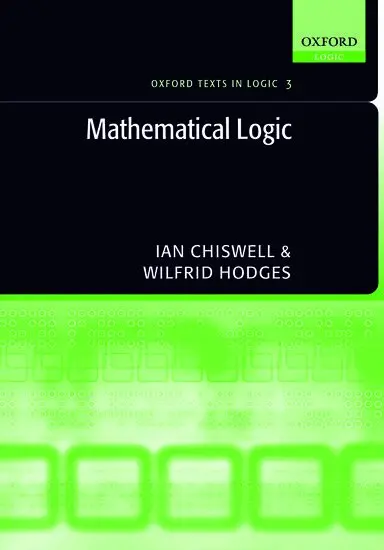
Assuming no previous study in logic, this informal yet rigorous text covers the material of a standard undergraduate first course in mathematical logic, using natural deduction and leading up to the completeness theorem for first-order logic. At each stage of the text, the reader is given an intuition based on standard mathematical practice, which is subsequently developed with clean formal mathematics. Alongside the practical examples, readers learn what can and can't be calculated; for example the correctness of a derivation proving a given sequent can be tested mechanically, but there is no general mechanical test for the existence of a derivation proving the given sequent. The undecidability results are proved rigorously in an optional final chapter, assuming Matiyasevich's theorem characterising the computably enumerable relations. Rigorous proofs of the adequacy and completeness proofs of the relevant logics are provided, with careful attention to the languages involved. Optional sections discuss the classification of mathematical structures by first-order theories; the required theory of cardinality is developed from scratch. Throughout the book there are notes on historical aspects of the material, and connections with linguistics and computer science, and the discussion of syntax and semantics is influenced by modern linguistic approaches. Two basic themes in recent cognitive science studies of actual human reasoning are also introduced. Including extensive exercises and selected solutions, this text is ideal for students in Logic, Mathematics, Philosophy, and Computer Science.
973 kr
Skickas inom 5-8 vardagar
Assuming no previous study in logic, this informal yet rigorous text covers the material of a standard undergraduate first course in mathematical logic, using natural deduction and leading up to the completeness theorem for first-order logic. At each stage of the text, the reader is given an intuition based on standard mathematical practice, which is subsequently developed with clean formal mathematics. Alongside the practical examples, readers learn what can and can't be calculated; for example the correctness of a derivation proving a given sequent can be tested mechanically, but there is no general mechanical test for the existence of a derivation proving the given sequent. The undecidability results are proved rigorously in an optional final chapter, assuming Matiyasevich's theorem characterising the computably enumerable relations. Rigorous proofs of the adequacy and completeness proofs of the relevant logics are provided, with careful attention to the languages involved. Optional sections discuss the classification of mathematical structures by first-order theories; the required theory of cardinality is developed from scratch. Throughout the book there are notes on historical aspects of the material, and connections with linguistics and computer science, and the discussion of syntax and semantics is influenced by modern linguistic approaches. Two basic themes in recent cognitive science studies of actual human reasoning are also introduced. Including extensive exercises and selected solutions, this text is ideal for students in Logic, Mathematics, Philosophy, and Computer Science.
Del 195 - Cambridge Tracts in Mathematics
A Universal Construction for Groups Acting Freely on Real Trees
Inbunden, Engelska, 2012
1 521 kr
Skickas inom 7-10 vardagar
The theory of R-trees is a well-established and important area of geometric group theory and in this book the authors introduce a construction that provides a new perspective on group actions on R-trees. They construct a group RF(G), equipped with an action on an R-tree, whose elements are certain functions from a compact real interval to the group G. They also study the structure of RF(G), including a detailed description of centralizers of elements and an investigation of its subgroups and quotients. Any group acting freely on an R-tree embeds in RF(G) for some choice of G. Much remains to be done to understand RF(G), and the extensive list of open problems included in an appendix could potentially lead to new methods for investigating group actions on R-trees, particularly free actions. This book will interest all geometric group theorists and model theorists whose research involves R-trees.
1 525 kr
Tillfälligt slut
The theory of Λ-trees has its origin in the work of Lyndon on length functions in groups. The first definition of an R-tree was given by Tits in 1977. The importance of Λ-trees was established by Morgan and Shalen, who showed how to compactify a generalisation of Teichmüller space for a finitely generated group using R-trees. In that work they were led to define the idea of a Λ-tree, where Λ is an arbitrary ordered abelian group. Since then there has been much progress in understanding the structure of groups acting on R-trees, notably Rips' theorem on free actions. There has also been some progress for certain other ordered abelian groups Λ, including some interesting connections with model theory.Introduction to Λ-Trees will prove to be useful for mathematicians and research students in algebra and topology.