Wilfrid Hodges - Böcker
Visar alla böcker från författaren Wilfrid Hodges. Handla med fri frakt och snabb leverans.
11 produkter
11 produkter
148 kr
Skickas
If a man supports Arsenal one day and Spurs the next then he is fickle but not necessarily illogical. From this starting point, and assuming no previous knowledge of logic, Wilfrid Hodges takes the reader through the whole gamut of logical expressions in a simple and lively way. Readers who are more mathematically adventurous will find optional sections introducing rather more challenging material. 'A lively and stimulating book' Philosophy
603 kr
Skickas inom 7-10 vardagar
This book contains twenty-one essays by leading authorities on aspects of contemporary logic, ranging from foundations of set theory to applications of logic in computing and in the theory of fields.In those parts of logic closest to computer science, the gap between foundations and applications is often small, as illustrated by three essays on the proof theory of non-classical logics. There are also chapters on the lambda calculus, on relating logic programs to inductive definitions, on Buechi and Presburger arithmetics, and on definability in Lindenbaum algebras. Aspects of constructive mathematics discussed are embeddings of Heyting algebras and proofs in mathematical anslysis.Set theory is well covered with six chapters discussing Cohen forcing, Baire category, determinancy, Nash-Williams theory, critical points (and the remarkable connection between them and properties of left distributive operations) and independent structures. The longest chapter in the book is a survey of 0-minimal structures, by Lou van den Dries; during the last ten years these structures have come to take a central place in applications of model theory to fields and function theory, and this chapter is the first broad survey of the area. Other chapters illustrate how to apply model theory to field theory, complex geometry and groups, and how to recover from its automorphism group. Finally, one chapter applies to the theory of toric varieties to solve problems about many-valued logics.
2 236 kr
Skickas inom 5-8 vardagar
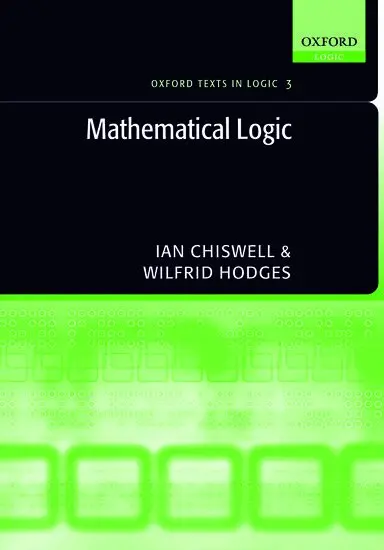
Assuming no previous study in logic, this informal yet rigorous text covers the material of a standard undergraduate first course in mathematical logic, using natural deduction and leading up to the completeness theorem for first-order logic. At each stage of the text, the reader is given an intuition based on standard mathematical practice, which is subsequently developed with clean formal mathematics. Alongside the practical examples, readers learn what can and can't be calculated; for example the correctness of a derivation proving a given sequent can be tested mechanically, but there is no general mechanical test for the existence of a derivation proving the given sequent. The undecidability results are proved rigorously in an optional final chapter, assuming Matiyasevich's theorem characterising the computably enumerable relations. Rigorous proofs of the adequacy and completeness proofs of the relevant logics are provided, with careful attention to the languages involved. Optional sections discuss the classification of mathematical structures by first-order theories; the required theory of cardinality is developed from scratch. Throughout the book there are notes on historical aspects of the material, and connections with linguistics and computer science, and the discussion of syntax and semantics is influenced by modern linguistic approaches. Two basic themes in recent cognitive science studies of actual human reasoning are also introduced. Including extensive exercises and selected solutions, this text is ideal for students in Logic, Mathematics, Philosophy, and Computer Science.
973 kr
Skickas inom 5-8 vardagar
Assuming no previous study in logic, this informal yet rigorous text covers the material of a standard undergraduate first course in mathematical logic, using natural deduction and leading up to the completeness theorem for first-order logic. At each stage of the text, the reader is given an intuition based on standard mathematical practice, which is subsequently developed with clean formal mathematics. Alongside the practical examples, readers learn what can and can't be calculated; for example the correctness of a derivation proving a given sequent can be tested mechanically, but there is no general mechanical test for the existence of a derivation proving the given sequent. The undecidability results are proved rigorously in an optional final chapter, assuming Matiyasevich's theorem characterising the computably enumerable relations. Rigorous proofs of the adequacy and completeness proofs of the relevant logics are provided, with careful attention to the languages involved. Optional sections discuss the classification of mathematical structures by first-order theories; the required theory of cardinality is developed from scratch. Throughout the book there are notes on historical aspects of the material, and connections with linguistics and computer science, and the discussion of syntax and semantics is influenced by modern linguistic approaches. Two basic themes in recent cognitive science studies of actual human reasoning are also introduced. Including extensive exercises and selected solutions, this text is ideal for students in Logic, Mathematics, Philosophy, and Computer Science.
968 kr
Skickas inom 7-10 vardagar
This is an up-to-date and integrated introduction to model theory, designed to be used for graduate courses (for students who are familiar with first-order logic), and as a reference for more experienced logicians and mathematicians. Model theory is concerned with the notions of definition, interpretation and structure in a very general setting, and is applied to a wide variety of other areas such as set theory, geometry, algebra (in particular group theory), and computer science (e.g. logic programming and specification). Professor Hodges emphasises definability and methods of construction, and introduces the reader to advanced topics such as stability. He also provides the reader with much historical information and a full bibliography, enhancing the book's use as a reference.
3 061 kr
Skickas inom 7-10 vardagar
This is an up-to-date and integrated introduction to model theory, designed to be used for graduate courses (for students who are familiar with first-order logic), and as a reference for more experienced logicians and mathematicians. Model theory is concerned with the notions of definition, interpretation and structure in a very general setting, and is applied to a wide variety of other areas such as set theory, geometry, algebra (in particular group theory), and computer science (e.g. logic programming and specification). Professor Hodges emphasises definability and methods of construction, and introduces the reader to advanced topics such as stability. He also provides the reader with much historical information and a full bibliography, enhancing the book's use as a reference.
838 kr
Skickas inom 7-10 vardagar
This is an up-to-date textbook of model theory taking the reader from first definitions to Morley's theorem and the elementary parts of stability theory. Besides standard results such as the compactness and omitting types theorems, it also describes various links with algebra, including the Skolem-Tarski method of quantifier elimination, model completeness, automorphism groups and omega-categoricity, ultraproducts, O-minimality and structures of finite Morley rank. The material on back-and-forth equivalences, interpretations and zero-one laws can serve as an introduction to applications of model theory in computer science. Each chapter finishes with a brief commentary on the literature and suggestions for further reading.
1 476 kr
Skickas inom 10-15 vardagar
The philosopher Abu Nasr al-Farabi (c. 870-c. 950 CE) is a key Arabic intermediary figure. He knew Aristotle, and in particular Aristotle’s logic, through Greek Neoplatonist interpretations translated into Arabic via Syriac and possibly Persian. For example, he revised a general description of Aristotle’s logic by the 6th century Paul the Persian, and further influenced famous later philosophers and theologians writing in Arabic in the 11th to 12th centuries: Avicenna, Al-Ghazali, Avempace and Averroes. Averroes’ reports on Farabi were subsequently transmitted to the West in Latin translation. This book is an abridgement of Aristotle’s Prior Analytics, rather than a commentary on successive passages. In it Farabi discusses Aristotle’s invention, the syllogism, and aims to codify the deductively valid arguments in all disciplines.He describes Aristotle’s categorical syllogisms in detail; these are syllogisms with premises such as ‘Every A is a B’ and ‘No A is a B’. He adds a discussion of how categorical syllogisms can codify arguments by induction from known examples or by analogy, and also some kinds of theological argument from perceived facts to conclusions lying beyond perception. He also describes post-Aristotelian hypothetical syllogisms, which draw conclusions from premises such as ‘If P then Q’ and ‘Either P or Q’. His treatment of categorical syllogisms is one of the first to recognise logically productive pairs of premises by using ‘conditions of productivity’, a device that had appeared in the Greek Philoponus in 6th century Alexandria.
434 kr
Skickas inom 10-15 vardagar
The philosopher Abu Nasr al-Farabi (c. 870-c. 950 CE) is a key Arabic intermediary figure. He knew Aristotle, and in particular Aristotle’s logic, through Greek Neoplatonist interpretations translated into Arabic via Syriac and possibly Persian. For example, he revised a general description of Aristotle’s logic by the 6th century Paul the Persian, and further influenced famous later philosophers and theologians writing in Arabic in the 11th to 12th centuries: Avicenna, Al-Ghazali, Avempace and Averroes. Averroes’ reports on Farabi were subsequently transmitted to the West in Latin translation. This book is an abridgement of Aristotle’s Prior Analytics, rather than a commentary on successive passages. In it Farabi discusses Aristotle’s invention, the syllogism, and aims to codify the deductively valid arguments in all disciplines.He describes Aristotle’s categorical syllogisms in detail; these are syllogisms with premises such as ‘Every A is a B’ and ‘No A is a B’. He adds a discussion of how categorical syllogisms can codify arguments by induction from known examples or by analogy, and also some kinds of theological argument from perceived facts to conclusions lying beyond perception. He also describes post-Aristotelian hypothetical syllogisms, which draw conclusions from premises such as ‘If P then Q’ and ‘Either P or Q’. His treatment of categorical syllogisms is one of the first to recognise logically productive pairs of premises by using ‘conditions of productivity’, a device that had appeared in the Greek Philoponus in 6th century Alexandria.
232 kr
Skickas inom 5-8 vardagar
Logic, Methodology and Philosophy of Science. Logic and Science Facing the New Technologies
Häftad, Engelska, 2015
279 kr
Skickas inom 5-8 vardagar