Ilaria Mariotti - Böcker
Visar alla böcker från författaren Ilaria Mariotti. Handla med fri frakt och snabb leverans.
7 produkter
7 produkter
430 kr
Skickas inom 10-15 vardagar
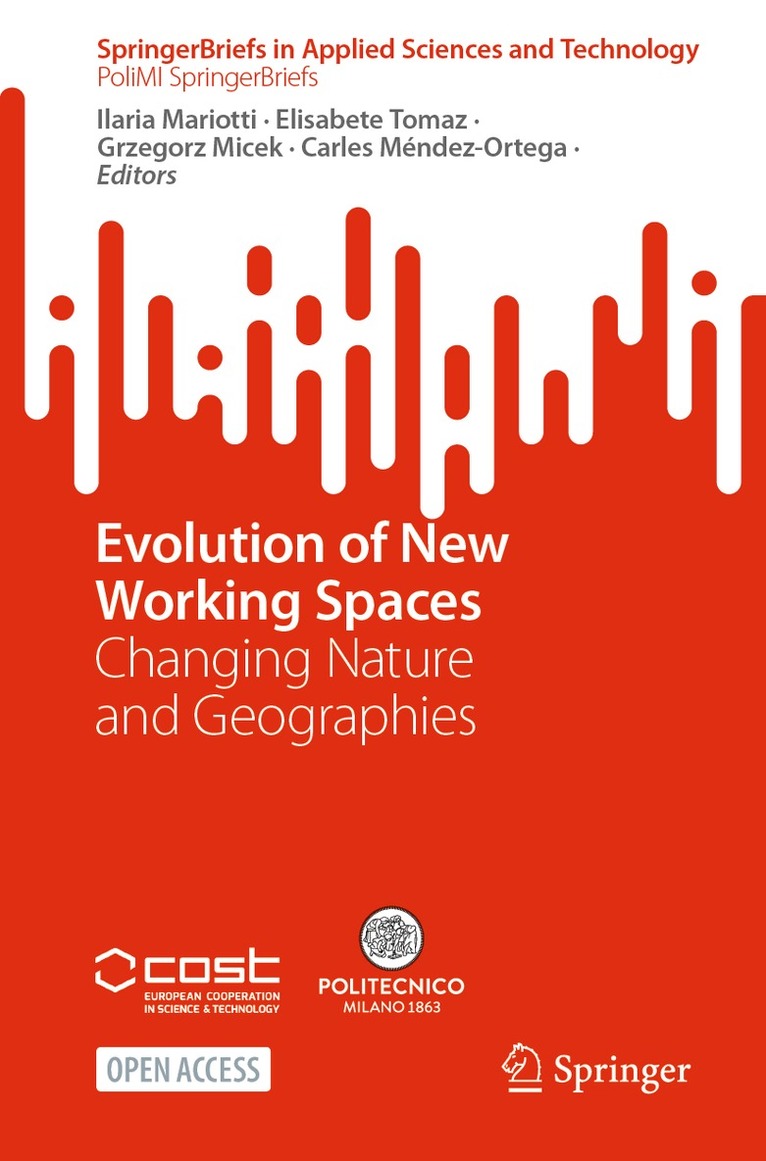
This open access book provides multidisciplinary perspectives on the changing dynamics of new working spaces, with insights from various European countries and observing critical theoretical approaches.
2 151 kr
Skickas inom 10-15 vardagar
This edited volume presents a compendium of emerging and innovative studies on the proliferation of new working spaces (NeWSps), both formal and informal (such as coworking spaces, maker spaces, fab labs, public libraries, and coffee shops), and their role during and following the COVID-19 pandemic in urban and regional development and planning. This book presents an original, interdisciplinary approach to NeWSps through three features: (i) situating the debate in the context of the COVID-19 pandemic, which has transformed NeWSp business models and the everyday work life of their owners and users; (ii) repositioning and rethinking the debate on NeWSps in the context of socioeconomics and planning and comparing conditions between before and during the COVID-19 pandemic; and (iii) providing new directions for urban and regional development and resilience to the COVID-19 pandemic, considering new ways of working and living. The 17 chapters are co-authored by both leading international scholars who have studied the proliferation of NeWSps in the last decade and young, talented researchers, resulting in a total of 55 co-authors from different disciplines (48 of whom are currently involved in the COST Action CA18214 ‘The Geography of New Working Spaces and Impact on the Periphery’ 2019–2023: www.new-working-spaces.eu). Selected comparative studies among several European countries (Western and Eastern Europe) and from the US and Lebanon are presented. The book contributes to the understanding of multi-disciplinary theoretical and practical implications of NeWSps for our society, economy, and urban/regional planning in conditions following the COVID-19 pandemic. The Open Access version of this book, available at www.taylorfrancis.com, has been made available under a Creative Commons Attribution-Non Commercial-No Derivatives 4.0 license.
576 kr
Skickas inom 10-15 vardagar
This edited volume presents a compendium of emerging and innovative studies on the proliferation of new working spaces (NeWSps), both formal and informal (such as coworking spaces, maker spaces, fab labs, public libraries, and coffee shops), and their role during and following the COVID-19 pandemic in urban and regional development and planning. This book presents an original, interdisciplinary approach to NeWSps through three features: (i) situating the debate in the context of the COVID-19 pandemic, which has transformed NeWSp business models and the everyday work life of their owners and users; (ii) repositioning and rethinking the debate on NeWSps in the context of socioeconomics and planning and comparing conditions between before and during the COVID-19 pandemic; and (iii) providing new directions for urban and regional development and resilience to the COVID-19 pandemic, considering new ways of working and living. The 17 chapters are co-authored by both leading international scholars who have studied the proliferation of NeWSps in the last decade and young, talented researchers, resulting in a total of 55 co-authors from different disciplines (48 of whom are currently involved in the COST Action CA18214 ‘The Geography of New Working Spaces and Impact on the Periphery’ 2019–2023: www.new-working-spaces.eu). Selected comparative studies among several European countries (Western and Eastern Europe) and from the US and Lebanon are presented. The book contributes to the understanding of multi-disciplinary theoretical and practical implications of NeWSps for our society, economy, and urban/regional planning in conditions following the COVID-19 pandemic. The Open Access version of this book, available at www.taylorfrancis.com, has been made available under a Creative Commons Attribution-Non Commercial-No Derivatives 4.0 license.
New Workplaces—Location Patterns, Urban Effects and Development Trajectories
A Worldwide Investigation
Inbunden, Engelska, 2021
1 682 kr
Skickas inom 10-15 vardagar
This book explores the innovative workplaces, namely coworking spaces and makerspaces, that are emerging as a consequence of digital innovations and the related development of the knowledge economy and society in the wake of deindustrialization.
New Workplaces—Location Patterns, Urban Effects and Development Trajectories
A Worldwide Investigation
Häftad, Engelska, 2022
1 222 kr
Skickas inom 10-15 vardagar
This book explores the innovative workplaces, namely coworking spaces and makerspaces, that are emerging as a consequence of digital innovations and the related development of the knowledge economy and society in the wake of deindustrialization.
535 kr
Skickas inom 10-15 vardagar
Globalization of the economy, fragmentation of the production process, increasing externalization of TNCs activities through their global value chains and the widespread adoption of Just-in-Time have increased the flows of raw materials, intermediate goods and finished products, with a direct effect on the transport and logistics industry.
Collaborative Workspaces Beyond the Urban
Economy, Community and Regional Development
Inbunden, Engelska, 2026
535 kr
Skickas inom 10-15 vardagar
This book explores the contemporary socio-economic challenges that European non-urban areas face, illuminating how collaborative workspaces (CWS) contribute to tackling them in multiple ways. Collaborative workspaces (such as coworking spaces, fab labs, creative hubs, etc.) for freelancers, self-employed, remote workers and start-ups are increasingly becoming a subject of local and regional economic development policies as they are considered important intermediaries that help deliver entrepreneurial development and local innovation agendas. There has also been a rise in CWS in less densely populated communities in rural and peripheral regions across the European Union that face particular challenges such as brain drain, low investment levels, and low levels of entrepreneurship. These non-urban CWS differ in terms of scopes, functions and impacts compared to those in urban centers. The contributions in this volume unpack the development processes of CWS in rural, suburban, remote and peripheral areas, their wider economic, social and community impacts at the local and regional level, as well as at the level of the individual worker and the enterprise. The book brings together contributions from a broad range of scientific disciplines, including social and economic geography, economics, business studies, architecture, planning, gender studies, and management studies.