Inderjit Chopra – författare
Visar alla böcker från författaren Inderjit Chopra. Handla med fri frakt och snabb leverans.
7 produkter
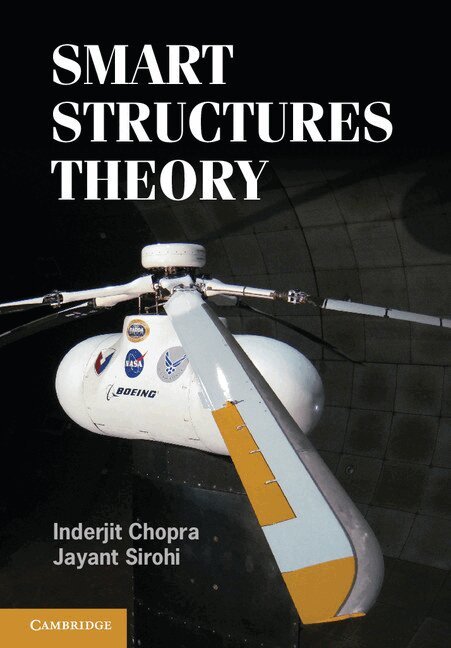
Smart Structures Theory
Av Inderjit Chopra, Jayant Sirohi
Inbunden, 2013
2117 kr
Lägg i varukorg
The twenty-first century could be called the 'Multifunctional Materials Age'. The inspiration for multifunctional materials comes from nature, and therefore these are often referred to as bio-inspired materials. Bio-inspired materials encompass smart materials and structures, multifunctional …
Smart Structures Theory
Av Jayant Sirohi, Inderjit Chopra
E-bok, 2013
2057 kr
Lägg i varukorg
The twenty-first century could be called the ''Multifunctional Materials Age''. The inspiration for multifunctional materials comes from nature, and therefore these are often referred to as bio-inspired materials. Bio-inspired materials encompass smart materials and structures, multifunctional …
Smart Structures Theory
Av Jayant Sirohi, Inderjit Chopra
E-bok, 2013
2102 kr
Lägg i varukorg
The twenty-first century could be called the ''Multifunctional Materials Age''. The inspiration for multifunctional materials comes from nature, and therefore these are often referred to as bio-inspired materials. Bio-inspired materials encompass smart materials and structures, multifunctional …
Revival: Twelfth International Conference on Adaptive Structures and Technologies (2002)
Av Norman Wereley, Inderjit Chopra m. fl.
Inbunden, 2017
3790 kr
Lägg i varukorg
This paper reviews some of the important technical barriers that must be overcome to achieve truly efficient flying adaptive micro air vehicles (MAVs). As defined by the Defense Advanced Research Agency (DARPA), MAVs are vehicles with no length dimension greater than 6 inches. These vehicles …
Revival: Twelfth International Conference on Adaptive Structures and Technologies (2002)
Av Darryll Pines, Inderjit Chopra m. fl.
E-bok, 2017
1195 kr
Lägg i varukorg
This paper reviews some of the important technical barriers that must be overcome to achieve truly efficient flying adaptive micro air vehicles (MAVs). As defined by the Defense Advanced Research Agency (DARPA), MAVs are vehicles with no length dimension greater than 6 inches. These vehicles …
Revival: Twelfth International Conference on Adaptive Structures and Technologies (2002)
Av Darryll Pines, Inderjit Chopra m. fl.
E-bok, 2017
1169 kr
Lägg i varukorg
This paper reviews some of the important technical barriers that must be overcome to achieve truly efficient flying adaptive micro air vehicles (MAVs). As defined by the Defense Advanced Research Agency (DARPA), MAVs are vehicles with no length dimension greater than 6 inches. These vehicles …
Revival: Twelfth International Conference on Adaptive Structures and Technologies (2002)
Av Norman Wereley, Inderjit Chopra m. fl.
Häftad, 2019
997 kr
Tillfälligt slut
This paper reviews some of the important technical barriers that must be overcome to achieve truly efficient flying adaptive micro air vehicles (MAVs). As defined by the Defense Advanced Research Agency (DARPA), MAVs are vehicles with no length dimension greater than 6 inches. These vehicles …