Norman Wereley – författare
Visar alla böcker från författaren Norman Wereley. Handla med fri frakt och snabb leverans.
6 produkter
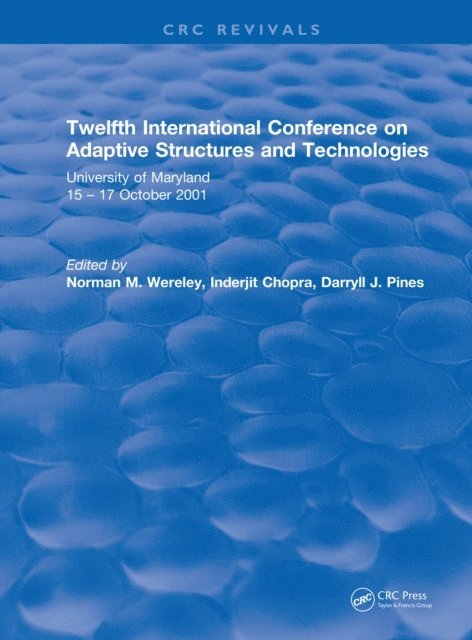
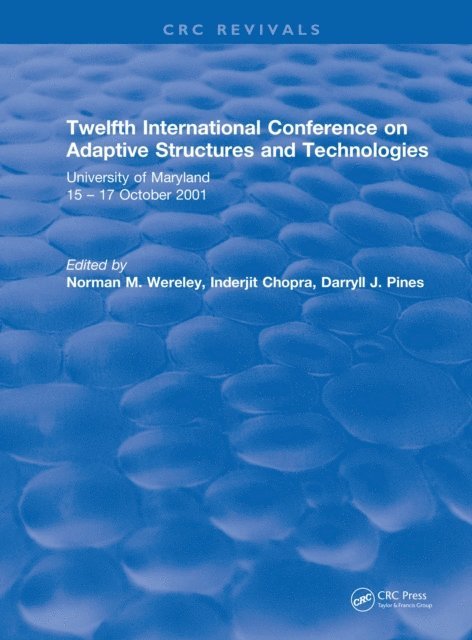
Revival: Twelfth International Conference on Adaptive Structures and Technologies (2002)
Av Norman Wereley, Inderjit Chopra m. fl.
Inbunden, 2017
3790 kr
Lägg i varukorg
This paper reviews some of the important technical barriers that must be overcome to achieve truly efficient flying adaptive micro air vehicles (MAVs). As defined by the Defense Advanced Research Agency (DARPA), MAVs are vehicles with no length dimension greater than 6 inches. These vehicles …
Revival: Twelfth International Conference on Adaptive Structures and Technologies (2002)
Av Darryll Pines, Inderjit Chopra m. fl.
E-bok, 2017
1195 kr
Lägg i varukorg
This paper reviews some of the important technical barriers that must be overcome to achieve truly efficient flying adaptive micro air vehicles (MAVs). As defined by the Defense Advanced Research Agency (DARPA), MAVs are vehicles with no length dimension greater than 6 inches. These vehicles …
Revival: Twelfth International Conference on Adaptive Structures and Technologies (2002)
Av Darryll Pines, Inderjit Chopra m. fl.
E-bok, 2017
1169 kr
Lägg i varukorg
This paper reviews some of the important technical barriers that must be overcome to achieve truly efficient flying adaptive micro air vehicles (MAVs). As defined by the Defense Advanced Research Agency (DARPA), MAVs are vehicles with no length dimension greater than 6 inches. These vehicles …
Introduction to Vibration in Engineering
Häftad, 2024
1252 kr
Lägg i varukorg
Introduction to Vibration in Engineering is a concise text that helps students master the fundamentals of vibration. Students develop a solid understanding of single-degree-of-freedom systems that can be used as building blocks to tackle more difficult and general multi-degree-of-freedom systems. …
Revival: Twelfth International Conference on Adaptive Structures and Technologies (2002)
Av Norman Wereley, Inderjit Chopra m. fl.
Häftad, 2019
997 kr
Tillfälligt slut
This paper reviews some of the important technical barriers that must be overcome to achieve truly efficient flying adaptive micro air vehicles (MAVs). As defined by the Defense Advanced Research Agency (DARPA), MAVs are vehicles with no length dimension greater than 6 inches. These vehicles …