Ismail K. Poonawala – författare
Visar alla böcker från författaren . Handla med fri frakt och snabb leverans.
3 produkter
3 produkter
Inbunden, Engelska, 2017
1 268 kr
Skickas inom 5-8 vardagar
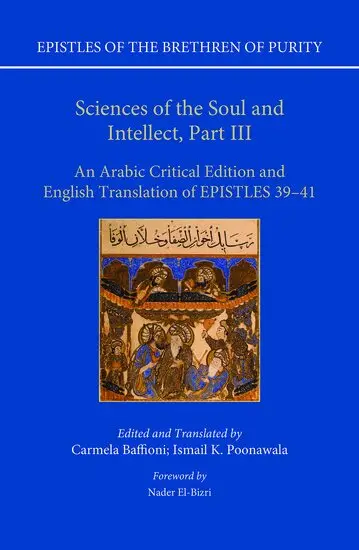
The Ikhwan al-Safa' (Brethren of Purity), the anonymous adepts of a tenth-century esoteric fraternity based in Basra and Baghdad, hold an eminent position in the history of science and philosophy in Islam due to the wide reception and assimilation of their monumental encyclopaedia, the Rasa 'il Ikhwan al-Safa' (Epistles of the Brethren of Purity). This compendium contains fifty-two epistles offering synoptic accounts of the classical sciences and philosophies of the age; divided into four classificatory parts, it treats themes in mathematics, logic, natural philosophy, psychology, metaphysics, and theology, in addition to didactic fables. Epistles 39 and 40 return to the Aristotelian philosophy of certain earlier Epistles. Yet the topics taken up here are considered by the Ikhwan in light of theological issues, affording an occasion to refute eternalism. Epistle 39 explains movement and rest, the kinds of physical movement, and the species of moved beings, before introducing the divine Mover and the idea that when He ceases to move the world, it will end. The highly composite Epistle 40 addresses themes beyond the various types of causes and effects, including 'divine gifts', God's origination and organization of the world, emanation, and the frequently invoked analogy of numbers. Drawing heavily on al-Kindi's risala of the same name, the main section of Epistle 41: 'On the Definitions and Descriptions' conforms to the title, defining variously categorized phenomena; then follows a diverse range of chapters detailing colours, numbers, ratios, and geometry. The detailed survey of the world presented in these three Epistles concludes the penultimate section of the encyclopaedia, on soul and intellect.
Inbunden, Engelska, 2021
2 685 kr
Skickas inom 5-8 vardagar
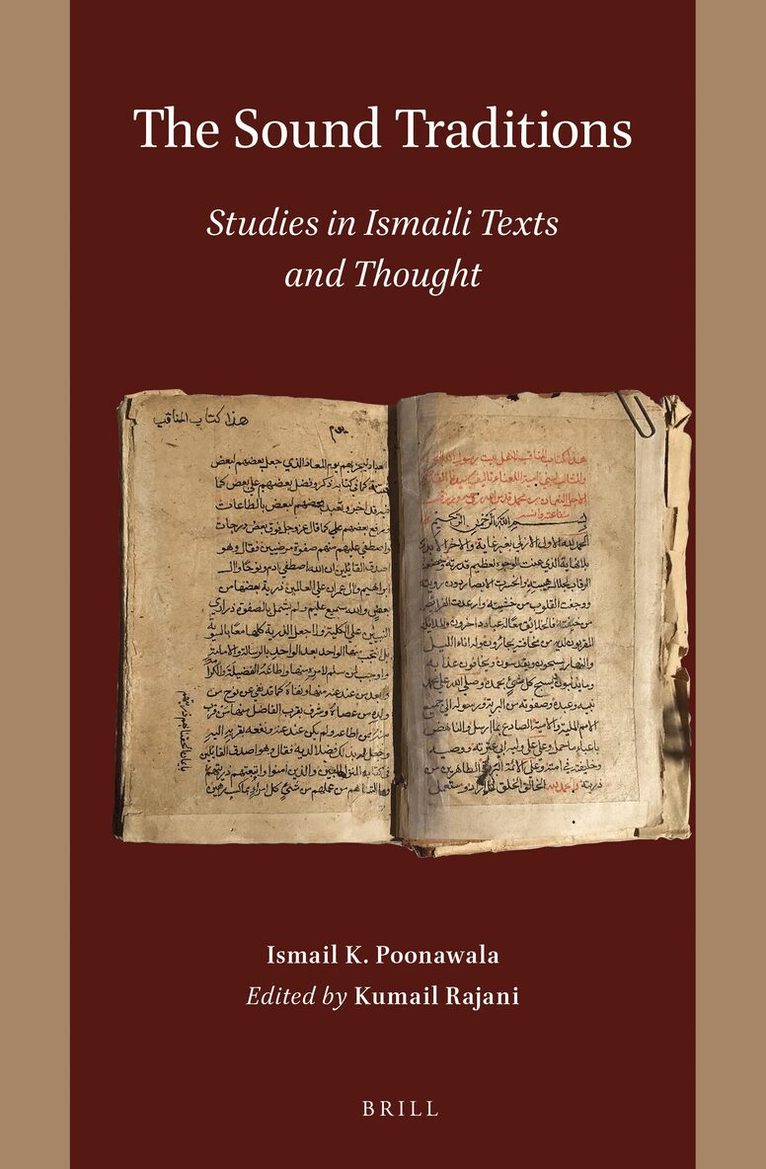
The Sound Traditions: Studies in Ismaili Texts and Thought is a collection of Ismail K. Poonawala’s articles on Ismaili studies. Divided into three sections, the volume consists of nineteen articles that have been published over a long period of more than forty years. Part One focuses on Ismaili sources and the question of their authorship. The aspects of Ismaili rational discourses are examined in Part Two. Focusing on the scriptural knowledge of Ismaili tradition, Part Three then delves into investigating al-Qāḍī al-Nuʿmān’s life and contribution. This volume is an excellent gateway to the study of origins and development of Ismaili thought.
Inbunden, Engelska, 2016
956 kr
Tillfälligt slut
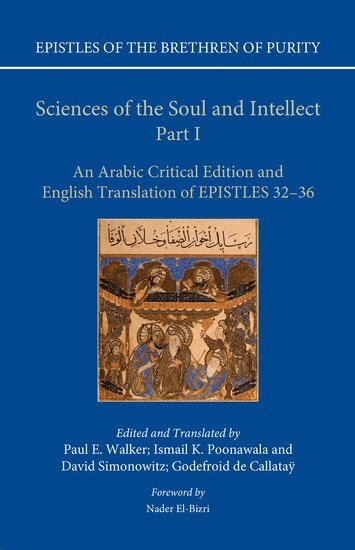
The Ikhwan al-Safa (Brethren of Purity), the anonymous adepts of a tenth-century esoteric fraternity based in Basra and Baghdad, hold an eminent position in the history of science and philosophy in Islam due to the wide reception and assimilation of their monumental encyclopaedia, the Rasa'il Ikhwan al-Safa (Epistles of the Brethren of Purity). This compendium contains fifty-two epistles offering synoptic accounts of the classical sciences and philosophies of the age; divided into four classificatory parts, it treats themes in mathematics, logic, natural philosophy, psychology, metaphysics, and theology, in addition to didactic fables. Epistles 32 to 36 comprise the first five treatises in the third division of the Rasa'il, on the sciences of the soul and intellect. Combining Islamic revelation with Hellenistic philosophy, the Ikhwan delineate herein their metaphysical system. Epistles 32 and 33 present adaptations of the Pythagorean doctrines, and of Neo-Platonist leitmotifs, whereby a numerical analogy is applied to the unique and transcendent God, or the One, from whom all existence emanates. Epistle 34 takes up the pervasive theme of the correspondence between microcosm and macrocosm, situating the human being as the central link between the celestial and terrestrial realms. In Epistle 35, we find an explanation of the intellectual faculties of the individual human soul, whose ultimate aim is ascension to the timeless reality of pure intellect. Finally, Epistle 36 presents itself as the astrological epistle par excellence of the Rasa'il; from the coming-to-be of worms, to the emergence of religions and empires, nothing in the sub-lunar sphere escapes the determining influence of the celestial cycles.