István Bodnár – författare
Visar alla böcker från författaren István Bodnár. Handla med fri frakt och snabb leverans.
7 produkter
7 produkter
Inbunden, Engelska, 2002
2 174 kr
Skickas inom 5-8 vardagar
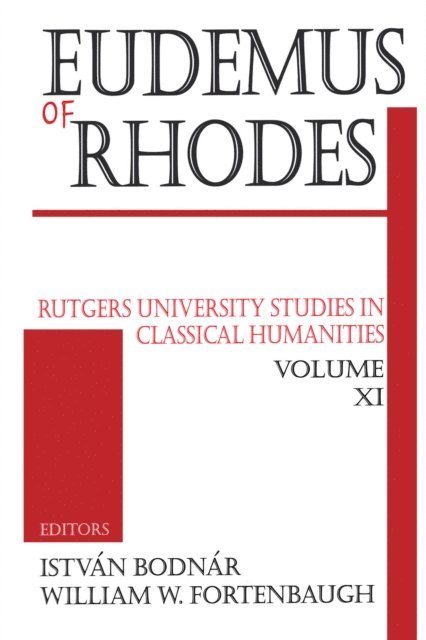
Eudemus of Rhodes was a pupil of Aristotle in the second half of the fourth century BCE. When Aristotle died, having chosen Theophrastus as his successor, Eudemus returned to Rhodes where it appears he founded his own school. His contributions to logic were significant: he took issue with Aristotle concerning the status of the existential "is," and together with Theophrastus he made important contributions to hypothetical syllogistic and modal logic. He wrote at length on physics, largely following Aristotle, and took an interest in animal behavior. His histories of geometry, arithmetic, and astronomy were of great importance and are responsible for much of what we know of these subjects in earlier times.Volume 11 in the series Rutgers Studies in Classical Humanities is different in that it is composed entirely of articles that discuss Eudemus from a variety of viewpoints. Sixteen scholars representing seven nations have contributed essays to the volume. A special essay by Dimitri Gutas brings together for the first time the Arabic material relating to Eudemus. Other contributors and essays are: Hans B. Gottschalk, "Eudemus and the Peripatos"; Tiziano Dorandi, "Quale aspetto controverso della biografia di Eudemo di Rodi"; William W. Fortenbaugh, "Eudemus' Work On Expression"; Pamela M. Huby, "Did Aristotle Reply to Eudemus and Theophrastus on Some Logical Issues?"; Robert Sharples, "Eudemus Physics: Change, Place and Time"; Han Baltussen, "Wehrli's Edition of Eudemus of Rhodes: The Physical Fragments from Simplicius' Commentary on Aristotle's Physics"; Sylvia Berryman, "Sumphues and Suneches: Continuity and Coherence in Early Peripatetic Texts"; Istvbn Bodnbr, "Eudemus' Unmoved Movers: Fragments 121-123b Wehrli"; Deborah K. W. Modrak, "Phantasia, Thought and Science in Eudemus"; Stephen White, "Eudemus the Naturalist"; J orgen Mejer, "Eudemus and the History of Science"; Leonid Zhmud, "Eudemus' History of Mathematics"; Alan C. Bowen, "Eudemus' History of Early Greek Astronomy: Two Hypotheses"; Dmitri Panchenko, "Eudemus Fr. 145 Wehrli and the Ancient Theories of Lunar Light"; and Gbbor Betegh, "On Eudemus Fr. 150 Wehrli.""[Eudemus of Rhodes] marks a substantial progress in our knowledge of Eurdemus. For it enlarges the scope of the information available on this author, highlights the need of, and paves the way to, a new critical edition of the Greek fragments of his works, and provides a clearer view of his life, thought, sources and influence. In all these respects, it represents a necessary complement to Wehrli's edition of Eudemus' fragments." -Amos Bertolacci, The Classical BulletinIstvbn Bodnbr is a member of the philosophy department at the Eotvos University in Budapest, where he teaches and does research on ancient philosophy. He has been a junior fellow at the Center for Hellenic Studies and most recently has been an Alexander von Humboldt Stipendiat in Berlin at the Max Plank Institut for Wissenschaftsgeschichte and at the Freie Universitot.William W. Fortenbaugh is professor of classics at Rutgers University. In addition to editing several books in this series, he has written Aristotle on Emotion and Quellen zur Ethik Theophrastus. New is his edition of Theophrastus's treatise On Sweat.
Häftad, Engelska, 2018
709 kr
Skickas inom 10-15 vardagar
Eudemus of Rhodes was a pupil of Aristotle in the second half of the fourth century BCE. When Aristotle died, having chosen Theophrastus as his successor, Eudemus returned to Rhodes where it appears he founded his own school. His contributions to logic were significant: he took issue with Aristotle concerning the status of the existential "is," and together with Theophrastus he made important contributions to hypothetical syllogistic and modal logic. He wrote at length on physics, largely following Aristotle, and took an interest in animal behavior. His histories of geometry, arithmetic, and astronomy were of great importance and are responsible for much of what we know of these subjects in earlier times.Volume 11 in the series Rutgers Studies in Classical Humanities is different in that it is composed entirely of articles that discuss Eudemus from a variety of viewpoints. Sixteen scholars representing seven nations have contributed essays to the volume. A special essay by Dimitri Gutas brings together for the first time the Arabic material relating to Eudemus. Other contributors and essays are: Hans B. Gottschalk, "Eudemus and the Peripatos"; Tiziano Dorandi, "Quale aspetto controverso della biografia di Eudemo di Rodi"; William W. Fortenbaugh, "Eudemus' Work On Expression"; Pamela M. Huby, "Did Aristotle Reply to Eudemus and Theophrastus on Some Logical Issues?"; Robert Sharples, "Eudemus Physics: Change, Place and Time"; Han Baltussen, "Wehrli's Edition of Eudemus of Rhodes: The Physical Fragments from Simplicius' Commentary on Aristotle's Physics"; Sylvia Berryman, "Sumphues and Suneches: Continuity and Coherence in Early Peripatetic Texts"; Istvbn Bodnbr, "Eudemus' Unmoved Movers: Fragments 121-123b Wehrli"; Deborah K. W. Modrak, "Phantasia, Thought and Science in Eudemus"; Stephen White, "Eudemus the Naturalist"; J orgen Mejer, "Eudemus and the History of Science"; Leonid Zhmud, "Eudemus' History of Mathematics"; Alan C. Bowen, "Eudemus' History of Early Greek Astronomy: Two Hypotheses"; Dmitri Panchenko, "Eudemus Fr. 145 Wehrli and the Ancient Theories of Lunar Light"; and Gbbor Betegh, "On Eudemus Fr. 150 Wehrli.""[Eudemus of Rhodes] marks a substantial progress in our knowledge of Eurdemus. For it enlarges the scope of the information available on this author, highlights the need of, and paves the way to, a new critical edition of the Greek fragments of his works, and provides a clearer view of his life, thought, sources and influence. In all these respects, it represents a necessary complement to Wehrli's edition of Eudemus' fragments." -Amos Bertolacci, The Classical BulletinIstvbn Bodnbr is a member of the philosophy department at the Eotvos University in Budapest, where he teaches and does research on ancient philosophy. He has been a junior fellow at the Center for Hellenic Studies and most recently has been an Alexander von Humboldt Stipendiat in Berlin at the Max Plank Institut for Wissenschaftsgeschichte and at the Freie Universitot.William W. Fortenbaugh is professor of classics at Rutgers University. In addition to editing several books in this series, he has written Aristotle on Emotion and Quellen zur Ethik Theophrastus. New is his edition of Theophrastus's treatise On Sweat.
E-bok
PDF, Engelska, 2014590 kr
Läs direkt efter köp
In this commentary on Aristotle Physics book eight, chapters one to five, the sixth-century philosopher Simplicius quotes and explains important fragments of the Presocratic philosophers, provides the fragments of his Christian opponent Philoponus'' Against Aristotle On the Eternity of the World, and makes extensive use of the lost commentary of Aristotle''s leading defender, Alexander of Aphrodisias.This volume contains an English translation of Simplicius'' important commentary, as well as a detailed introduction, explanatory notes and a bibliography.
Häftad, Engelska, 2014
546 kr
Skickas inom 10-15 vardagar
In this commentary on Aristotle Physics book eight, chapters one to five, the sixth-century philosopher Simplicius quotes and explains important fragments of the Presocratic philosophers, provides the fragments of his Christian opponent Philoponus' Against Aristotle On the Eternity of the World, and makes extensive use of the lost commentary of Aristotle's leading defender, Alexander of Aphrodisias.This volume contains an English translation of Simplicius' important commentary, as well as a detailed introduction, explanatory notes and a bibliography.
Häftad, Engelska, 2012
220 kr
Skickas inom 5-8 vardagar
E-bok
Engelska, 201238 kr
Läs direkt efter köp
Judaism and Christianity differ from each other on the most fundamental issues. Yet both use the same Jewish Bible as the foundation of their faiths. Only one of these belief systems can be true.Those who talk about Judeo-Christian heritage have no idea that Judaism and Christianity are the most fundamentally conflicting principles in the history of humanity. They inherently cannot co-exist, as light cannot co-exist with darkness. History since the beginning of the Common Era testifies that humanity cannot afford to regard Christianity as an innocent lie, as a bad idea.A real war is being waged around us between alien spirits and G-ds angels. People usually ignore this unintuitive and invisible reality, but this ongoing celestial conflict often affects our everyday affairs, as if no one is in control.The Torah and the New Testament cannot co-exist, despite ongoing efforts of Christian preachers to prove the contrary.This book is intended to be an encouragement to those who have already begun to see though the vicious veil of the Christian delusion.The basic principle of Christianity is nonsense. Any human being with the weakest sense of justice would reject the idea that someone else died for his or her sins. The fake god came up with the death trick. Death will be its everlasting reward.Christians are desperate to support their faith with fabricated references from the Torah and Prophets, while those who live on the Torah have never needed the New Testament to support their faith.Everyone on this planet should have realized the issues presented in this book by now, as theological qualifications or credentials are not necessary to understand them. Mankind has been given more than 2,000 years to comprehend these ideas.Humanity has paid a heavy price for false rationalizations motivated by a wicked desire to cast off the Torahs requirements. Let us value and safeguard this wisdom acquired with difficulty with unspeakable gratefulness.
Inbunden, Engelska, 2012
2 217 kr
Skickas inom 10-15 vardagar