Ivan Berend – författare
Visar alla böcker från författaren Ivan Berend. Handla med fri frakt och snabb leverans.
16 produkter
Europe in Crisis
Bolt from the Blue?
Av Ivan Berend
Inbunden, 2012
2590 kr
Lägg i varukorg
This book analyzes the European Great Recession of 2008-12, its economic and social causes, its historical roots, and the policies adopted by the European Union to find a way out of it. It contains explicit debates with several economists and analysts on some of the most controversial questions …
Europe in Crisis
Bolt from the Blue?
Av Ivan Berend
Häftad, 2012
638 kr
Lägg i varukorg
This book analyzes the European Great Recession of 2008-12, its economic and social causes, its historical roots, and the policies adopted by the European Union to find a way out of it. It contains explicit debates with several economists and analysts on some of the most controversial questions …
Case Studies on Modern European Economy
Entrepreneurship, Inventions, and Institutions
Av Ivan Berend
Inbunden, 2013
2590 kr
Lägg i varukorg
The last two centuries have been the scene of dramatic change throughout Europe. And one of the main causes of these tremendous and spectacular changes was the economy. These transformations were achieved by people: scientists and political thinkers, inventors and entrepreneurs, educators, skilled …
Case Studies on Modern European Economy
Entrepreneurship, Inventions, and Institutions
Av Ivan Berend
Häftad, 2013
758 kr
Lägg i varukorg
The last two centuries have been the scene of dramatic change throughout Europe. And one of the main causes of these tremendous and spectacular changes was the economy. These transformations were achieved by people: scientists and political thinkers, inventors and entrepreneurs, educators, skilled …
Central and Eastern Europe, 1944-1993
Detour from the Periphery to the Periphery
Av Ivan Berend
Inbunden, 1996
1291 kr
Lägg i varukorg
In this wide-ranging account, Ivan Berend traces the post-war fortunes of the countries lying between Germany and the former Soviet Union. Professor Berend draws both on his academic expertise and personal involvement in many of the events which he describes to produce a synthesis of a huge array …
Central and Eastern Europe, 1944-1993
Detour from the Periphery to the Periphery
Av Ivan Berend, Charles Feinstein m. fl.
Häftad, 1999
586 kr
Lägg i varukorg
In this wide-ranging account, Ivan Berend traces the post-war fortunes of the countries lying between Germany and the former Soviet Union. Professor Berend draws both on his academic expertise and personal involvement in many of the events which he describes to produce a synthesis of a huge array …
Evolution of the Hungarian Economy, 1848–1998 – One–and–a–Half Centuries of Semi–Successful Modernization, 1848–1989 vol.2
Av János Kornai, Iván Berend m. fl.
Inbunden, 2000
335 kr
Lägg i varukorg
Kornai presents an assessment of Hungary's transition from a socialist to a market economy. In a comprehensive critique of socialist economy reform, Kornai explains how the system's ideological and political attributes deny the idea of "market socialism". Kornai provides examples of Hungary's …
Evolution of the Hungarian Economy 1848–1998 – One–and–a–Half Centuries of Semi–Successful Modernization, 1848–1989, vol 1
Av János Kornai, Iván Berend m. fl.
Inbunden, 2002
906 kr
Lägg i varukorg
This volume is a major contribution to Hungarian economic history since the middle of the nineteenth century. In this first volume of three on the evolution of that economy, the authors focus on the beginnings of the modern capitalist economy (1848-1914), on economic nationalism (1918-1944) and on …
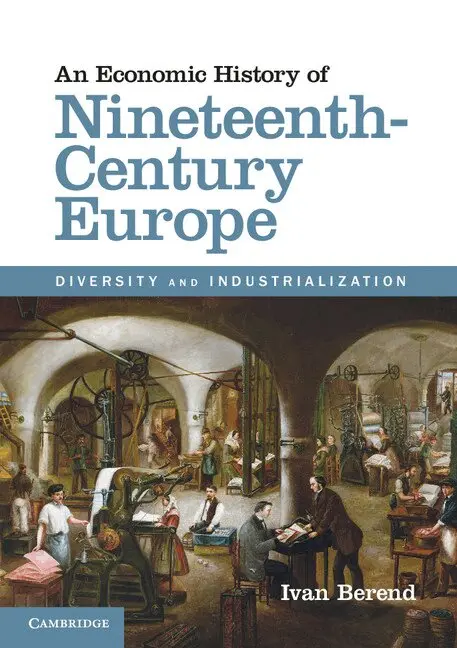
An Economic History of Nineteenth-Century Europe
Diversity and Industrialization
Av Ivan Berend
Inbunden, 2012
1391 kr
Lägg i varukorg
Why did some countries and regions of Europe reach high levels of economic advancement in the nineteenth century, while others were left behind? This new transnational survey of the continent's economic development highlights the role of regional differences in shaping each country's economic path …
An Economic History of Nineteenth-Century Europe
Diversity and Industrialization
Av Ivan Berend
Häftad, 2012
468 kr
Lägg i varukorg
Why did some countries and regions of Europe reach high levels of economic advancement in the nineteenth century, while others were left behind? This new transnational survey of the continent's economic development highlights the role of regional differences in shaping each country's economic path …
Case Studies on Modern European Economy
Entrepreneurship, Inventions, and Institutions
Av Ivan Berend
E-bok, 2013
866 kr
Lägg i varukorg
The last two centuries have been the scene of dramatic change throughout Europe. And one of the main causes of these tremendous and spectacular changes was the economy. These transformations were achieved by people: scientists and political thinkers, inventors and entrepreneurs, educators, skilled …
Case Studies on Modern European Economy
Entrepreneurship, Inventions, and Institutions
Av Ivan Berend
E-bok, 2013
892 kr
Lägg i varukorg
The last two centuries have been the scene of dramatic change throughout Europe. And one of the main causes of these tremendous and spectacular changes was the economy. These transformations were achieved by people: scientists and political thinkers, inventors and entrepreneurs, educators, skilled …
Europe in Crisis
Bolt from the Blue?
Av Ivan Berend
E-bok, 2012
727 kr
Lägg i varukorg
This book analyzes the European Great Recession of 2008-12, its economic and social causes, its historical roots, and the policies adopted by the European Union to find a way out of it. It contains explicit debates with several economists and analysts on some of the most controversial questions …
Europe in Crisis
Bolt from the Blue?
Av Ivan Berend
E-bok, 2012
712 kr
Lägg i varukorg
This book analyzes the European Great Recession of 2008-12, its economic and social causes, its historical roots, and the policies adopted by the European Union to find a way out of it. It contains explicit debates with several economists and analysts on some of the most controversial questions …
Economic History of Nineteenth-Century Europe
Diversity and Industrialization
Av Ivan Berend
E-bok, 2012
454 kr
Lägg i varukorg
Why did some countries and regions of Europe reach high levels of economic advancement in the nineteenth century, while others were left behind? This new transnational survey of the continent''s economic development highlights the role of regional differences in shaping each country''s economic …
Economic History of Nineteenth-Century Europe
Diversity and Industrialization
Av Ivan Berend
E-bok, 2012
454 kr
Lägg i varukorg
Why did some countries and regions of Europe reach high levels of economic advancement in the nineteenth century, while others were left behind? This new transnational survey of the continent''s economic development highlights the role of regional differences in shaping each country''s economic …