Ivan Boldyrev – författare
Visar alla böcker från författaren Ivan Boldyrev. Handla med fri frakt och snabb leverans.
8 produkter
8 produkter
Interpreting Hegel’s Phenomenology of Spirit
Expositions and Critique of Contemporary Readings
Inbunden, Engelska, 2022
2 117 kr
Skickas inom 10-15 vardagar
This book focuses on the interpretations of Hegel’s Phenomenology of Spirit that have proved influential over the past decades. Current readers of Hegel’s Phenomenology face an abundance of interpretive literature devoted to this difficult text and confront a plethora of different philosophical presuppositions, research strategies and hermeneutic efforts.To enable a better orientation within the interpretative landscape, the essays in this volume summarize, contextualize and critically comment on the issues and currents in contemporary Phenomenology scholarship. There is a common set of three questions that each of the contributions seeks to answer: (1) What kind of text is The Phenomenology of Spirit? (2) What do the different strategies of interpretation conceptually bring to the text? (3) How do different interpreters justify their verdict on whether the Phenomenology is still a viable project?
2 185 kr
Skickas inom 10-15 vardagar
Hegel’s philosophy has witnessed periods of revival and oblivion, at times considered to be an unrivalled and all-embracing system of thought, but often renounced with no less ardour. This book renews the dialogue with Hegel by looking at his legacy as a source of insight and judgement that helps us rethink contemporary economics. This book focuses on a concept of institution which is equally important for Hegel's political philosophy and for economic theory to date. The key contributions of this Hegelian perspective on economics lead us to the synthesis of traditional approaches and new ideas gained in economic experiments and advanced by neuroeconomists, sociologists and cognitive scientists. The proper account of contemporary 'civil society' involves comprehending it as a historically evolving totality of individual minds, ideas and intersubjective structures that are mutually dependent, tied by recognitive relations, and assert themselves as a whole in the ongoing performative movement of 'objective spitit'. The ethics of recognition is paired with the ethics of associations that supports moral principles and gives them true, concrete universality. This unusual constellation of seemingly remote fields suggests that Hegel, read in a pragmatist mode, anticipated the new theories and philosophies of extended mind, social cognition and performativity. By providing a new conceptual apparatus and reformulating the theory of institutions in the light of this new synthesis, this book claims to give new meaning both to Hegel as interpreted from today, and to the social sciences. Seen from this perspective, such phenomena as cooperation in games, personal identity or justice in the version of Amartya Sen's 'realization-focused comparisons' are reinscribed into the logic of institutional theory. This 'Hegel' clearly goes beyond the limits of philosophical discussion and becomes a decisive reference for economists, sociologists, political scientists and other scholars who study the foundations and consequences of human sociality and try to explore and design the institutions necessary for a worthy common life.
Interpreting Hegel’s Phenomenology of Spirit
Expositions and Critique of Contemporary Readings
Häftad, Engelska, 2024
581 kr
Skickas inom 10-15 vardagar
This book focuses on the interpretations of Hegel’s Phenomenology of Spirit that have proved influential over the past decades. Current readers of Hegel’s Phenomenology face an abundance of interpretive literature devoted to this difficult text and confront a plethora of different philosophical presuppositions, research strategies and hermeneutic efforts.To enable a better orientation within the interpretative landscape, the essays in this volume summarize, contextualize and critically comment on the issues and currents in contemporary Phenomenology scholarship. There is a common set of three questions that each of the contributions seeks to answer: (1) What kind of text is The Phenomenology of Spirit? (2) What do the different strategies of interpretation conceptually bring to the text? (3) How do different interpreters justify their verdict on whether the Phenomenology is still a viable project?
Economists and Economics in Policymaking
Historical Episodes and Methodological Perspectives
Inbunden, Engelska, 2026
2 292 kr
Kommande
This book examines how economic knowledge shapes policy and society, challenging readers to consider not whether economics influences the real world, but how—through which models, experts, and institutions, and with what underlying assumptions and power dynamics. Drawing on the history and philosophy of economics, it moves beyond simplistic assessments of success or failure to explore the epistemic, political, ethical, and institutional conditions that grant economic expertise its authority.The chapters trace economic ideas from theory to practice, investigating how models are constructed, negotiated, and deployed across central banks, international organizations, technology firms, and government agencies. Contributors examine the conceptual and institutional assumptions behind economists' interventions and reveal how they can constrain or expand democratic possibilities and human autonomy. The volume asks critical questions: for whom does economics work, and what consequences follow? By attending to historical trajectories and philosophical foundations, this collection offers a nuanced understanding of economics as a deeply embedded social science whose practices, assumptions, and power structures often remain hidden. It illuminates how economic ideas travel, transform, and quietly govern the societies they explain, making visible the complex processes through which technical knowledge becomes political action.Spanning the history and philosophy of economics, political economy, economic methodology, science and technology studies, and critical policy analysis, this volume is essential reading for students, academics, and policymakers in government agencies, central banks, and international organizations.The chapters in this book were originally published as a special issue of Journal of Economic Methodology.
813 kr
Skickas inom 10-15 vardagar
Hegel’s philosophy has witnessed periods of revival and oblivion, at times considered to be an unrivalled and all-embracing system of thought, but often renounced with no less ardour. This book renews the dialogue with Hegel by looking at his legacy as a source of insight and judgement that helps us rethink contemporary economics. This book focuses on a concept of institution which is equally important for Hegel's political philosophy and for economic theory to date. The key contributions of this Hegelian perspective on economics lead us to the synthesis of traditional approaches and new ideas gained in economic experiments and advanced by neuroeconomists, sociologists and cognitive scientists. The proper account of contemporary 'civil society' involves comprehending it as a historically evolving totality of individual minds, ideas and intersubjective structures that are mutually dependent, tied by recognitive relations, and assert themselves as a whole in the ongoing performative movement of 'objective spitit'. The ethics of recognition is paired with the ethics of associations that supports moral principles and gives them true, concrete universality. This unusual constellation of seemingly remote fields suggests that Hegel, read in a pragmatist mode, anticipated the new theories and philosophies of extended mind, social cognition and performativity. By providing a new conceptual apparatus and reformulating the theory of institutions in the light of this new synthesis, this book claims to give new meaning both to Hegel as interpreted from today, and to the social sciences. Seen from this perspective, such phenomena as cooperation in games, personal identity or justice in the version of Amartya Sen's 'realization-focused comparisons' are reinscribed into the logic of institutional theory. This 'Hegel' clearly goes beyond the limits of philosophical discussion and becomes a decisive reference for economists, sociologists, political scientists and other scholars who study the foundations and consequences of human sociality and try to explore and design the institutions necessary for a worthy common life.
280 kr
Skickas inom 10-15 vardagar
In this book, sociologists, philosophers, and economists investigate the conceptual issues around the performativity of economics over a variety of disciplinary contexts and provide new case studies illuminating this phenomenon.
1 889 kr
Skickas inom 10-15 vardagar
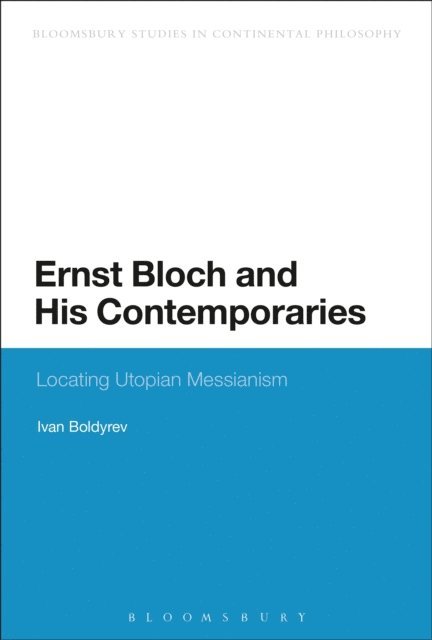
Ernst Bloch and His Contemporaries is a much needed concise yet comprehensive overview of Ernst Bloch's early and later thought. It fills an important gap in research on the history of German thought in the 20th century by reconstructing the contexts of Bloch's philosophy, while focusing on his contemporaries - Georg Lukács, Walter Benjamin, and Theodor Adorno. Ernst Bloch's influential ideas include his theory of utopian consciousness, his resolute inclination to merge aesthetics and politics, rehabilitation of hope, and atheistic conception of Christianity. Although Bloch's major early texts, Spirit of Utopia and Traces, have recently been translated into English, and there has been renewed interest in Bloch over the last 15 years, he is still relatively unknown compared to other left German-Jewish intellectuals. Ivan Boldyrev places Bloch's often enigmatic prose within contexts more familiar to English-speaking readers, and outlines the most important messages in Bloch's legacy still relevant today to European intellectual discourse, in particular aesthetics and philosophy of history.
531 kr
Skickas inom 10-15 vardagar
Ernst Bloch and His Contemporaries is a much needed concise yet comprehensive overview of Ernst Bloch's early and later thought. It fills an important gap in research on the history of German thought in the 20th century by reconstructing the contexts of Bloch's philosophy, while focusing on his contemporaries - Georg Lukács, Walter Benjamin, and Theodor Adorno. Ernst Bloch's influential ideas include his theory of utopian consciousness, his resolute inclination to merge aesthetics and politics, rehabilitation of hope, and atheistic conception of Christianity. Although Bloch's major early texts, Spirit of Utopia and Traces, have recently been translated into English, and there has been renewed interest in Bloch over the last 15 years, he is still relatively unknown compared to other left German-Jewish intellectuals. Ivan Boldyrev places Bloch's often enigmatic prose within contexts more familiar to English-speaking readers, and outlines the most important messages in Bloch's legacy still relevant today to European intellectual discourse, in particular aesthetics and philosophy of history.