Ivan Ingelbrecht – författare
Visar alla böcker från författaren Ivan Ingelbrecht. Handla med fri frakt och snabb leverans.
6 produkter
6 produkter
Häftad, Engelska, 2020
513 kr
Skickas inom 5-8 vardagar
Inbunden, Engelska, 2020
582 kr
Skickas inom 5-8 vardagar
Inbunden, Engelska, 2021
2 027 kr
Skickas inom 5-8 vardagar
The year 2018 marked the 90th anniversary of induced mutagenesis in plants. The FAO/IAEA International Symposium on Plant Mutation Breeding and Biotechnology held in 2018 reviewed achievements in crop improvement through mutation breeding in several countries across the globe, and discussed innovations in mutation induction, precision phenotyping and genomics applications. Induced genetic variation is important for crop improvement especially in instances where there is limited variation in existing germplasm pools to achieve desired levels of crop performance, and where techniques such as hybridization cannot be easily applied. Its application becomes further significant as the dual threats of population growth and climate change increasingly challenge global food and nutrition security. Higher production of nutritional food and reduction of crop losses imposed by extreme events like droughts, high temperatures, floods, diseases and pests call for induced novel genetic variation. While recent breakthroughs in whole genome-based mutation detection technologies increase the efficiency and precision of breeding in all crops, in vitro techniques coupled with mutagenesis broaden the genetic base of vegetative and horticultural tree crops and reduce their breeding cycles. In this book an international team of expert authors review achievements, new developments, trends and challenges in the field of plant mutation breeding, across the scientific community and the private sector. Chapters highlight specific challenges, such as emerging transboundary threats to crop production, and assess the overall importance of mutation breeding to food security. Coverage includes: · Contribution and impact of mutant varieties to food security. · Mutation breeding for adaptation to climate change in seed propagated crops. · Mutation breeding for ornamental and vegetatively propagated crops. · Enhancing agro biodiversity through new mutation induction techniques. · New challenges and technologies in plant genomics and breeding. This book is a comprehensive and essential resource for students, researchers and professionals in plant breeding.
Häftad, Engelska, 2019
545 kr
Skickas inom 10-15 vardagar
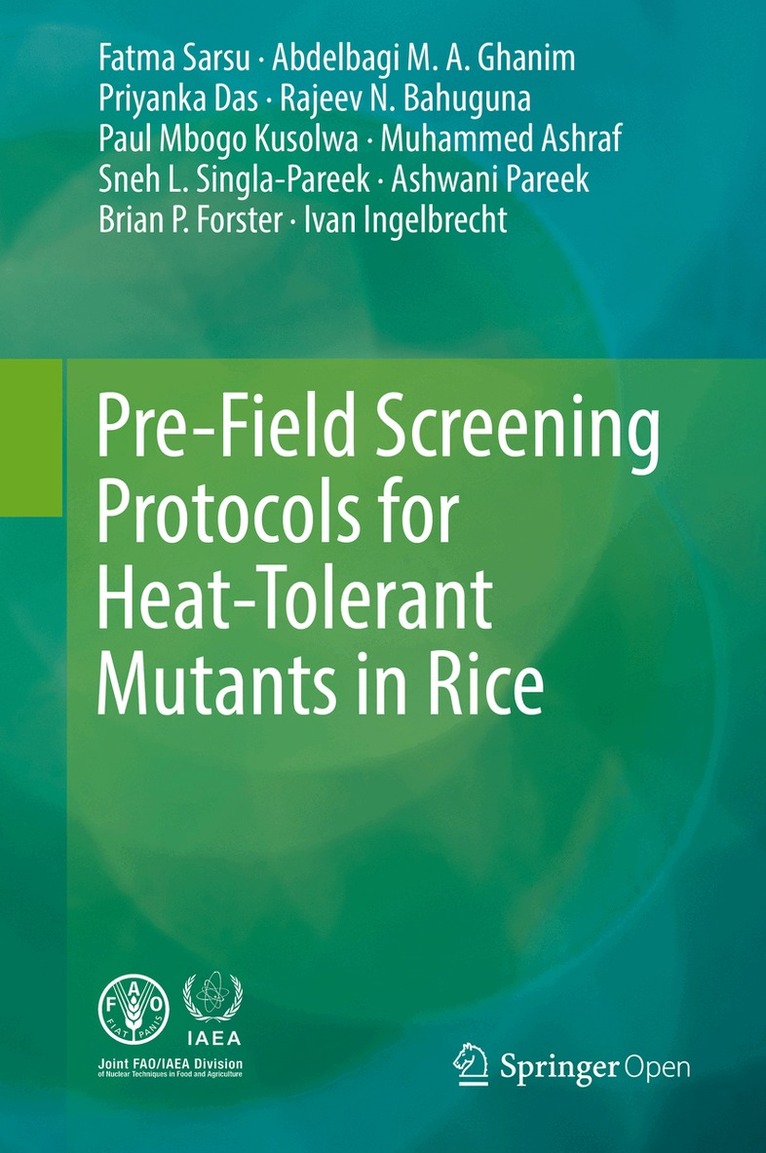
This open access book presents simple, robust pre-field screening protocols that allow plant breeders to screen for enhanced tolerance to heat stress in rice. Two critical heat-sensitive stages in the lifecycle of the rice crop are targeted – the seedling and flowering stages – with screening based on simple phenotypic responses. The protocols are based on the use of a hydroponics system and/or pot experiments in a glasshouse in combination with a controlled growth chamber where the heat stress treatment is applied. The protocols are designed to be effective, simple, reproducible and user-friendly.The protocols will enable plant breeders to effectively reduce the number of plants from a few thousands to less than 100 candidate individual mutants or lines in a greenhouse/growth chamber, which can then be used for further testing and validation in the field conditions. The methods can also be used to classify rice genotypes according to their heat tolerance characteristics. Thus, different types of heat stress tolerance mechanisms can be identified, presenting opportunities for pyramiding different (mutant) sources of heat stress tolerance.
Inbunden, Engelska, 2018
545 kr
Skickas inom 5-8 vardagar
This open access book presents simple, robust pre-field screening protocols that allow plant breeders to screen for enhanced tolerance to heat stress in rice. Two critical heat-sensitive stages in the lifecycle of the rice crop are targeted – the seedling and flowering stages – with screening based on simple phenotypic responses. The protocols are based on the use of a hydroponics system and/or pot experiments in a glasshouse in combination with a controlled growth chamber where the heat stress treatment is applied. The protocols are designed to be effective, simple, reproducible and user-friendly.The protocols will enable plant breeders to effectively reduce the number of plants from a few thousands to less than 100 candidate individual mutants or lines in a greenhouse/growth chamber, which can then be used for further testing and validation in the field conditions. The methods can also be used to classify rice genotypes according to their heat tolerance characteristics. Thus, different types of heat stress tolerance mechanisms can be identified, presenting opportunities for pyramiding different (mutant) sources of heat stress tolerance.
E-bok
Spanska, 201496 kr
Läs direkt efter köp
La bioeconomía se fundamenta en paradigmas de producción basados en procesos biológicos. Contribuye a transformar el conocimiento de las ciencias biológicas en productos nuevos, sostenibles, ecoeficientes y competitivos capaces de mejorar la calidad de vida de la creciente población mundial. Esta publicación establece a la bioeconomía como uno de los paradigmas de América Latina y el Caribe, ya que son regiones con una enorme riqueza y bien ubicadas para contribuir y beneficiarse de los procesos emergentes de la bioeconomía.