J. E. Marsden – författare
Visar alla böcker från författaren J. E. Marsden. Handla med fri frakt och snabb leverans.
5 produkter
5 produkter
Häftad, Engelska, 1976
1 082 kr
Skickas inom 10-15 vardagar
The goal of these notes is to give a reasonahly com plete, although not exhaustive, discussion of what is commonly referred to as the Hopf bifurcation with applications to spe cific problems, including stability calculations. Historical ly, the subject had its origins in the works of Poincare [1] around 1892 and was extensively discussed by Andronov and Witt [1] and their co-workers starting around 1930. Hopf's basic paper [1] appeared in 1942. Although the term "Poincare Andronov-Hopf bifurcation" is more accurate (sometimes Friedrichs is also included), the name "Hopf Bifurcation" seems more common, so we have used it. Hopf's crucial contribution was the extension from two dimensions to higher dimensions. The principal technique employed in the body of the text is that of invariant manifolds. The method of Ruelle Takens [1] is followed, with details, examples and proofs added. Several parts of the exposition in the main text come from papers of P. Chernoff, J. Dorroh, O. Lanford and F. Weissler to whom we are grateful. The general method of invariant manifolds is common in dynamical systems and in ordinary differential equations: see for example, Hale [1,2] and Hartman [1]. Of course, other methods are also available. In an attempt to keep the picture balanced, we have included samples of alternative approaches. Specifically, we have included a translation (by L. Howard and N. Kopell) of Hopf's original (and generally unavailable) paper.
E-bok
PDF, Engelska, 20121 367 kr
Läs direkt efter köp
The goal of these notes is to give a reasonahly com plete, although not exhaustive, discussion of what is commonly referred to as the Hopf bifurcation with applications to spe cific problems, including stability calculations. Historical ly, the subject had its origins in the works of Poincare [1] around 1892 and was extensively discussed by Andronov and Witt [1] and their co-workers starting around 1930. Hopf''s basic paper [1] appeared in 1942. Although the term "Poincare Andronov-Hopf bifurcation" is more accurate (sometimes Friedrichs is also included), the name "Hopf Bifurcation" seems more common, so we have used it. Hopf''s crucial contribution was the extension from two dimensions to higher dimensions. The principal technique employed in the body of the text is that of invariant manifolds. The method of Ruelle Takens [1] is followed, with details, examples and proofs added. Several parts of the exposition in the main text come from papers of P. Chernoff, J. Dorroh, O. Lanford and F. Weissler to whom we are grateful. The general method of invariant manifolds is common in dynamical systems and in ordinary differential equations: see for example, Hale [1,2] and Hartman [1]. Of course, other methods are also available. In an attempt to keep the picture balanced, we have included samples of alternative approaches. Specifically, we have included a translation (by L. Howard and N. Kopell) of Hopf''s original (and generally unavailable) paper.
E-bok
PDF, Engelska, 20121 100 kr
Läs direkt efter köp
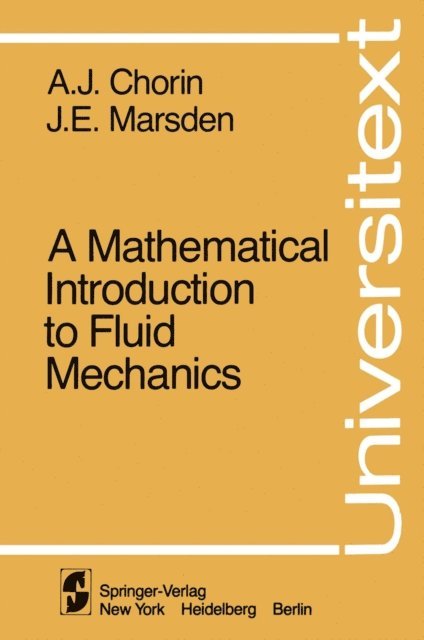
These notes are based on a one-quarter (i. e. very short) course in fluid mechanics taught in the Department of Mathematics of the University of California, Berkeley during the Spring of 1978. The goal of the course was not to provide an exhaustive account of fluid mechanics, nor to assess the engineering value of various approxima tion procedures. The goals were: (i) to present some of the basic ideas of fluid mechanics in a mathematically attractive manner (which does not mean "fully rigorous"); (ii) to present the physical back ground and motivation for some constructions which have been used in recent mathematical and numerical work on the Navier-Stokes equations and on hyperbolic systems; (iil. ) ''to interest some of the students in this beautiful and difficult subject. The notes are divided into three chapters. The first chapter contains an elementary derivation of the equations; the concept of vorticity is introduced at an early stage. The second chapter contains a discussion of potential flow, vortex motion, and boundary layers. A construction of boundary layers using vortex sheets and random walks is presented; it is hoped that it helps to clarify the ideas. The third chapter contains an analysis of one-dimensional gas iv flow, from a mildly modern point of view. Weak solutions, Riemann problems, Glimm''s scheme, and combustion waves are discussed. The style is informal and no attempt was made to hide the authors'' biases and interests.
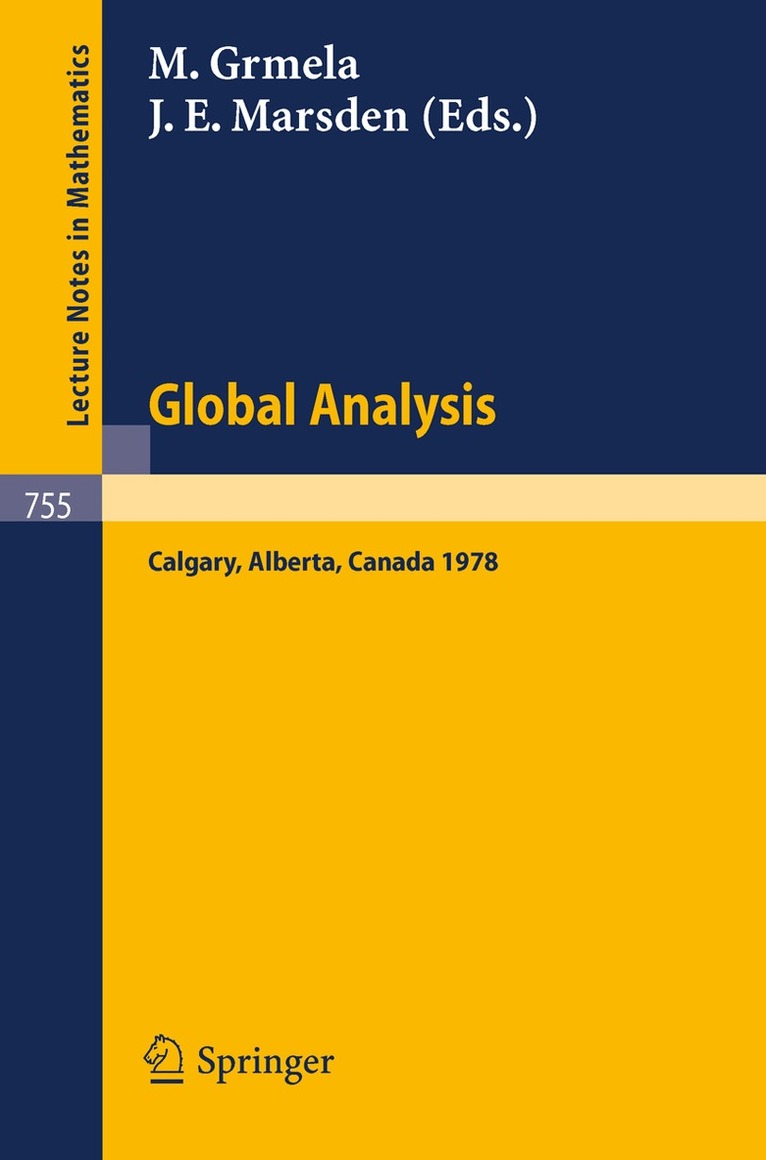
Del 755 - Lecture Notes in Mathematics
Global Analysis
Proceedings of the Biennial Seminar of the Canadian Mathematical Congress, Calgary, Alberta, June 12-27, 1978
Häftad, Engelska, 1979
383 kr
Skickas inom 10-15 vardagar
E-bok
PDF, Engelska, 2006413 kr
Läs direkt efter köp