J. Patrick Kelley – författare
Visar alla böcker från författaren J. Patrick Kelley. Handla med fri frakt och snabb leverans.
5 produkter
5 produkter
Inbunden, Engelska, 1991
2 174 kr
Skickas inom 10-15 vardagar
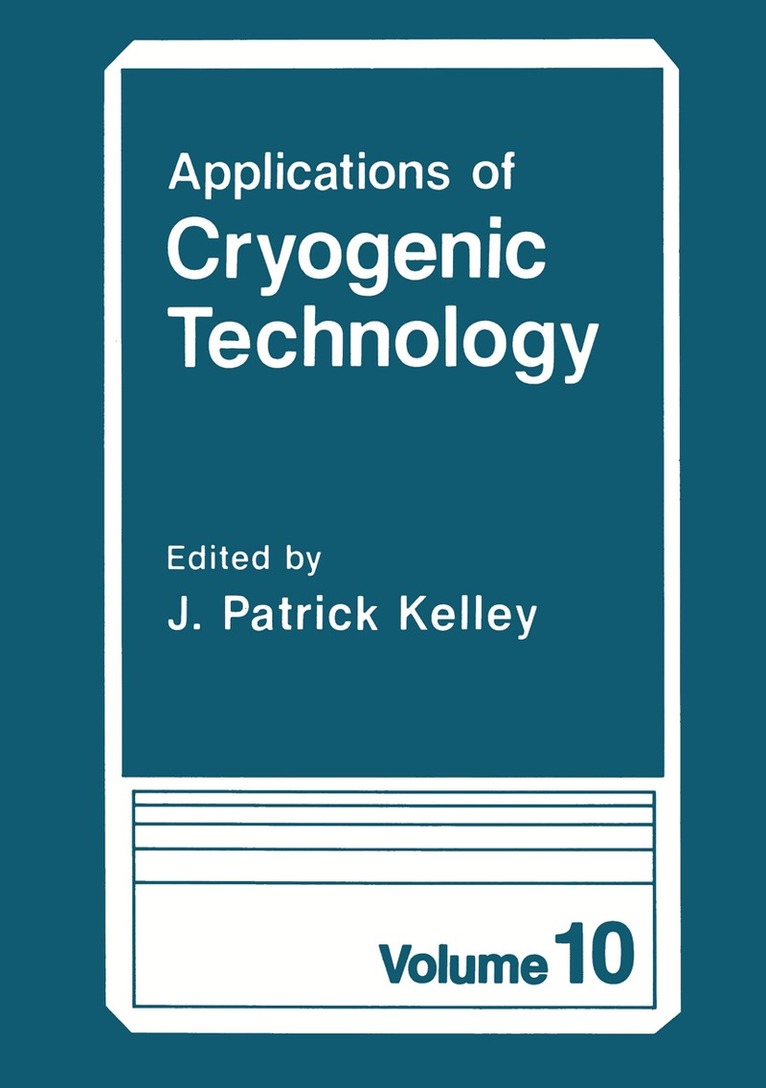
Applications of Cryogenic Technology, Vol. 10, is the proceedings from the portion of the conference CRYO-90 sponsored by the Cryogenic Society of America (CSA). CRYO-90, held on the campus of the State University of New York, Binghamton, New York, was an unusual interdisciplinary event, drawing from the life sciences as well as the physical science and engineering areas of the low temperature community. Co-sponsoring CRYO-90 with CSA were the Society for Cryobiology and the Symposium on Invertebrate and Plant Cold Hardiness. These latter two organizations brought an exciting developing field to the conference, a field whose exploration will lead to the betterment of all mankind through improved cryosurgical and organ preservation techniques in addition to improved agricultural and herd yields under extreme conditions. Specific goals of the cryobiological community are cryopreservation, the arrest and recovery of living processes of cells, tissues and organs; and cryosurgery - the local cryodestruction of diseased cells while preserving the healthy surrounding tissue. These goals present great technological challenges. The technological requirements of the cryobiologist include the ability to cool tissues 6 at rates of 10 degrees per second (vitrification), to thaw frozen tissue without damaging the delicate cells, to freeze dry tissue using molecular distillation (vacuum) drying, to supercool cell structures below O°C without freezing, and to successfully store the preserved tissues and organs for any required length of time.
Häftad, Engelska, 2013
3 258 kr
Skickas inom 10-15 vardagar
In recent years, the technology of cryogenic comminution has been widely applied in the field of chemical engineering, food making, medicine production, and particularly in recycling of waste materials. Because of the increasing pollution of waste tires and the shortage of raw rubber resource, the recycling process for waste rubber products has become important and commercially viable. This technology has shown a great number of advantages such as causing no environmental pollution, requiring low energy consumption and producing high quality products. Hence, the normal crusher which was used to reclaim materials, such as waste tires, nylon, plastic and many polymer materials at atmospheric 12 temperature is being replaced by a cryogenic crusher. • In the cryogenic crusher, the property of the milled material is usually very sensitive to temperature change. When a crusher is in operation, it will generate a great deal of heat that causes the material temperature increased. Once the temperature increases over the vitrification temperature, the material property will change and lose the brittle behavior causing the energy consumption to rise sharply. Consequently, the comminution process cannot be continued. Therefore, it is believed that the cryogenic crusher is the most critical component in the cryogenic comminution system. The research on the temperature increase and energy consumption in the cryogenic crusher is not only to reduce the energy consumption of the crasher, but also to reduce the energy consumption of the cryogenic system.
E-bok
PDF, Engelska, 20133 948 kr
Läs direkt efter köp
In recent years, the technology of cryogenic comminution has been widely applied in the field of chemical engineering, food making, medicine production, and particularly in recycling of waste materials. Because of the increasing pollution of waste tires and the shortage of raw rubber resource, the recycling process for waste rubber products has become important and commercially viable. This technology has shown a great number of advantages such as causing no environmental pollution, requiring low energy consumption and producing high quality products. Hence, the normal crusher which was used to reclaim materials, such as waste tires, nylon, plastic and many polymer materials at atmospheric 12 temperature is being replaced by a cryogenic crusher. • In the cryogenic crusher, the property of the milled material is usually very sensitive to temperature change. When a crusher is in operation, it will generate a great deal of heat that causes the material temperature increased. Once the temperature increases over the vitrification temperature, the material property will change and lose the brittle behavior causing the energy consumption to rise sharply. Consequently, the comminution process cannot be continued. Therefore, it is believed that the cryogenic crusher is the most critical component in the cryogenic comminution system. The research on the temperature increase and energy consumption in the cryogenic crusher is not only to reduce the energy consumption of the crasher, but also to reduce the energy consumption of the cryogenic system.
E-bok
PDF, Engelska, 20132 741 kr
Läs direkt efter köp
Applications of Cryogenic Technology, Vol. 10, is the proceedings from the portion of the conference CRYO-90 sponsored by the Cryogenic Society of America (CSA). CRYO-90, held on the campus of the State University of New York, Binghamton, New York, was an unusual interdisciplinary event, drawing from the life sciences as well as the physical science and engineering areas of the low temperature community. Co-sponsoring CRYO-90 with CSA were the Society for Cryobiology and the Symposium on Invertebrate and Plant Cold Hardiness. These latter two organizations brought an exciting developing field to the conference, a field whose exploration will lead to the betterment of all mankind through improved cryosurgical and organ preservation techniques in addition to improved agricultural and herd yields under extreme conditions. Specific goals of the cryobiological community are cryopreservation, the arrest and recovery of living processes of cells, tissues and organs; and cryosurgery - the local cryodestruction of diseased cells while preserving the healthy surrounding tissue. These goals present great technological challenges. The technological requirements of the cryobiologist include the ability to cool tissues 6 at rates of 10 degrees per second (vitrification), to thaw frozen tissue without damaging the delicate cells, to freeze dry tissue using molecular distillation (vacuum) drying, to supercool cell structures below O°C without freezing, and to successfully store the preserved tissues and organs for any required length of time.
Häftad, Engelska, 2013
2 174 kr
Skickas inom 10-15 vardagar
Applications of Cryogenic Technology, Vol. 10, is the proceedings from the portion of the conference CRYO-90 sponsored by the Cryogenic Society of America (CSA). CRYO-90, held on the campus of the State University of New York, Binghamton, New York, was an unusual interdisciplinary event, drawing from the life sciences as well as the physical science and engineering areas of the low temperature community. Co-sponsoring CRYO-90 with CSA were the Society for Cryobiology and the Symposium on Invertebrate and Plant Cold Hardiness. These latter two organizations brought an exciting developing field to the conference, a field whose exploration will lead to the betterment of all mankind through improved cryosurgical and organ preservation techniques in addition to improved agricultural and herd yields under extreme conditions. Specific goals of the cryobiological community are cryopreservation, the arrest and recovery of living processes of cells, tissues and organs; and cryosurgery - the local cryodestruction of diseased cells while preserving the healthy surrounding tissue. These goals present great technological challenges. The technological requirements of the cryobiologist include the ability to cool tissues 6 at rates of 10 degrees per second (vitrification), to thaw frozen tissue without damaging the delicate cells, to freeze dry tissue using molecular distillation (vacuum) drying, to supercool cell structures below O°C without freezing, and to successfully store the preserved tissues and organs for any required length of time.