J. Schulte – författare
Visar alla böcker från författaren J. Schulte. Handla med fri frakt och snabb leverans.
9 produkter
9 produkter
Inbunden, Engelska, 1994
1 619 kr
Skickas inom 10-15 vardagar
INTRODUCTION The present volume unites contributions by the leading figure of the Vienna Circle and by two of his closest assoCiates, contributions that deal with an area of thought represented, indeed, in this Collection but certainly not the central one in the common picture ofthe Circle's activities. It is no accident that an interest in ethics and the philosophy of action was particularly marked in what Neurath was apt to call the right wing of the Circle. For them, as for Wittgenstein (the respected mentorofSchlickandWaismanninparticular),theadvancetobehoped for in philosophy consisted not solely in freeing natural science from a confused sense of dependence on speculative metaphysics but also in seeingthatotherareasoflanguageandaction hadto bethoughtaboutin theirownterms, whichwereneitherthoseofnaturalsciencenorthoseof philosophy as traditionally conceived. The scepticismofSchlick about theprogrammeofUnifiedSciencewaswellknown: EinheizwissenschaJt he called it, as it might be 'boozified science'.And in sober truth the programme sometimes masked a left-wing set of values taken (surely illogically) for granted, though the membersofthe Circle entertained a wide range ofpolitical views. Schlick's own contribution to the present volume is a section from thenotesforoneofhisfinal lectureseries,forsightofwhich wewarmly thanktheonlysurvivingcontributortoourvolume,DrJosephSchachter: Schlick'sgrandsonDra. M. H. vandeVeldehaskindlyconsentedtotheir publication. This section poses the problem we have outlined: there are questionsandaneedforclarificationinethics,butthesenomoredemand a metaphysical solution than does a similar situation in epistemology. Here, as in his earlier Problems of Ethics,l Schlick sets his face against thewholeprocess,mostobviousin Kant,ofmakingtheconceptofvalue absolute. One might say that for Schlick there is no unhypothetical imperative.
Inbunden, Engelska, 1994
1 667 kr
Skickas inom 10-15 vardagar
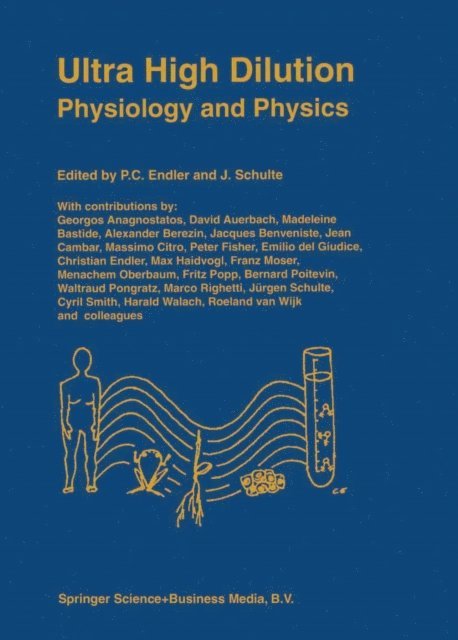
This multidisciplinary work addresses in a serious and strictly scientific way the "hows" and "whys" underlying the actions of ultra high dilutions (UHD). The contributions, written by leading scientists in the fields of physics, physiology and biophysics, present an overview of UHD research which, to some extent, has been stimulated by the recognition of the therapeutic efficacy of homoeopathy. The book is divided into four parts. Part 1 presents relevant data from physiological laboratories, serving as an introduction to what follows. Part 2 evaluates and discusses the most promising physical theories. Part 3 deals with biophysical aspects and Part 4 appraises the medical and historical context. The book concludes with a discussion of future research prospects. Current research activity, as the book emphasizes, is generating new scientific concepts which are likely to have consequences far beyond biology and medicine. "Ultra High Dilution Physiology and Physics" is a source of references and concepts and should stimulate more interest in the field.The text should be of interest to physicists, biologists, and medical scientists interested in the science of ultra high dilution and in its efficacy in homoeopathy.
Inbunden, Engelska, 1998
1 667 kr
Skickas inom 10-15 vardagar
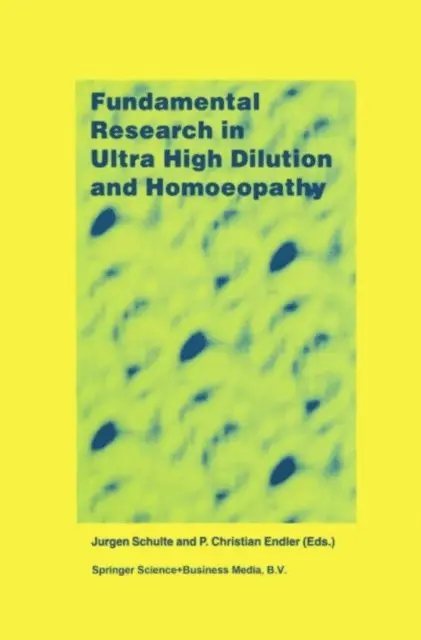
This interdisciplinary work addresses the fundamental scientific problems in ultra-high dilution and homoeopathy. A brief introduction into the scientific history of homoeopathy familiarizes the reader with the concept of homoeopathy as well as the scientific problems in characterizing the efficacy of homoeopathy and phenomena observed in ultra-high dilutions. Much of the book covers the fundamental theoretical medicine and physics of homoeopathy. Based on modern physics, the text covers energetics, entropic and electrodynamics of ultra-high dilutions from the perspective of physicists and biologists who bring the findings of basic science into the field of ultra-high dilutions and homoeopathy. The theoretical medicine and physics set the basis for a critical evaluation of the fundamental experiments presented, which employ botanical and zoological bio-assays and immunology as well as reaction cybernetics. The book also includes a critical review of clinical trials as well as a presentation of the research strategy into homoeopathy as recommended by the European Commission for Homoeopathy.
Häftad, Engelska, 2010
1 667 kr
Skickas inom 10-15 vardagar
This is the first multidisciplinary work to address in a serious and strictly scientific way the hows and whys underlying the actions of ultra high dilutions (UHD). The contributions, all of them written by leading scientists in the fields of physics, physiology and biophysics, present an overview of UHD research which, to some extent, has been stimulated by the recognition of the therapeutic efficacy of homoeopathy. The book is divided into four parts. Part 1 presents relevant data from physiological laboratories, serving as an introduction to what follows. Part 2 evaluates and discusses the most promising physical theories. Part 3 deals with biophysical aspects and Part 4 appraises the medical and historical context. The book concludes with a discussion of future research prospects. Current research activity, as the book convincingly emphasises, is generating genuinely new scientific concepts which are likely to have consequences far beyond biology and medicine. Ultra High Dilution is a fertile source of references and concepts and should command wide attention, and stimulate yet more interest.For physicists, biologists, and medical scientists interested in the science of ultra high dilution and in its efficacy in homoeopathy.
Häftad, Engelska, 2012
1 605 kr
Skickas inom 10-15 vardagar
INTRODUCTION The present volume unites contributions by the leading figure of the Vienna Circle and by two of his closest assoCiates, contributions that deal with an area of thought represented, indeed, in this Collection but certainly not the central one in the common picture ofthe Circle's activities. It is no accident that an interest in ethics and the philosophy of action was particularly marked in what Neurath was apt to call the right wing of the Circle. For them, as for Wittgenstein (the respected mentorofSchlickandWaismanninparticular),theadvancetobehoped for in philosophy consisted not solely in freeing natural science from a confused sense of dependence on speculative metaphysics but also in seeingthatotherareasoflanguageandaction hadto bethoughtaboutin theirownterms, whichwereneitherthoseofnaturalsciencenorthoseof philosophy as traditionally conceived. The scepticismofSchlick about theprogrammeofUnifiedSciencewaswellknown: EinheizwissenschaJt he called it, as it might be 'boozified science'.And in sober truth the programme sometimes masked a left-wing set of values taken (surely illogically) for granted, though the membersofthe Circle entertained a wide range ofpolitical views. Schlick's own contribution to the present volume is a section from thenotesforoneofhisfinal lectureseries,forsightofwhich wewarmly thanktheonlysurvivingcontributortoourvolume,DrJosephSchachter: Schlick'sgrandsonDra. M. H. vandeVeldehaskindlyconsentedtotheir publication. This section poses the problem we have outlined: there are questionsandaneedforclarificationinethics,butthesenomoredemand a metaphysical solution than does a similar situation in epistemology. Here, as in his earlier Problems of Ethics,l Schlick sets his face against thewholeprocess,mostobviousin Kant,ofmakingtheconceptofvalue absolute. One might say that for Schlick there is no unhypothetical imperative.
Häftad, Engelska, 2012
1 653 kr
Skickas inom 10-15 vardagar
Jurgen Schulte and Christian Endler met in 1990 at an international conference on the Structure of Water held in the Lecture Halls of the University of Graz (Austria). Disappointed by the lack of a systematic strategy of research into the physics of homoeopathy Jurgen Schulte started to work on the establishment of scientifically acceptable research standards in physics of homoeopathy and encouraged academic researchers to establish a coordinated and focused research strategy. In 1994, with the help of major representatives of the international research community, they edited one of the fIrst academic interdisciplinary books on Ultra High Dilution and homoeopathy that underwent a rigorous scientific international referee process before publishing. Due to the dedicated help of the prominent referees (BD Josephson, Nobel Laureate, Cavendish Lab. , Cambridge; M Bastide, Fac de Pharmacy, University Montpellier; RG Jahn, Aerospace Science, Princeton University), the book 1994 was quickly considered a mile stone and turning point for the scientific approach of research into Ultra High Dilution and homoeopathy. Since then the academic research community has grown considerably and many international conferences have been held. Today, research into homoeopathy is to be accepted by the European Union as part of the academic sciences, worthy to be funded at European Union level; an effort that took many years of research coordination and research strategy development. Excerpts of the Research Strategy of the European Committee for Homoeopathy (ECH) have been included in this book.
E-bok
PDF, Engelska, 20121 977 kr
Läs direkt efter köp
E-bok
PDF, Engelska, 20122 036 kr
Läs direkt efter köp
Jurgen Schulte and Christian Endler met in 1990 at an international conference on the Structure of Water held in the Lecture Halls of the University of Graz (Austria). Disappointed by the lack of a systematic strategy of research into the physics of homoeopathy Jurgen Schulte started to work on the establishment of scientifically acceptable research standards in physics of homoeopathy and encouraged academic researchers to establish a coordinated and focused research strategy. In 1994, with the help of major representatives of the international research community, they edited one of the fIrst academic interdisciplinary books on Ultra High Dilution and homoeopathy that underwent a rigorous scientific international referee process before publishing. Due to the dedicated help of the prominent referees (BD Josephson, Nobel Laureate, Cavendish Lab. , Cambridge; M Bastide, Fac de Pharmacy, University Montpellier; RG Jahn, Aerospace Science, Princeton University), the book 1994 was quickly considered a mile stone and turning point for the scientific approach of research into Ultra High Dilution and homoeopathy. Since then the academic research community has grown considerably and many international conferences have been held. Today, research into homoeopathy is to be accepted by the European Union as part of the academic sciences, worthy to be funded at European Union level; an effort that took many years of research coordination and research strategy development. Excerpts of the Research Strategy of the European Committee for Homoeopathy (ECH) have been included in this book.
E-bok
PDF, Engelska, 20132 036 kr
Läs direkt efter köp
The idea of editing this book was born in the winter of 1988/1989. Christian Endler was organizing the workshop ''Wasser und Information'' (water and information) in Austria [1], and Jürgen Schulte was working on a publication of his results on atomic cluster stabilities and long-range electromagnetic interaction in atomic clusters. It was Franz Moser from the Technical University of Graz who brought these two together. After a talk that Moser had given in Bremen, Schulte explained to hirn his ideas about clusters and long range interaction, and his concern about reliable theories and experiments in research on ultra high dilutions (UHD) and homoeopathy. He was suggested to be a speaker at the Austrian workshop. Reviewing the contributions of this workshop and the current literature on UHD and homoeopathy, especially the PhD thesis by Giesela King [2] and the excellent survey by Marco Righetti [3], we decided to work on a book in order to critically encou rage more scientists to work and publish in this field with a high scientific standard. What we had in mind was a useful contribution to the goal to lift research on UHD and homoeo pathy to an internationally acceptable scientific standard, to encourage international scien tists to work in this area and to establish UHD and homoeopathy in academic science. Delayed by our individual academic careers in our specific fields, and delayed by lack of funds it took us about four years to finish this book.