Jamele Rigolini – författare
Visar alla böcker från författaren Jamele Rigolini. Handla med fri frakt och snabb leverans.
9 produkter
Social Insurance, Informality, and Labour Markets
How to Protect Workers While Creating Good Jobs
Av David Robalino, Jamele Rigolini m. fl.
E-bok, 2014
888 kr
Lägg i varukorg
Most countries implement social protection programs to help individuals manage risks such as unemployment, disability, illness, longevity or death. In many middle income countries, these are often based on a ''Bismarckian model'' (named after Otto von Bismarck), where benefits are financed by …
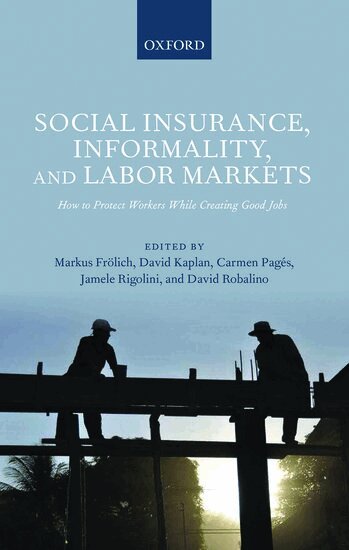
Social Insurance, Informality, and Labor Markets
How to Protect Workers While Creating Good Jobs
Av Markus Frölich, David Kaplan m. fl.
Inbunden, 2014
1167 kr
Lägg i varukorg
Most countries implement social protection programs to help individuals manage risks such as unemployment, disability, illness, longevity or death. In many middle income countries, these are often based on a 'Bismarckian model' (named after Otto von Bismarck), where benefits are financed by …
Left Behind
Chronic Poverty in Latin America and the Caribbean
Av Renos Vakis, Jamele Rigolini m. fl.
Häftad, 2016
357 kr
Lägg i varukorg
Chronic poverty raises perhaps the most complex and difficult challenge for governments around the world. Chronic poverty refers to those people that persistently live in low levels of welfare over long periods, as opposed to vulnerable populations that may get in and out of poverty due to shocks. …
Decoding Universal Basic Income
A Guide to Navigate Concepts, Evidence, and Practices
Av World Bank, Ugo Gentilini m. fl.
Häftad, 2019
573 kr
Lägg i varukorg
Universal Basic Income (UBI) is one of the most hotly-debated ideas in development and social protection. Drawing from global evidence and experiences, this volume provides a compass to help navigate key issues and trade-offs, as well as offering new data and insights to better inform choices …
State of Social Protection Report 2025
The 2-Billion-Person Challenge
Av World Bank, Jamele Rigolini m. fl.
Häftad, 2025
607 kr
Lägg i varukorg
The rising frequency of shocks and crises calls for major investments in social protection's adaptability and preparedness in low- and middle-income countries. Yet, 2 billion people remain uncovered or inadequately covered by social protection. This report discusses avenues to gradually close the …
Economic Mobility and the Rise of the Latin American Middle Class
Av Francisco H. G. Ferreira, Julian Messina m. fl.
Häftad, 2012
310 kr
Tillfälligt slut
With moderate but sustained economic growth and generally declining inequality, the 2000s were a good decade for Latin America. Moderate poverty fell from roughly 40% to 30% of the population. Economic mobility powered a perceived increase in the ranks of the Latin American middle class. But who, …
La Movilidad Económica Y El Crecimiento De La Clase Media En América Latina
Av Francisco H. G. Ferreira, Julian Messina m. fl.
Häftad, 2013
310 kr
Tillfälligt slut
Tras décadas de estancamiento, la población de clase media en América Latina y el Caribe ha aumentado en un 50%-de aproximadamente 100 millones de personas en 2003 a 150 millones (o un 30% de la población del continente) en 2009. Durante este periodo, el porcentaje de la población pobre disminuyó …
Latin American Entrepreneurs
Many Firms but Little Innovation
Av Daniel Lederman, Julian Messina m. fl.
Häftad, 2013
354 kr
Tillfälligt slut
Entrepreneurship—manifested in the entry of new firms or products into new markets, or substantial improvements in technological capacity or process innovation by incumbent firms—is widely considered to be an important ingredient for long term economic development. Entrepreneurship in Latin America …
El Emprendimiento En América Latina
Muchas Empresas Y Poca Innovación
Av Daniel Lederman, Julian Messina m. fl.
Häftad, 2014
354 kr
Tillfälligt slut
Entrepreneurship is a fundamental driver of growth, development, and job creation. While Latin America and the Caribbean has a wealth of entrepreneurs, firms in the region, compared to those in other regions, are small in size and less likely to grow or innovate. Productivity growth has remained …