James L. Szalma - Böcker
Visar alla böcker från författaren James L. Szalma. Handla med fri frakt och snabb leverans.
3 produkter
3 produkter
2 224 kr
Skickas inom 10-15 vardagar
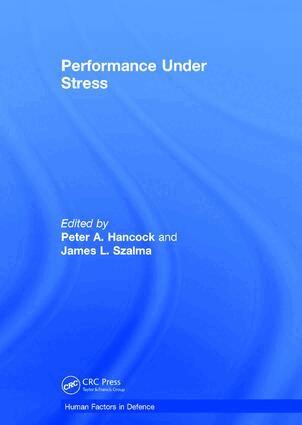
The world is a dangerous place and recent events have served to make it less safe. There are many arenas of conflict and even combat across the world. Such situations are the quintessential expression of stress; you stand in imminent danger and live with the knowledge that you may be attacked, injured or even killed at any moment. How do people perform under these conditions? How do they keep a heightened level of vigilance when nothing may happen in their immediate location for weeks or even months? What happens when the bullets actually start flying? How is it you distinguish friend from foe, and each from innocent bystanders when in immediate peril of your life? Can we design technology to help people make good decisions in these ultimately hazardous situations? To what degree does your membership in a team act to dissipate these particular effects? Can we generate sufficiently stressful field exercises to simulate these conditions and can we train and/or select those most able to withstand such adverse conditions? How will the next generation of servicemen deal with these inherent problems? These are the sorts of questions that Performance Under Stress addresses. This book is derived largely from a multiple-year, multiple university initiative (MURI) on stress and soldier performance on the modern, electronic battlefield. It involved leading researchers from many institutions who have brought their individual expertise to bear on these crucial, contemporary concerns. United by a common research framework, these groups attacked the issue from different methodological and conceptual approaches, ranging from traditional laboratory modeling and experimentation, to realistic simulations; from involved field exercises to personal experiences of actual combat conditions. The insights generated have been distilled and presented as a benchmark of current understanding and provide future directions for research in this arena. Although this work focuses on soldier stress and soldier performance, the principles that are derived extend well beyond this single application. Their findings can be applied to people facing the demands of the business world or research as much as to those who meet life or death situations, such as homeland security, first responders, and law enforcement personnel.
6 114 kr
Skickas inom 11-20 vardagar
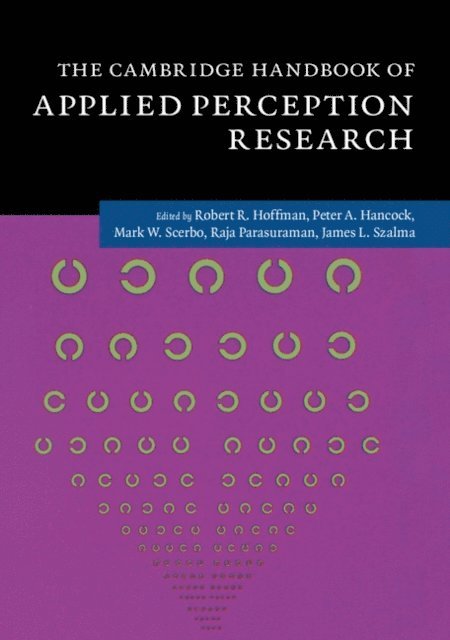
The Cambridge Handbook of Applied Perception Research covers core areas of research in perception with an emphasis on its application to real-world environments. Topics include multisensory processing of information, time perception, sustained attention, and signal detection, as well as pedagogical issues surrounding the training of applied perception researchers. In addition to familiar topics, such as perceptual learning, the Handbook focuses on emerging areas of importance, such as human-robot coordination, haptic interfaces, and issues facing societies in the twenty-first century (such as terrorism and threat detection, medical errors, and the broader implications of automation). Organized into sections representing major areas of theoretical and practical importance for the application of perception psychology to human performance and the design and operation of human-technology interdependence, it also addresses the challenges to basic research, including the problem of quantifying information, defining cognitive resources, and theoretical advances in the nature of attention and perceptual processes.
820 kr
Skickas inom 10-15 vardagar
The world is a dangerous place and recent events have served to make it less safe. There are many arenas of conflict and even combat across the world. Such situations are the quintessential expression of stress; you stand in imminent danger and live with the knowledge that you may be attacked, injured or even killed at any moment. How do people perform under these conditions? How do they keep a heightened level of vigilance when nothing may happen in their immediate location for weeks or even months? What happens when the bullets actually start flying? How is it you distinguish friend from foe, and each from innocent bystanders when in immediate peril of your life? Can we design technology to help people make good decisions in these ultimately hazardous situations? To what degree does your membership in a team act to dissipate these particular effects? Can we generate sufficiently stressful field exercises to simulate these conditions and can we train and/or select those most able to withstand such adverse conditions? How will the next generation of servicemen deal with these inherent problems? These are the sorts of questions that Performance Under Stress addresses. This book is derived largely from a multiple-year, multiple university initiative (MURI) on stress and soldier performance on the modern, electronic battlefield. It involved leading researchers from many institutions who have brought their individual expertise to bear on these crucial, contemporary concerns. United by a common research framework, these groups attacked the issue from different methodological and conceptual approaches, ranging from traditional laboratory modeling and experimentation, to realistic simulations; from involved field exercises to personal experiences of actual combat conditions. The insights generated have been distilled and presented as a benchmark of current understanding and provide future directions for research in this arena. Although this work focuses on soldier stress and soldier performance, the principles that are derived extend well beyond this single application. Their findings can be applied to people facing the demands of the business world or research as much as to those who meet life or death situations, such as homeland security, first responders, and law enforcement personnel.