525 kr
Skickas inom 5-8 vardagar
525 kr
Skickas inom 5-8 vardagar
1 943 kr
Skickas inom 5-8 vardagar
461 kr
Skickas inom 5-8 vardagar
303 kr
Läs direkt efter köp
303 kr
Läs direkt efter köp
496 kr
Skickas inom 10-15 vardagar
2 105 kr
Skickas inom 10-15 vardagar
621 kr
Skickas inom 5-8 vardagar
1 482 kr
Skickas inom 5-8 vardagar
1 457 kr
Skickas inom 3-6 vardagar
2 378 kr
Skickas inom 10-15 vardagar
576 kr
Läs direkt efter köp
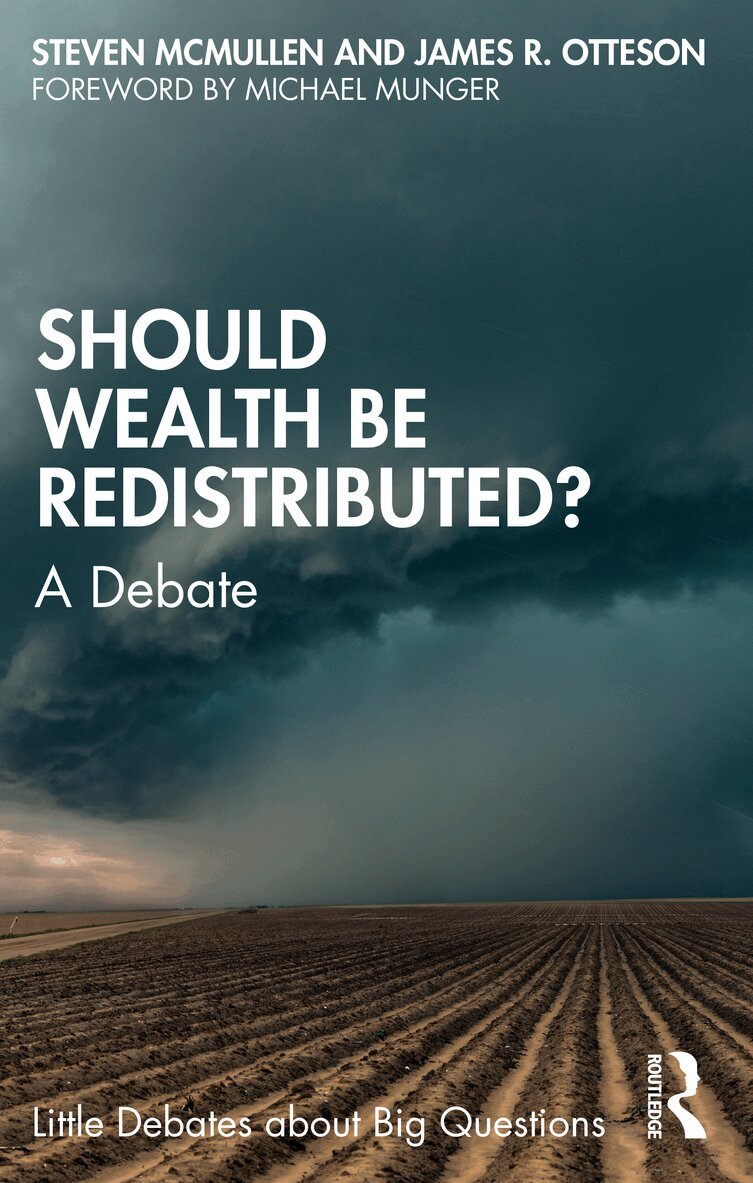
A central contested issue in contemporary economics and political philosophy is whether governments should redistribute wealth. In this book, a philosopher and an economist debate this question. James Otteson argues that respect for individual persons requires that the government should usually not alter the results of free exchanges, and so redistribution is usually wrong. Steven McMullen argues that governments should substantially redistribute wealth in order to ensure that all have a minimal opportunity to participate in economic life. Over the course of the exchange, the authors investigate a number of important questions. Is redistribution properly a question of justice, and what is the appropriate standard? Has the welfare state been effective at fighting poverty? Can we expect government intervention in the economy to be helpful or counterproductive? Are our obligations to help the poor best met through government action, or through private philanthropy and individual charity?
The book features clear statements of each argument, responses to counterarguments, in-text definitions, a glossary of key terms, and section summaries. Scholars and students alike will find it easy to follow the debate and learn the key concepts from philosophy, politics, and economics necessary to understand each position.
Key Features:
Offers clear arguments written to be accessible to readers and students without a deep background in economics, philosophy, or political theory. Fosters a deep exchange of ideas with responses from each author to the main arguments. Provides in-text definitions and a glossary with definitions of key terms. Includes section summaries that give an overview of the main arguments and a comprehensive bibliography for further reading.
576 kr
Läs direkt efter köp
A central contested issue in contemporary economics and political philosophy is whether governments should redistribute wealth. In this book, a philosopher and an economist debate this question. James Otteson argues that respect for individual persons requires that the government should usually not alter the results of free exchanges, and so redistribution is usually wrong. Steven McMullen argues that governments should substantially redistribute wealth in order to ensure that all have a minimal opportunity to participate in economic life. Over the course of the exchange, the authors investigate a number of important questions. Is redistribution properly a question of justice, and what is the appropriate standard? Has the welfare state been effective at fighting poverty? Can we expect government intervention in the economy to be helpful or counterproductive? Are our obligations to help the poor best met through government action, or through private philanthropy and individual charity?
The book features clear statements of each argument, responses to counterarguments, in-text definitions, a glossary of key terms, and section summaries. Scholars and students alike will find it easy to follow the debate and learn the key concepts from philosophy, politics, and economics necessary to understand each position.
Key Features:
Offers clear arguments written to be accessible to readers and students without a deep background in economics, philosophy, or political theory. Fosters a deep exchange of ideas with responses from each author to the main arguments. Provides in-text definitions and a glossary with definitions of key terms. Includes section summaries that give an overview of the main arguments and a comprehensive bibliography for further reading.
276 kr
Skickas inom 3-6 vardagar
549 kr
Skickas
277 kr
Läs direkt efter köp
280 kr
Läs direkt efter köp
458 kr
Läs direkt efter köp
425 kr
Skickas inom 10-15 vardagar
241 kr
Skickas inom 3-6 vardagar
227 kr
Läs direkt efter köp
458 kr
Läs direkt efter köp
432 kr
Skickas inom 3-6 vardagar
Adam Smith (1723–90) studied under Francis Hutcheson at the University of Glasgow, befriended David Hume while lecturing on rhetoric and jurisprudence in Edinburgh, was elected Professor of Logic, Professor of Moral Philosophy, Vice-rector, and eventually Lord Rector of the University of Glasgow, and, along with Hutcheson, Hume, and a few others, went on to become one of the chief figures of the astonishing period of learning known as the Scottish Enlightenment. He is the author of two books: The Theory of Moral Sentiments (1759) and An Inquiry into the Nature and Causes of the Wealth of Nations (1776). TMS brought Smith considerable acclaim during his lifetime and was quickly considered one of the great works of moral theory. It deeply impressed Immanuel Kant, for example, who called Smith his ' Liebling ' or ‘favourite', and Charles Darwin, who in his Descent of Man (1871) endorsed and accepted several of Smith's ‘striking' conclusions. TMS went through fully six revised editions during Smith's lifetime. Since the nineteenth century, Smith's fame has largely rested on his Wealth of Nations, which must be considered one of the most important works of the millennium: its argument for free trade, its explanation of the price mechanism and the division of labor, its qualified defense of market economies, and its powerful criticisms of mercantilist economic theories are now standard fare in economics courses, not to mention the basis of a large portion of today's worldwide economic policy. And its account of human nature is now classic. Both The Theory of Moral Sentiments and the Wealth of Nations reveal Smith's impressively broad learning, but he wrote and lectured on a number of other subjects as well. This anthology collects, for the first time in one volume, not only generous selections from each of Smith's books but also substantial selections from his other work, including his lectures on jurisprudence, his history and philosophy of science, his criticism and belles lettres, and his philosophy of language. It also includes two important letters from Hume, as well as Smith's account of Hume's death.