Jamie Pearce – författare
Visar alla böcker från författaren Jamie Pearce. Handla med fri frakt och snabb leverans.
6 produkter
6 produkter
721 kr
Skickas inom 10-15 vardagar
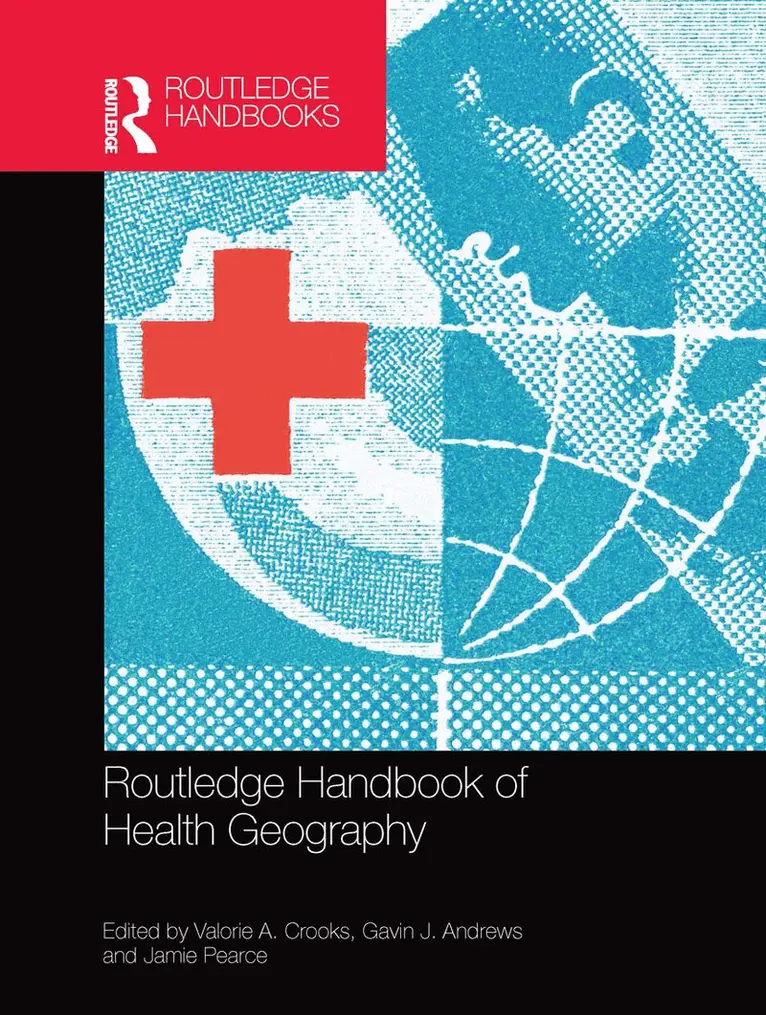
The places of our daily life affect our health, well-being, and receipt of health care in complex ways. The connection between health and place has been acknowledged for centuries, and the contemporary discipline of health geography sets as its core mission to uncover and explicate all facets of this connection.The Routledge Handbook of Health Geography features 52 chapters from leading international thinkers that collectively characterize the breadth and depth of current thinking on the health–place connection. It will be of interest to students seeking an introduction to health geography as well as multidisciplinary health scholars looking to explore the intersection between health and place. This book provides a coherent synthesis of scholarship in health geography as well as multidisciplinary insights into cutting-edge research. It explores the key concepts central to appreciating the ways in which place influences our health, from the micro-space of the body to the macro-scale of entire world regions, in order to articulate historical and contemporary aspects of this influence.
2 246 kr
Skickas inom 10-15 vardagar
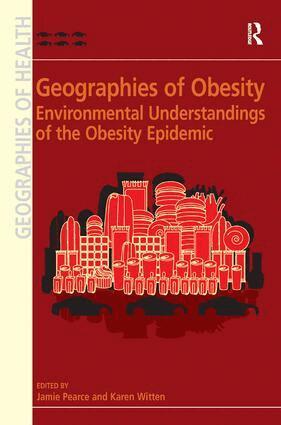
Over the past two decades, rates of adult and childhood obesity in the developed world have risen sharply. By the year 2000, 65% of the United States population were overweight, 30% of these obese. Whilst medical treatment has tended to focus on individual habits of diet and exercise, this approach does little to account for globally increasing levels of obesity, and the external, environmental factors that may be responsible. This in-depth study assembles the evidence for a geographical explanation of current obesity trends, and is the first work to examine the ways in which environment and living conditions promote an imbalance of energy intake over energy expenditure. The book calls upon the expertise of geographers, nutritionists, epidemiologists, sociologists and public health researchers, resulting in a broad, multidisciplinary analysis of this important health issue. Cover graphic designed by Georgia Witten-Sage.
3 295 kr
Skickas inom 10-15 vardagar
The places of our daily life affect our health, well-being, and receipt of health care in complex ways. The connection between health and place has been acknowledged for centuries, and the contemporary discipline of health geography sets as its core mission to uncover and explicate all facets of this connection.The Routledge Handbook of Health Geography features 52 chapters from leading international thinkers that collectively characterize the breadth and depth of current thinking on the health–place connection. It will be of interest to students seeking an introduction to health geography as well as multidisciplinary health scholars looking to explore the intersection between health and place. This book provides a coherent synthesis of scholarship in health geography as well as multidisciplinary insights into cutting-edge research. It explores the key concepts central to appreciating the ways in which place influences our health, from the micro-space of the body to the macro-scale of entire world regions, in order to articulate historical and contemporary aspects of this influence.
777 kr
Skickas inom 10-15 vardagar
Over the past two decades, rates of adult and childhood obesity in the developed world have risen sharply. By the year 2000, 65% of the United States population were overweight, 30% of these obese. Whilst medical treatment has tended to focus on individual habits of diet and exercise, this approach does little to account for globally increasing levels of obesity, and the external, environmental factors that may be responsible. This in-depth study assembles the evidence for a geographical explanation of current obesity trends, and is the first work to examine the ways in which environment and living conditions promote an imbalance of energy intake over energy expenditure. The book calls upon the expertise of geographers, nutritionists, epidemiologists, sociologists and public health researchers, resulting in a broad, multidisciplinary analysis of this important health issue. Cover graphic designed by Georgia Witten-Sage.
336 kr
Skickas inom 7-10 vardagar
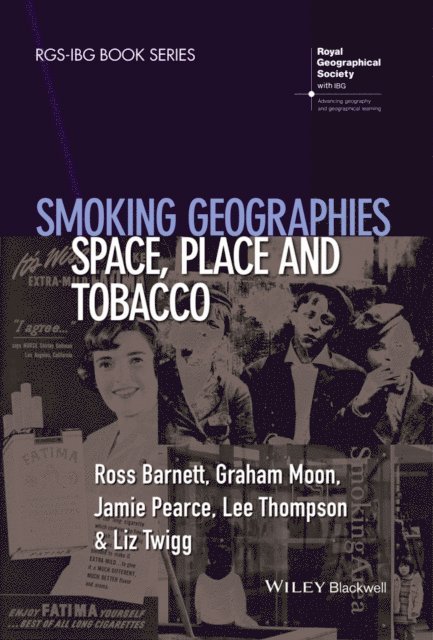
Smoking Geographies provides a research-led assessment of the impact of geographical factors on smoking. The contributors uncover how geography can show us not only why people smoke but also broader issues of tobacco control, providing deeper clarity on how smoking and tobacco is ‘governed’. The text centres on one of the most important public health issues worldwide, and a major determinant of preventable mortality and morbidity in developed and developing countriesRecords the outcomes of a long-term research collaboration that brings a geographical lens to smoking behaviourUncovers how geography can play a part in understanding not only why people smoke but also broader issues of tobacco controlProvides a deeper understanding of how smoking and tobacco is ‘governed’, regarding where people may smoke, but also more subtle governance as a climate is produced in which smoking becomes ‘denormalised’Brings both quantitative and qualitative perspectives to bear on this major source of mortality and morbidity
820 kr
Skickas inom 11-20 vardagar
Smoking Geographies provides a research-led assessment of the impact of geographical factors on smoking. The contributors uncover how geography can show us not only why people smoke but also broader issues of tobacco control, providing deeper clarity on how smoking and tobacco is ‘governed’. The text centres on one of the most important public health issues worldwide, and a major determinant of preventable mortality and morbidity in developed and developing countriesRecords the outcomes of a long-term research collaboration that brings a geographical lens to smoking behaviourUncovers how geography can play a part in understanding not only why people smoke but also broader issues of tobacco controlProvides a deeper understanding of how smoking and tobacco is ‘governed’, regarding where people may smoke, but also more subtle governance as a climate is produced in which smoking becomes ‘denormalised’Brings both quantitative and qualitative perspectives to bear on this major source of mortality and morbidity