Jamil Salmi - Böcker
Visar alla böcker från författaren Jamil Salmi. Handla med fri frakt och snabb leverans.
11 produkter
11 produkter
1 860 kr
Skickas inom 5-8 vardagar
This volume focuses on the recent lessons of experience with reform and innovation in higher education that are most relevant to the challenges of developing countries. These lessons are explored in a series of twelve papers which analyze experience and issues in four priority areas. The first examines the relationship between higher education and development in a global environment in which economic growth is expected to be driven increasingly by scientific and technological innovation. To meet this development challenge effectively, systems of higher education will need to have a solid financial basis, and the second priority area is the examination of the options for reform in higher education financing. Yet, as essential as financial reforms, are reforms in management and government. This implies changes in the relationship between the Government and institutions of higher education. The third part examines these evolving relationships and implies that the mechanisms and indicators will need to be developed to more effectively monitor the performance of institutions of higher education. The final section reviews recent trends in this area and the book concludes with a case study of the effects of the implementation of a comprehensive reform in Chile including many of the reform policies advocated, and a proposal of the central options for policy reform and innovation in higher education.
372 kr
Skickas inom 10-15 vardagar
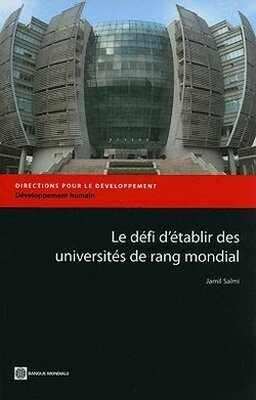
Governments are becoming increasingly aware of the important contribution that high performance universities make to competitiveness and economic growth. This book explores what are the challenges involved in setting up globally competitive universities, also called "elite" or "flagship"universities
La Voie De L’excellence Académique
La Création D'universités De Recherche De Rang Mondial
Häftad, Franska, 2012
268 kr
Skickas inom 10-15 vardagar
The positive contribution of tertiary education is increasingly recognized as not limited to middle-income and advanced countries, since it applies equally to low-income economies. Tertiary education can help countries become more globally competitive by developing a skilled, productive, and flexible labor force and by creating, applying, and spreading new ideas and technologies. Research universities are reckoned among the central institutions of the 21st century knowledge economies. This book extends the analysis of the framework presented in The Challenge of Establishing World-Class Universities (Salmi 2009) and by examining the recent experience of 11 universities in nine countries that have grappled with the challenges of building successful research institutions in difficult circumstances and learning from the lessons of these experiences.
Higher Education in Romania: Overcoming Challenges and Embracing Opportunities
Inbunden, Engelska, 2022
525 kr
Skickas inom 10-15 vardagar
This open access book includes a series of relevant policy research articles, elaborared in the framework of the “Quality in higher education: internationalisation and databases to enhance the Romanian education system” project, implemented by the Executive Agency for Higher Education, Research, Development and Innovation Funding (UEFISCDI), together with the Ministry of Education. The project aims to develop and implement systemic measures at tertiary education level, leading to an increased quality of the overall higher education system and universities better prepared for labour market requirements and international standards. The book focuses on areas of interest for Romanian higher education, such as systemic measures to improve access, participation and completion for (vulnerable) students, better promotion of the Romanian higher education to attract students, as well as instruments for a more efficient use of data at higher education level. Each article includes evidence-based policy proposals that could support new strategic initiatives in higher education, including new legislation. Additionally, the collection of articles tells a comprehensive story about the audacity of a higher education system which went through significant challenges to align itself with both European and international trends, as well as respond to national imperatives.Over the last three decades, since the fall of the Iron Curtain, Romanian higher education has undergone significant transformations, aiming to align itself to the latest developments and trends at European and international level. The National Law on Education no. 1/2011 has set the stage for a full implementation of the Bologna Process action lines, taking into account that Romania was already a part of the largest European intergovernmental process – currently the European Higher Education Area (EHEA) – as a founding member.However, since the adoption of this normative framework, the law suffered numerous amendments, making it challenging to observe and achieve coherence in its implementation. Furthermore, Romania is also currently redesigning the strategy for the alocation of European structural funds 2021-2027, based on two strategic documents - the new Education and Employment Operational Programme and the National Recovery and Resilience Plan which highlight the reform and investment priorities at a national level.At the same time, 2021 is a good time to analyze the level of implementation for the objectives and measures included in the National Strategy for Tertiary Education 2015-2020, the Europe 2020 Strategy, and the Bologna Process action lines in the 2010 – 2020 timeframe. Therefore, the present moment may be an important time to assess the impact of strategic documents and actions in the last decade and, possibly, to draft a new National Education Law, better adapted to current realities, starting from the recent initiative by the President of Romania – theEducated Romania strategic vision which was also politically assumed by the Romanian Government.
Higher Education in Romania: Overcoming Challenges and Embracing Opportunities
Häftad, Engelska, 2022
421 kr
Skickas inom 10-15 vardagar
This open access book includes a series of relevant policy research articles, elaborared in the framework of the “Quality in higher education: internationalisation and databases to enhance the Romanian education system” project, implemented by the Executive Agency for Higher Education, Research, Development and Innovation Funding (UEFISCDI), together with the Ministry of Education. The project aims to develop and implement systemic measures at tertiary education level, leading to an increased quality of the overall higher education system and universities better prepared for labour market requirements and international standards. The book focuses on areas of interest for Romanian higher education, such as systemic measures to improve access, participation and completion for (vulnerable) students, better promotion of the Romanian higher education to attract students, as well as instruments for a more efficient use of data at higher education level. Each article includes evidence-based policy proposals that could support new strategic initiatives in higher education, including new legislation. Additionally, the collection of articles tells a comprehensive story about the audacity of a higher education system which went through significant challenges to align itself with both European and international trends, as well as respond to national imperatives.Over the last three decades, since the fall of the Iron Curtain, Romanian higher education has undergone significant transformations, aiming to align itself to the latest developments and trends at European and international level. The National Law on Education no. 1/2011 has set the stage for a full implementation of the Bologna Process action lines, taking into account that Romania was already a part of the largest European intergovernmental process – currently the European Higher Education Area (EHEA) – as a founding member.However, since the adoption of this normative framework, the law suffered numerous amendments, making it challenging to observe and achieve coherence in its implementation. Furthermore, Romania is also currently redesigning the strategy for the alocation of European structural funds 2021-2027, based on two strategic documents - the new Education and Employment Operational Programme and the National Recovery and Resilience Plan which highlight the reform and investment priorities at a national level.At the same time, 2021 is a good time to analyze the level of implementation for the objectives and measures included in the National Strategy for Tertiary Education 2015-2020, the Europe 2020 Strategy, and the Bologna Process action lines in the 2010 – 2020 timeframe. Therefore, the present moment may be an important time to assess the impact of strategic documents and actions in the last decade and, possibly, to draft a new National Education Law, better adapted to current realities, starting from the recent initiative by the President of Romania – theEducated Romania strategic vision which was also politically assumed by the Romanian Government.
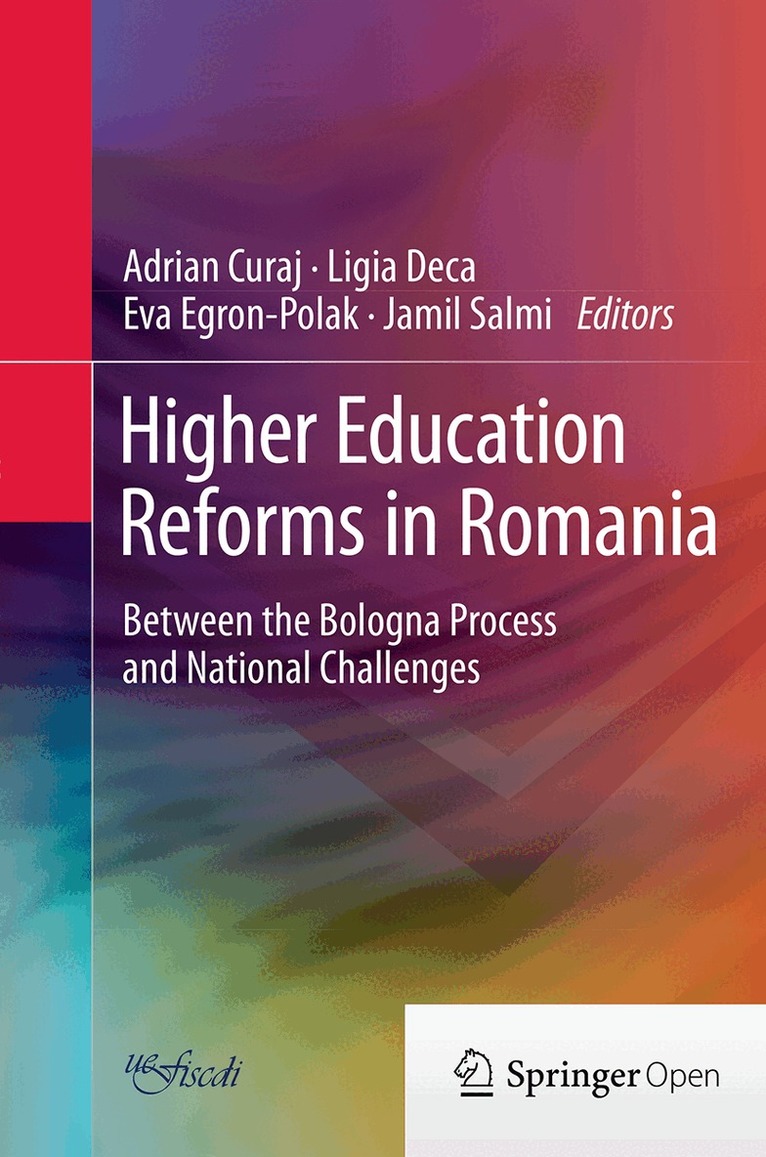
Higher Education Reforms in Romania
Between the Bologna Process and National Challenges
Inbunden, Engelska, 2014
525 kr
Skickas inom 10-15 vardagar
Romania is an active player in various international higher education areas, while undergoing a series of higher education reforms within its national framework.
619 kr
Skickas inom 10-15 vardagar
Bridging the gap between higher education research and policy making was always a challenge, but the recent calls for more evidence-based policies have opened a window of unprecedented opportunity for researchers to bring more contributions to shaping the future of the European Higher Education Area (EHEA). Encouraged by the success of the 2011 first edition, Romania and Armenia have organised a 2nd edition of the Future of Higher Education – Bologna Process Researchers’ Conference (FOHE-BPRC) in November 2014, with the support of the Italian Presidency of the European Union and as part of the official EHEA agenda. Reuniting over 170 researchers from more than 30 countries, the event was a forum to debate the trends and challenges faced by higher education today and look at the future of European cooperation in higher education. The research volumes offer unique insights regarding the state of affairs of European higher education and research, as well as forward-looking policy proposals. More than 50 articles focus on essential themes in higher education: Internationalization of higher education; Financing and governance; Excellence and the diversification of missions; Teaching, learning and student engagement; Equity and the social dimension of higher education; Education, research and innovation; Quality assurance, The impacts of the Bologna Process on the EHEA and beyond and Evidence-based policies in higher education. "The Bologna process was launched at a time of great optimism about the future of the European project – to which, of course, the reform of higher education across the continent has made a major contribution. Today, for the present, that optimism has faded as economic troubles have accumulated in the Euro-zone, political tensions have been increased on issues such as immigration and armed conflict has broken out in Ukraine. There is clearly a risk that, against this troubled background, the Bologna process itself may falter. There are already signsthat it has been downgraded in some countries with evidence of political withdrawal. All the more reason for the voice of higher education researchers to be heard. Since the first conference they have established themselves as powerful stakeholders in the development of the EHEA, who are helping to maintain the momentum of the Bologna process. Their pivotal role has been strengthened by the second Bucharest conference." Peter Scott, Institute of Education, London (General Rapporteur of the FOHE-BPRC first edition)
Del 3 - Knowledge Studies in Higher Education
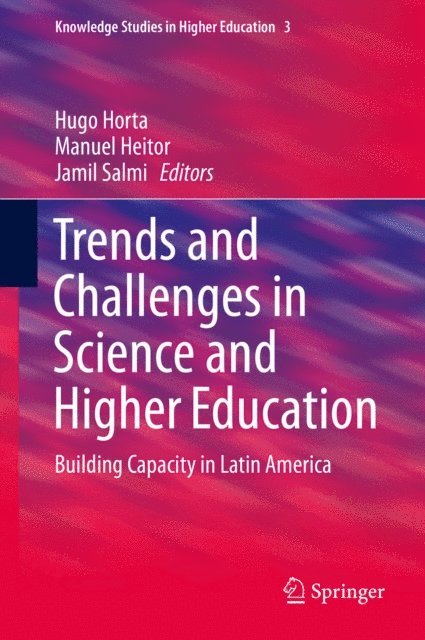
Trends and Challenges in Science and Higher Education
Building Capacity in Latin America
Inbunden, Engelska, 2015
1 073 kr
Skickas inom 10-15 vardagar
This book discusses the role that integrated science and higher education policies may play in further democratizing and promoting social-economic development in Latin America. It suggests that such democratizing and development may be achieved in two complementary ways: i) broadening the access to knowledge through formal learning processes of higher education, and ii) promoting the advanced qualification of people while strengthening research institutions. The book shows how this entails a complex process of policy integration, with an emphasis on human resources and institutional issues combined in processes of technical change. It discusses in detail the three main challenges that most Latin American countries face in a globalized age, based on knowledge and ever-evolving learning processes. These challenges are the need to broaden the access to higher education; to make this access more socially balanced; and to recover from a long gap in investing in knowledge production and dissemination. This book treats these issues from a variety of conceptual and methodological perspectives that present a contribution to the field of science policy and higher education studies, and inform policymakers in Latin America.
Higher Education Reforms in Romania
Between the Bologna Process and National Challenges
Häftad, Engelska, 2016
525 kr
Skickas inom 10-15 vardagar
Romania is an active player in various international higher education areas, while undergoing a series of higher education reforms within its national framework.
619 kr
Skickas inom 10-15 vardagar
Bridging the gap between higher education research and policy making was always a challenge, but the recent calls for more evidence-based policies have opened a window of unprecedented opportunity for researchers to bring more contributions to shaping the future of the European Higher Education Area (EHEA). Encouraged by the success of the 2011 first edition, Romania and Armenia have organised a 2nd edition of the Future of Higher Education – Bologna Process Researchers’ Conference (FOHE-BPRC) in November 2014, with the support of the Italian Presidency of the European Union and as part of the official EHEA agenda. Reuniting over 170 researchers from more than 30 countries, the event was a forum to debate the trends and challenges faced by higher education today and look at the future of European cooperation in higher education. The research volumes offer unique insights regarding the state of affairs of European higher education and research, as well as forward-looking policy proposals. More than 50 articles focus on essential themes in higher education: Internationalization of higher education; Financing and governance; Excellence and the diversification of missions; Teaching, learning and student engagement; Equity and the social dimension of higher education; Education, research and innovation; Quality assurance, The impacts of the Bologna Process on the EHEA and beyond and Evidence-based policies in higher education. "The Bologna process was launched at a time of great optimism about the future of the European project – to which, of course, the reform of higher education across the continent has made a major contribution. Today, for the present, that optimism has faded as economic troubles have accumulated in the Euro-zone, political tensions have been increased on issues such as immigration and armed conflict has broken out in Ukraine. There is clearly a risk that, against this troubled background, the Bologna process itself may falter. There are already signsthat it has been downgraded in some countries with evidence of political withdrawal. All the more reason for the voice of higher education researchers to be heard. Since the first conference they have established themselves as powerful stakeholders in the development of the EHEA, who are helping to maintain the momentum of the Bologna process. Their pivotal role has been strengthened by the second Bucharest conference." Peter Scott, Institute of Education, London (General Rapporteur of the FOHE-BPRC first edition)
Del 3 - Knowledge Studies in Higher Education
Trends and Challenges in Science and Higher Education
Building Capacity in Latin America
Häftad, Engelska, 2019
1 037 kr
Skickas inom 10-15 vardagar
This book discusses the role that integrated science and higher education policies may play in further democratizing and promoting social-economic development in Latin America.