Liviu Matei - Böcker
Visar alla böcker från författaren Liviu Matei. Handla med fri frakt och snabb leverans.
4 produkter
4 produkter
614 kr
Skickas inom 10-15 vardagar
Bridging the gap between higher education research and policy making was always a challenge, but the recent calls for more evidence-based policies have opened a window of unprecedented opportunity for researchers to bring more contributions to shaping the future of the European Higher Education Area (EHEA). Encouraged by the success of the 2011 first edition, Romania and Armenia have organised a 2nd edition of the Future of Higher Education – Bologna Process Researchers’ Conference (FOHE-BPRC) in November 2014, with the support of the Italian Presidency of the European Union and as part of the official EHEA agenda. Reuniting over 170 researchers from more than 30 countries, the event was a forum to debate the trends and challenges faced by higher education today and look at the future of European cooperation in higher education. The research volumes offer unique insights regarding the state of affairs of European higher education and research, as well as forward-looking policy proposals. More than 50 articles focus on essential themes in higher education: Internationalization of higher education; Financing and governance; Excellence and the diversification of missions; Teaching, learning and student engagement; Equity and the social dimension of higher education; Education, research and innovation; Quality assurance, The impacts of the Bologna Process on the EHEA and beyond and Evidence-based policies in higher education. "The Bologna process was launched at a time of great optimism about the future of the European project – to which, of course, the reform of higher education across the continent has made a major contribution. Today, for the present, that optimism has faded as economic troubles have accumulated in the Euro-zone, political tensions have been increased on issues such as immigration and armed conflict has broken out in Ukraine. There is clearly a risk that, against this troubled background, the Bologna process itself may falter. There are already signsthat it has been downgraded in some countries with evidence of political withdrawal. All the more reason for the voice of higher education researchers to be heard. Since the first conference they have established themselves as powerful stakeholders in the development of the EHEA, who are helping to maintain the momentum of the Bologna process. Their pivotal role has been strengthened by the second Bucharest conference." Peter Scott, Institute of Education, London (General Rapporteur of the FOHE-BPRC first edition)
614 kr
Skickas inom 10-15 vardagar
Bridging the gap between higher education research and policy making was always a challenge, but the recent calls for more evidence-based policies have opened a window of unprecedented opportunity for researchers to bring more contributions to shaping the future of the European Higher Education Area (EHEA). Encouraged by the success of the 2011 first edition, Romania and Armenia have organised a 2nd edition of the Future of Higher Education – Bologna Process Researchers’ Conference (FOHE-BPRC) in November 2014, with the support of the Italian Presidency of the European Union and as part of the official EHEA agenda. Reuniting over 170 researchers from more than 30 countries, the event was a forum to debate the trends and challenges faced by higher education today and look at the future of European cooperation in higher education. The research volumes offer unique insights regarding the state of affairs of European higher education and research, as well as forward-looking policy proposals. More than 50 articles focus on essential themes in higher education: Internationalization of higher education; Financing and governance; Excellence and the diversification of missions; Teaching, learning and student engagement; Equity and the social dimension of higher education; Education, research and innovation; Quality assurance, The impacts of the Bologna Process on the EHEA and beyond and Evidence-based policies in higher education. "The Bologna process was launched at a time of great optimism about the future of the European project – to which, of course, the reform of higher education across the continent has made a major contribution. Today, for the present, that optimism has faded as economic troubles have accumulated in the Euro-zone, political tensions have been increased on issues such as immigration and armed conflict has broken out in Ukraine. There is clearly a risk that, against this troubled background, the Bologna process itself may falter. There are already signsthat it has been downgraded in some countries with evidence of political withdrawal. All the more reason for the voice of higher education researchers to be heard. Since the first conference they have established themselves as powerful stakeholders in the development of the EHEA, who are helping to maintain the momentum of the Bologna process. Their pivotal role has been strengthened by the second Bucharest conference." Peter Scott, Institute of Education, London (General Rapporteur of the FOHE-BPRC first edition)
625 kr
Skickas inom 10-15 vardagar
The thirteen papers in this collection address three aspects of higher education, primarily in Europe but also in the United States. These aspects are competition, collaboration, and complementarity, both on the level of policy and on the practical level of impact on students and staff. Competition, especially for funding, occurs between and within institutions. Collaboration, more than a basic code of conduct, has become a political principle across Europe. Complementarity in the market for higher education facilitates this collaboration. The themes and contexts in higher education for which the three Cs are examined include missions and identities, response to external forces, the impact of evaluation systems and ranking schemes, the effects of globalisation, intercultural awareness and gender imbalance, and the challenges of student participation. Statistical tables and visual aids support the analysis and arguments. This book is the fifth in a series of publications drawn from the annual Forums of the European Association of Institutional Research (EAIR) from 2013 onwards.
643 kr
Skickas inom 10-15 vardagar
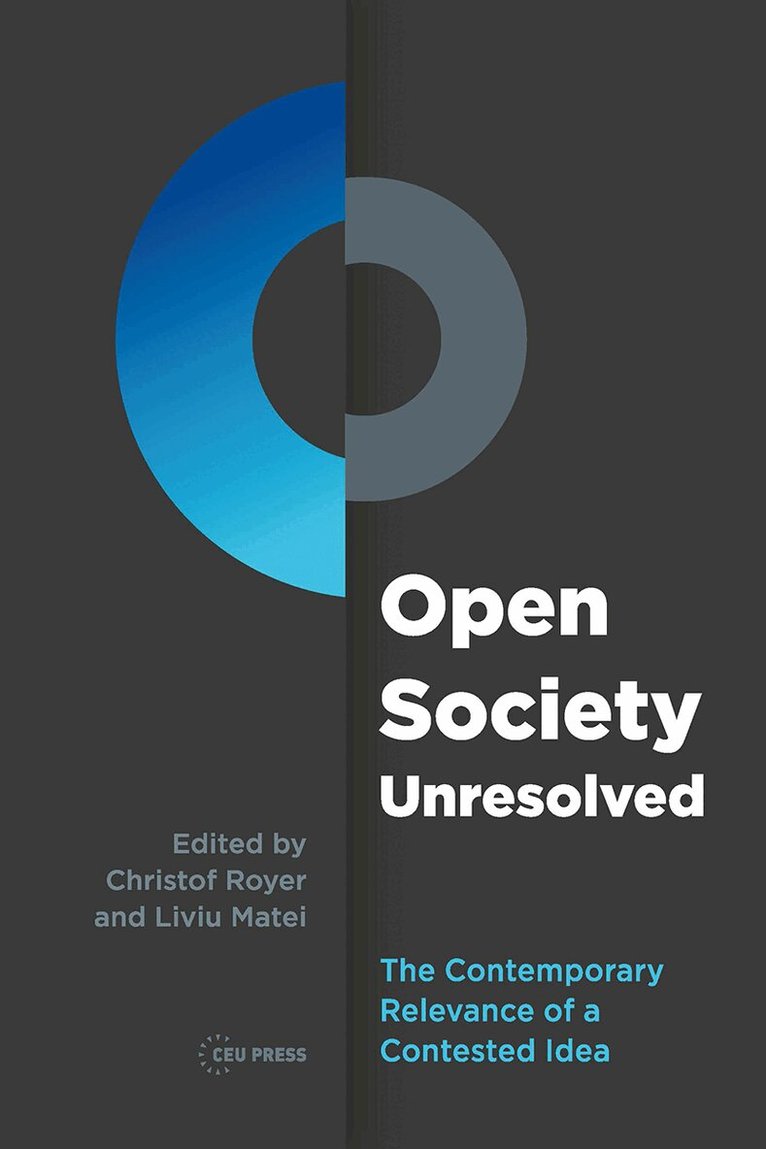
Is the concept of open society still relevant in the 21st century? Do the current social, moral, and political realities call for a drastic revision of this concept? Here fifteen essays address real-world contemporary challenges to open society from a variety of perspectives. What unites the individual authors and chapters is an interest in open society’s continuing usefulness and relevance to address current problems. And what distinguishes them is a rich variety of geographical and cultural backgrounds, and a wide range of academic disciplines and traditions.While focusing on probing the contemporary relevance of the concept, several chapters approach it historically. The book features a comprehensive introduction to the history and current ‘uses’ of the theory of open society. The authors link the concept to contemporary themes including education, Artificial Intelligence, cognitive science, African cosmology, colonialism, and feminism. The diversity of viewpoints in the analysis reflects a commitment to plurality that is at the heart of this book and of the idea of open society itself.