Jan C.A. Boeyens – författare
Visar alla böcker från författaren Jan C.A. Boeyens. Handla med fri frakt och snabb leverans.
14 produkter
14 produkter
E-bok
Engelska, 20052 215 kr
Läs direkt efter köp
Many new developments, related to the interpretation and importance of symmetry relationships, quantum mechanics, general relativity, field theory and mathematics have occurred in the second half of the 20th century without having a visible impact on chemical thinking. By re-examining basic theories, The New Theories for Chemistry aims to introduce a new understanding of old concepts, such as electron spin, The Periodic Table and electronegativity. The book focuses on the new mathematical concepts that enable the exploration of interactions between particles, waves and fields within a chemical context, and is packed with examples to support its arguments. The author adopts a practical approach and topics are arranged sequentially, from the mathematical basis through to general concepts. An essential reference source, this book is suitable for physicists, theoretical and physical chemists, as well as students and researchers working in the field.- Re-examines basic theories, such as electronegativity and electron spin, and introduces new theory- Full of practical experiments and examples- Is an excellent single reference source
E-bok
PDF, Engelska, 20033 115 kr
Läs direkt efter köp
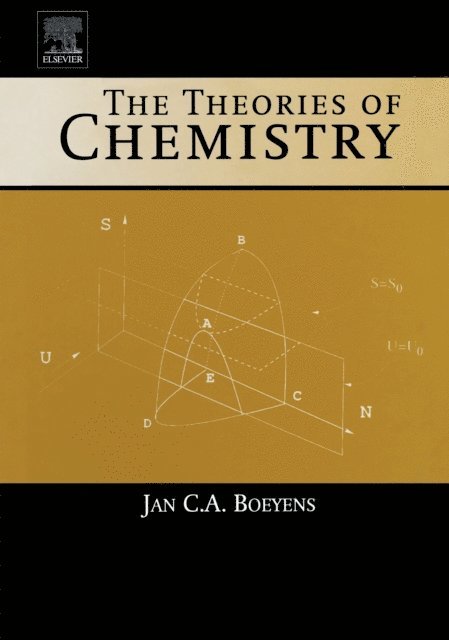
Theories of Chemistry reviews the theories that underpin chemistry, but yet are not traditionally recognized as such, being normally considered as part of physics. Based on the argument that the needs of chemistry are distinctive, a mathematical structure of topics such as quantum mechanics, relativity theory, thermodynamics and statistical mechanics, suiting the needs of chemistry, is outlined. The subject matter is arranged in a sequence that reveals the foundations of chemistry. Starting from the mathematical basis, the sequence runs through the general concepts (mechanics and wave formalism) and the elementary building blocks, to molecules and macrosystems. The book is the product of the author''s reading of original literature rather than of standard texts. It differs from what is conventionally emphasized because of the different approach that it argues for the recognition of chemistry as an emergent discipline, ultimately based on the properties and structure of space and time. Hence the emphasis on otherwise unexpected topics such as quaternions, lie groups, polarized light, compressed atoms, rydberg atoms, solitons, molecular hydrogen, and phase transitions, amongst others. The topic is the understanding of chemistry from first principles. The book is self-contained and can be used without reference to other sources.- All chemisty theories are covered in this one volume.- The book is self-contained and can be used without reference to other sources.- Many topics, routinely referred to in advanced chemistry texts, without making them accessible to the non-specialist, are brought together.
Inbunden, Engelska, 1996
1 084 kr
Skickas inom 10-15 vardagar
Molecular similarity has always been an important conceptual tool of chemists, yet systematic approaches to molecular similarity problems have only recently been recognized as a major contributor to our understanding of molecular properties. Advanced approaches to molecular similarity analysis have their foundation in quantum similarity measures, and are important direct or indirect contributors to some of the predictive theoretical, computational, and also experimental methods of modern chemistry. This volume provides a survey of the foundations and the contemporary mathematical and computational methodologies of molecular similarity approaches, where special emphasis is given to applications of similarity studies to a range of practical and industrially significant fields, such as pharmaceutical drug design. The authors of individual chapters are leading experts in various sub-fields of molecular similarity analysis and the related fundamental theoretical chemistry topics, as well as the relevant computational and experimental methodologies. Whereas in each chapter the emphasis is placed on a different area, nevertheless, the overall coverage and the wide scope of the book provides the reader with a general yet sufficiently detailed description that may serve as a good starting point for new studies and applications of molecular similarity approaches. The editors of this volume are grateful to the authors for their contributions, and hope that the readers will find this book a useful and motivating source of information in the rapidly growing field of molecular similarity analysis.
Inbunden, Engelska, 2005
2 240 kr
Skickas inom 5-8 vardagar
Many new developments, related to the interpretation and importance of symmetry relationships, quantum mechanics, general relativity, field theory and mathematics have occurred in the second half of the 20th century without having a visible impact on chemical thinking. By re-examining basic theories, The New Theories for Chemistry aims to introduce a new understanding of old concepts, such as electron spin, The Periodic Table and electronegativity. The book focuses on the new mathematical concepts that enable the exploration of interactions between particles, waves and fields within a chemical context, and is packed with examples to support its arguments. The author adopts a practical approach and topics are arranged sequentially, from the mathematical basis through to general concepts. An essential reference source, this book is suitable for physicists, theoretical and physical chemists, as well as students and researchers working in the field. Re-examines basic theories, such as electronegativity and electron spin, and introduces new theory Full of practical experiments and examples Is an excellent single reference source
Häftad, Engelska, 2013
546 kr
Skickas inom 10-15 vardagar
This volume contains most of the invited lectures of the 2nd Structural Chemistry Indaba on "Molecular Interactions," held at Skukuza, Kruger Park, South Africa, August 3- 8, 1997. While the 1995 conference concentrated more on the principles underlying molecular modeling, like the existence of a molecular shape, this conference centers on molecular interactions or, more generally, on molecules in environments. Unfortunately, it was impossible, for various reasons, to unite all invited lectures in this volume, but nevertheless this collection contains contributions ranging from the fundamental quantum mechanical theory to recent research on organometallic crystals. For a summary, I would like to refer the reader to the introductory chapter by S.O. Sommerer, based on his concluding remarks at the conference. WemerGans for the editors v CONTENTS Intermolecular Interactions ...S. O. Sommerer Intermolecular Bonding ...3 1. C. A. Boeyens Chemical Reactions in the Framework of Single Quantum Systems ...9 A. Amann The Molecule and Its Environment ...25 ...B. T. Sutcliffe Dynamic Aspects of Intermolecular Interactions ...49 ...1. F. Ogilvie Atomic Interactions and the Charge Density ...57 ...T. Koritsanszky 71 Cyclometallation of Alkylphosphines M. T. Benson and T. R. Cundari C-H-. *0 Hydrogen Bonds in Organometallic Crystals 83 D. Braga and F. Grepioni The Importance of Intra-and Intermolecular Weak Bonds in Transition Metal Coordination Compounds ...97 P. Comba Relationships between Experiment and Theory in the Study of Intermolecular Interactions ...111 ...
E-bok
PDF, Engelska, 2013712 kr
Läs direkt efter köp
E-bok
PDF, Engelska, 20131 416 kr
Läs direkt efter köp
Molecular similarity has always been an important conceptual tool of chemists, yet systematic approaches to molecular similarity problems have only recently been recognized as a major contributor to our understanding of molecular properties. Advanced approaches to molecular similarity analysis have their foundation in quantum similarity measures, and are important direct or indirect contributors to some of the predictive theoretical, computational, and also experimental methods of modern chemistry. This volume provides a survey of the foundations and the contemporary mathematical and computational methodologies of molecular similarity approaches, where special emphasis is given to applications of similarity studies to a range of practical and industrially significant fields, such as pharmaceutical drug design. The authors of individual chapters are leading experts in various sub-fields of molecular similarity analysis and the related fundamental theoretical chemistry topics, as well as the relevant computational and experimental methodologies. Whereas in each chapter the emphasis is placed on a different area, nevertheless, the overall coverage and the wide scope of the book provides the reader with a general yet sufficiently detailed description that may serve as a good starting point for new studies and applications of molecular similarity approaches. The editors of this volume are grateful to the authors for their contributions, and hope that the readers will find this book a useful and motivating source of information in the rapidly growing field of molecular similarity analysis.
Häftad, Engelska, 2013
1 084 kr
Skickas inom 10-15 vardagar
Molecular similarity has always been an important conceptual tool of chemists, yet systematic approaches to molecular similarity problems have only recently been recognized as a major contributor to our understanding of molecular properties. Advanced approaches to molecular similarity analysis have their foundation in quantum similarity measures, and are important direct or indirect contributors to some of the predictive theoretical, computational, and also experimental methods of modern chemistry. This volume provides a survey of the foundations and the contemporary mathematical and computational methodologies of molecular similarity approaches, where special emphasis is given to applications of similarity studies to a range of practical and industrially significant fields, such as pharmaceutical drug design. The authors of individual chapters are leading experts in various sub-fields of molecular similarity analysis and the related fundamental theoretical chemistry topics, as well as the relevant computational and experimental methodologies. Whereas in each chapter the emphasis is placed on a different area, nevertheless, the overall coverage and the wide scope of the book provides the reader with a general yet sufficiently detailed description that may serve as a good starting point for new studies and applications of molecular similarity approaches. The editors of this volume are grateful to the authors for their contributions, and hope that the readers will find this book a useful and motivating source of information in the rapidly growing field of molecular similarity analysis.
Inbunden, Engelska, 2013
2 161 kr
Skickas inom 10-15 vardagar
The series Structure and Bonding publishes critical reviews on topics of research concerned with chemical structure and bonding. The scope of the series spans the entire Periodic Table and addresses structure and bonding issues associated with all of the elements. It also focuses attention on new and developing areas of modern structural and theoretical chemistry such as nanostructures, molecular electronics, designed molecular solids, surfaces, metal clusters and supramolecular structures. Physical and spectroscopic techniques used to determine, examine and model structures fall within the purview of Structure and Bonding to the extent that the focus is on the scientific results obtained and not on specialist information concerning the techniques themselves. Issues associated with the development of bonding models and generalizations that illuminate the reactivity pathways and rates of chemical processes are also relevant. The individual volumes in the series are thematic. The goal of each volume is to give the reader, whether at a university or in industry, a comprehensive overview of an area where new insights are emerging that are of interest to a larger scientific audience. Thus each review within the volume critically surveys one aspect of that topic and places it within the context of the volume as a whole. The most significant developments of the last 5 to 10 years should be presented using selected examples to illustrate the principles discussed. A description of the physical basis of the experimental techniques that have been used to provide the primary data may also be appropriate, if it has not been covered in detail elsewhere. The coverage need not be exhaustive in data, but should rather be conceptual, concentrating on the new principles being developed that will allow the reader, who is not a specialist in the area covered, to understand the data presented. Discussion of possible future research directions in the area is welcomed.
E-bok
PDF, Engelska, 20132 840 kr
Läs direkt efter köp
The series Structure and Bonding publishes critical reviews on topics of research concerned with chemical structure and bonding. The scope of the series spans the entire Periodic Table and addresses structure and bonding issues associated with all of the elements. It also focuses attention on new and developing areas of modern structural and theoretical chemistry such as nanostructures, molecular electronics, designed molecular solids, surfaces, metal clusters and supramolecular structures. Physical and spectroscopic techniques used to determine, examine and model structures fall within the purview of Structure and Bonding to the extent that the focus is on the scientific results obtained and not on specialist information concerning the techniques themselves. Issues associated with the development of bonding models and generalizations that illuminate the reactivity pathways and rates of chemical processes are also relevant. The individual volumes in the series are thematic. The goal of each volume is to give the reader, whether at a university or in industry, a comprehensive overview of an area where new insights are emerging that are of interest to a larger scientific audience. Thus each review within the volume critically surveys one aspect of that topic and places it within the context of the volume as a whole. The most significant developments of the last 5 to 10 years should be presented using selected examples to illustrate the principles discussed. A description of the physical basis of the experimental techniques that have been used to provide the primary data may also be appropriate, if it has not been covered in detail elsewhere. The coverage need not be exhaustive in data, but should rather be conceptual, concentrating on the new principles being developed that will allow the reader, who is not a specialist in the area covered, to understand the data presented. Discussion of possible future research directions in the area is welcomed.
Del 148 - Structure and Bonding
Electronic Structure and Number Theory
Bohr’s Boldest Dream
Häftad, Engelska, 2015
2 161 kr
Skickas inom 10-15 vardagar
The series Structure and Bonding publishes critical reviews on topics of research concerned with chemical structure and bonding. The scope of the series spans the entire Periodic Table and addresses structure and bonding issues associated with all of the elements. It also focuses attention on new and developing areas of modern structural and theoretical chemistry such as nanostructures, molecular electronics, designed molecular solids, surfaces, metal clusters and supramolecular structures. Physical and spectroscopic techniques used to determine, examine and model structures fall within the purview of Structure and Bonding to the extent that the focus is on the scientific results obtained and not on specialist information concerning the techniques themselves. Issues associated with the development of bonding models and generalizations that illuminate the reactivity pathways and rates of chemical processes are also relevant. The individual volumes in the series are thematic. The goal of each volume is to give the reader, whether at a university or in industry, a comprehensive overview of an area where new insights are emerging that are of interest to a larger scientific audience. Thus each review within the volume critically surveys one aspect of that topic and places it within the context of the volume as a whole. The most significant developments of the last 5 to 10 years should be presented using selected examples to illustrate the principles discussed. A description of the physical basis of the experimental techniques that have been used to provide the primary data may also be appropriate, if it has not been covered in detail elsewhere. The coverage need not be exhaustive in data, but should rather be conceptual, concentrating on the new principles being developed that will allow the reader, who is not a specialist in the area covered, to understand the data presented. Discussion of possible future research directions in the area is welcomed.
Inbunden, Engelska, 2013
1 192 kr
Skickas inom 10-15 vardagar
The quantum and relativity theories of physics are considered to underpin all of science in an absolute sense. This monograph argues against this proposition primarily on the basis of the two theories' incompatibility and of some untenable philosophical implications of the quantum model. Elementary matter is assumed in both theories to occur as zero-dimensional point particles. In relativity theory this requires the space-like region of the underlying Minkowski space-time to be rejected as unphysical, despite its precise mathematical characterization. In quantum theory it leads to an incomprehensible interpretation of the wave nature of matter in terms of a probability function and the equally obscure concept of wave-particle duality. The most worrisome aspect about quantum mechanics as a theory of chemistry is its total inability, despite unsubstantiated claims to the contrary, to account for the fundamental concepts of electron spin, molecular structure, and the periodic table of the elements. A remedy of all these defects by reformulation of both theories as nonlinear wave models in four-dimensional space-time is described.
E-bok
PDF, Engelska, 20131 519 kr
Läs direkt efter köp
The quantum and relativity theories of physics are considered to underpin all of science in an absolute sense. This monograph argues against this proposition primarily on the basis of the two theories'' incompatibility and of some untenable philosophical implications of the quantum model. Elementary matter is assumed in both theories to occur as zero-dimensional point particles. In relativity theory this requires the space-like region of the underlying Minkowski space-time to be rejected as unphysical, despite its precise mathematical characterization. In quantum theory it leads to an incomprehensible interpretation of the wave nature of matter in terms of a probability function and the equally obscure concept of wave-particle duality. The most worrisome aspect about quantum mechanics as a theory of chemistry is its total inability, despite unsubstantiated claims to the contrary, to account for the fundamental concepts of electron spin, molecular structure, and the periodic table of the elements. A remedy of all these defects by reformulation of both theories as nonlinear wave models in four-dimensional space-time is described.
Häftad, Engelska, 2015
1 192 kr
Skickas inom 10-15 vardagar
The quantum and relativity theories of physics are considered to underpin all of science in an absolute sense. This monograph argues against this proposition primarily on the basis of the two theories' incompatibility and of some untenable philosophical implications of the quantum model. Elementary matter is assumed in both theories to occur as zero-dimensional point particles. In relativity theory this requires the space-like region of the underlying Minkowski space-time to be rejected as unphysical, despite its precise mathematical characterization. In quantum theory it leads to an incomprehensible interpretation of the wave nature of matter in terms of a probability function and the equally obscure concept of wave-particle duality. The most worrisome aspect about quantum mechanics as a theory of chemistry is its total inability, despite unsubstantiated claims to the contrary, to account for the fundamental concepts of electron spin, molecular structure, and the periodic table of the elements. A remedy of all these defects by reformulation of both theories as nonlinear wave models in four-dimensional space-time is described.