Jan-Peter Vo – författare
1 367 kr
Läs direkt efter köp
779 kr
Läs direkt efter köp
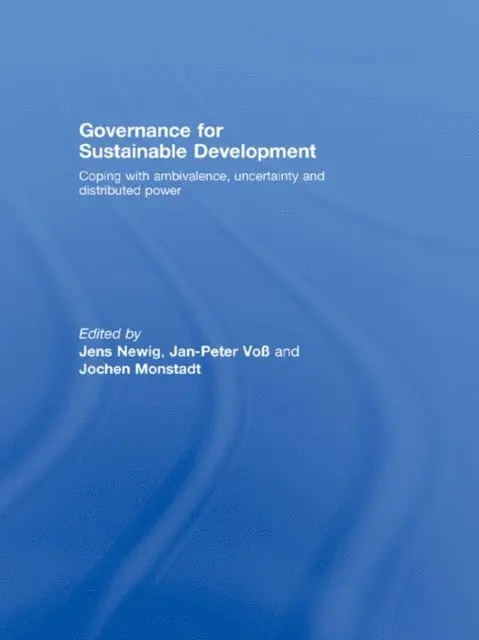
Sustainable development stirs up debate about the capacities of political steering and governance. The complexity of the task expounds limits of steering in three dimensions: goals, knowledge, and power: Sustainability goals are subject to changing and controversial risk perceptions, values and interests. Moreover, knowledge of the coupled dynamics of society, technology and nature is limited. Finally, the power to shape structural change in society and technology is distributed across a multitude of actors and societal subsystems. Steering attempts therefore have to cope with conflict and ambivalence, with uncertainty, and with a lack of central control; and they have to face the necessity of coordinating different actor groups and social networks.
This volume explores steering strategies and governance arrangements for sustainable development with a view to these problem dimensions. The contributions by authors from various disciplines approach these challenges from different conceptual angles, ranging from positivist, managerial up to post-modern, constructivist perspectives. By combining theoretical reflections with insights from empirical research in European and American contexts, the volume maps out conditions and identifies approaches which both reflect the limits of steering and reveal options for constructively taking up the task of sustainable development in science and practice.
779 kr
Läs direkt efter köp
Sustainable development stirs up debate about the capacities of political steering and governance. The complexity of the task expounds limits of steering in three dimensions: goals, knowledge, and power: Sustainability goals are subject to changing and controversial risk perceptions, values and interests. Moreover, knowledge of the coupled dynamics of society, technology and nature is limited. Finally, the power to shape structural change in society and technology is distributed across a multitude of actors and societal subsystems. Steering attempts therefore have to cope with conflict and ambivalence, with uncertainty, and with a lack of central control; and they have to face the necessity of coordinating different actor groups and social networks.
This volume explores steering strategies and governance arrangements for sustainable development with a view to these problem dimensions. The contributions by authors from various disciplines approach these challenges from different conceptual angles, ranging from positivist, managerial up to post-modern, constructivist perspectives. By combining theoretical reflections with insights from empirical research in European and American contexts, the volume maps out conditions and identifies approaches which both reflect the limits of steering and reveal options for constructively taking up the task of sustainable development in science and practice.
443 kr
Läs direkt efter köp
The authors assert that sustainability is not a defined end-state, but should be understood as the capacity of society to learn about the conditions of its future existence and wants. This requires, in their view, a specific kind of problem solving framework which emphasises the interlinkage of problems and scales, as well as long-term and indirect effects of various actions. Sustainability calls for new forms of governance with attention given to uncertainty, ambivalence about multiple goals and distributed power. The book develops an alternative framework with which to address the challenge of sustainability and derives a set of strategy elements for dealing with sustainability in practice. These are discussed from conceptual as well as practical perspectives.
Bringing recent insights from innovation research, governance studies and complexity theory in common focus, Reflexive Governance for Sustainable Development will be of great interest to researchers in social change, innovation and governance studies, as well as policymakers confronted with sustainable development issues.
1 977 kr
Läs direkt efter köp
794 kr
Läs direkt efter köp
1 977 kr
Läs direkt efter köp
Innovation is key to achieving a sustainable electricity system. New technologies and organizational changes can bring about more sustainable, climate-friendly electricity structures. Yet the dynamics of innovation are complex, and difficult to shape. This book, written by experts in the field, sets out to explore the dynamics, the drivers and the setting of innovation processes. Case studies on micro cogeneration, carbon capture and storage, consumer feedback, network regulation and emissions trading provide insights into innovation dynamics in the electricity system and are analyzed to derive strategic implications for innovation policies. A special focus is placed on drivers and barriers of change, and their consequences for shaping the innovation process. This book is an indispensable source of information for researchers and decision makers in energy and climate change as well as for lecturers and students interested in the principles and ramifications of electricity innovation dynamics.
578 kr
Skickas inom 3-6 vardagar