János Gács - Böcker
Visar alla böcker från författaren János Gács. Handla med fri frakt och snabb leverans.
4 produkter
4 produkter
551 kr
Skickas inom 10-15 vardagar
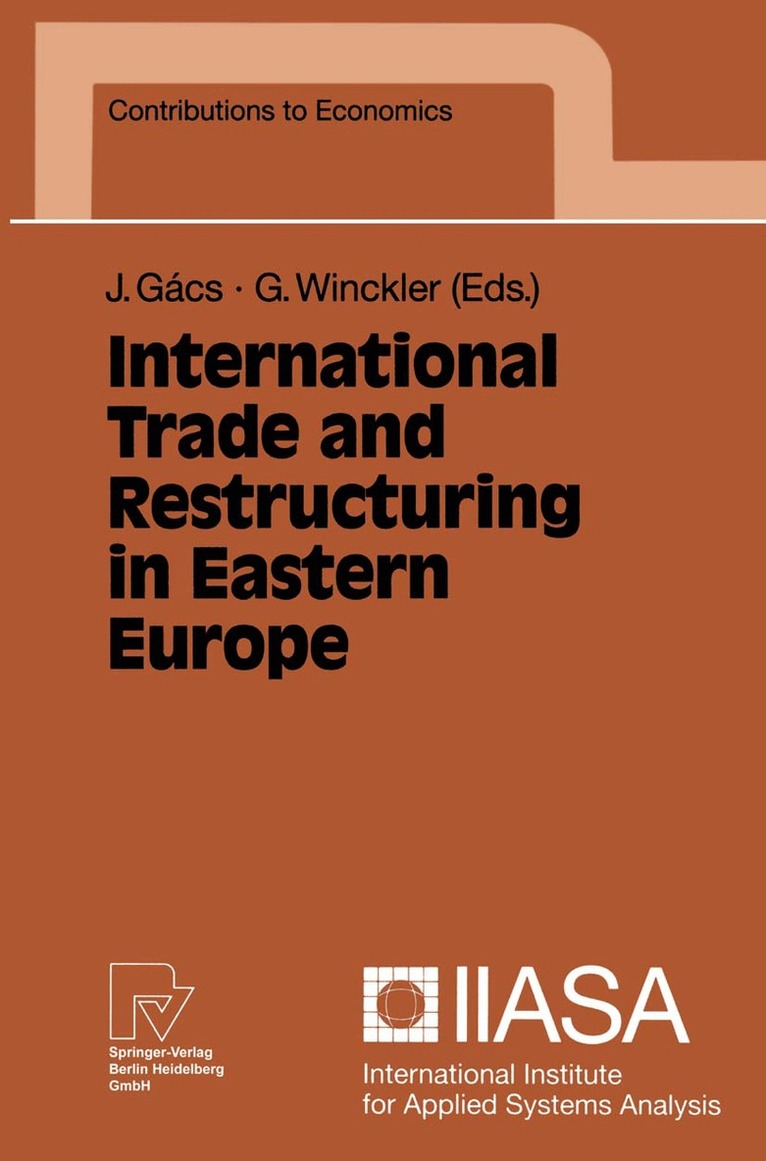
J anos Gaes and Georg Winekler In recognition of the key position of international trade in the transition and the need for concentrated discussions of topical trade issues the International Institute for Applied Systems Analysis (IIASA) organized an international conference on "International Trade and Restructuring in Eastern Europe" which took place in Laxenburg, Austria, on 19 and 21 November 1992. The Austrian National Bank joined IIASA to co-sponsor the event. Participants of the conference were experts of international economics and trade policy from East and West, policy makers, and representatives of international organizations like the IMF, the Commission of the European Communities, the OECD, and the European Bank for Reconstruction and Development (EBRD). The papers prepared for the event and the lively discussions during the conference itself prove that the topics are intellectually challenging and timely for policy makers. It has widely been recognized that international economic relations play a crucial role in the transition of count ries of Central and Eastern Europe. The scope, speed, and success of the efforts to transform the formerly cen trally planned economies to market economies have increasingly become de pendent on the pattern these count ries have in their relation to the rest of the world. Transition comprises three major processes: macro-stabilization, mar ketization, and restructuring. The success of these three hinges to a large extent on the response of these economies to the new conditions set by international trade and exchange regimes.
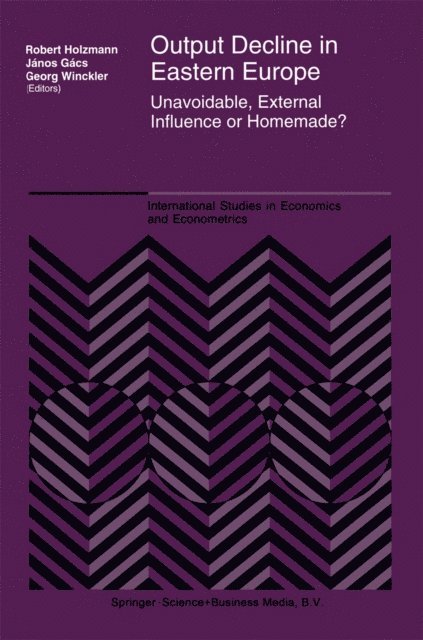
Output Decline in Eastern Europe
Unavoidable, External Influence or Homemade?
Inbunden, Engelska, 1995
1 204 kr
Skickas inom 10-15 vardagar
The first phase of transition to a market economy in Central and Eastern Europe was characterized by a sharp decline in output. The fall in real GDP exceeded 20% while real industrial production even decreased by 40%. This text provides comprehensive multi-factor explanations for this unique and painful experience. Various hypotheses are analyzed: credit and fiscal policies may have been too tight; the collapse of the CMEA and the USSR came as a shock; domestic producers were neither experienced, nor flexible enough to adjust the output to new patterns of demand. It contains a combination of authors from East and West who have extensively analyzed new data based on national studies. If we can understand the causes of recent output decline then we can hope to assess the prospects for Eastern Europe. The book is intended for researchers and students as well as interested officials who deal with the transition of formerly centrally planned economies in Central and Eastern Europe.
Mixed Blessing of Financial Inflows
Transition Countries in Comparative Perspective
Inbunden, Engelska, 1999
1 923 kr
Skickas inom 7-10 vardagar
The successful macroeconomic stabilization in Central and Eastern European countries has encouraged inflows of foreign capital badly needed to promote economic development. Strikingly, these countries have found capital inflows in their various forms to be a mixed blessing, threatening the macroeconomic balance that they have recently achieved. These countries have learned that it is not easy to continue to attract foreign capital and simultaneously to reduce its adverse effects on inflation, the exchange rate and the current account, and to contain disturbances resulting from reversals of the flows. This book investigates recent experiences in Central and Eastern Europe and contrasts it with that of Latin America and East Asia, and suggests appropriate policies and lessons to be learned. The authors conclude that many features of, and policy dilemmas faced by, formerly centrally planned economies in Europe are similar to those in other emerging economies. However, certain unique characteristics such as data limitations and the fragility of the banking and financial systems, compound the problems faced by policy makers in Central and Eastern Europe.This book will prove invaluable to policymakers and scholars interested in and responsible for international finance in transition economies.
1 064 kr
Skickas inom 10-15 vardagar
The first phase of transition to a market economy in Central and Eastern Europe was characterized by a sharp output decline. The fall in real GDP exceeded 20% while real industrial production decreased even by 40%. Output Decline in Eastern Europe aims at providing comprehensive, multi-factor explanations for this unique, painful experience. Various hypotheses are analyzed: credit and fiscal policies may have been too tight; the collapse of the CMEA and the USSR came as a shock; domestic producers were neither experienced, nor flexible enough to adjust the output to new patterns of demand. Output Decline in Eastern Europe contains a unique combination of authors from East and West who extensively analyze new data based on country studies. Understanding the causes of recent output decline, the subject matter of this volume may help to assess the prospects for Eastern Europe. The book is addressed to researchers and students as well as interested officials who deal with the transition of formerly centrally planned economies in Central and Eastern Europe.