Jari Saramäki – författare
Visar alla böcker från författaren Jari Saramäki. Handla med fri frakt och snabb leverans.
6 produkter
6 produkter
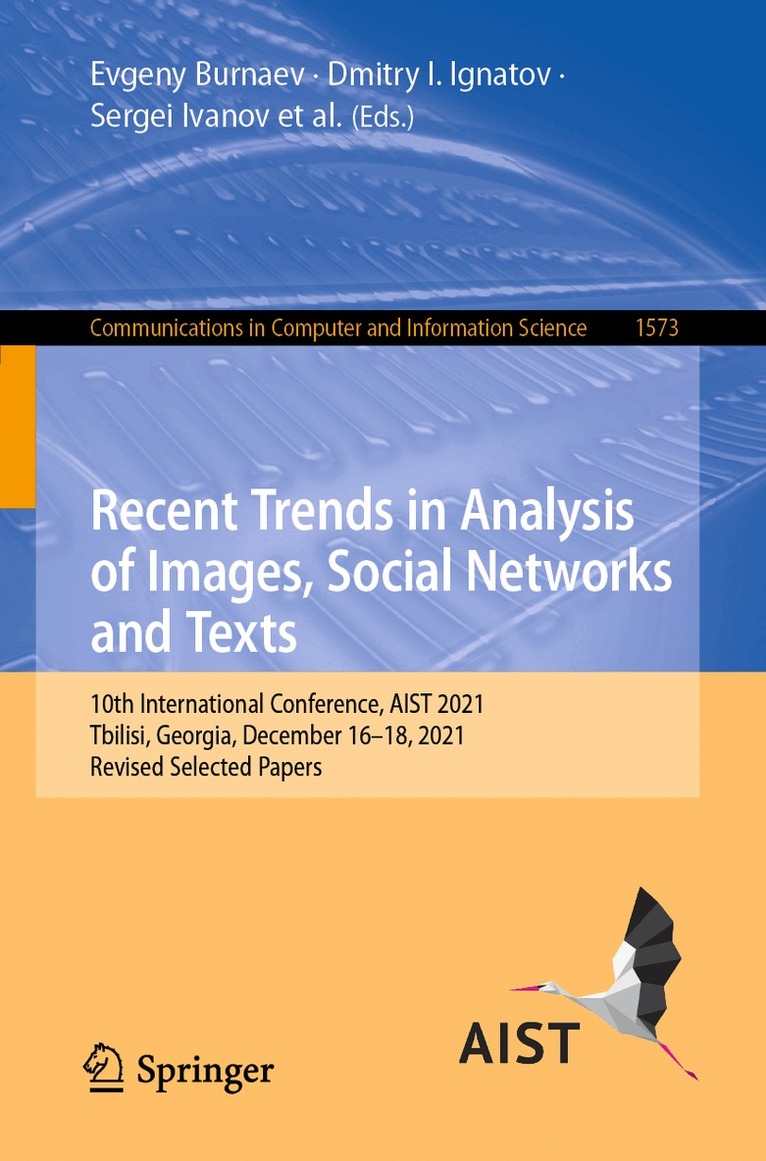
Del 1573 - Communications in Computer and Information Science
Recent Trends in Analysis of Images, Social Networks and Texts
10th International Conference, AIST 2021, Tbilisi, Georgia, December 16–18, 2021, Revised Selected Papers
Häftad, Engelska, 2022
839 kr
Skickas inom 10-15 vardagar
This book constitutes revised selected papers of the 10th International Conference on Analysis of Images, Social Networks and Texts, AIST 2021, held in Tbilisi, Georgia, in December 2021. Due to the COVID-19 pandemic the conference was held in hybrid mode. The 17 full papers were carefully reviewed and selected from 118 submissions, out of which 92 were sent to peer review. The papers are organized in topical sections on natural language processing; computer vision; data analysis and machine learning; social network analysis; theoretical machine learning and optimisation.
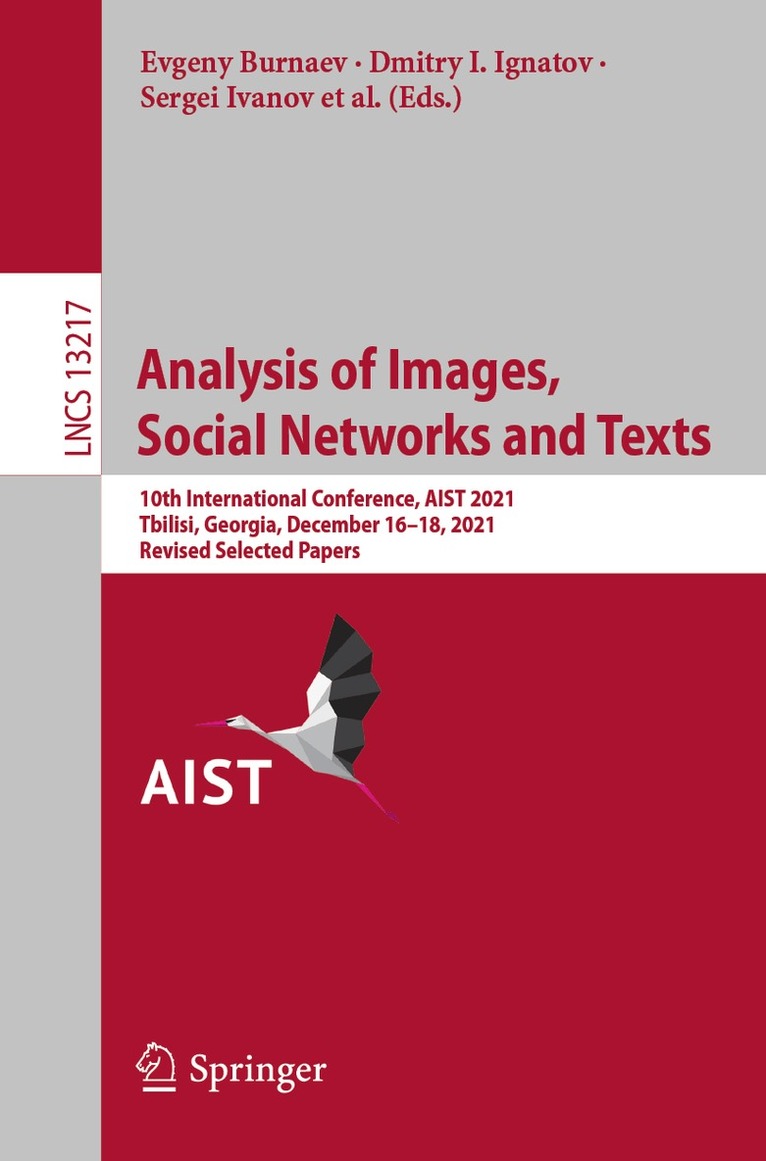
Del 13217 - Lecture Notes in Computer Science
Analysis of Images, Social Networks and Texts
10th International Conference, AIST 2021, Tbilisi, Georgia, December 16–18, 2021, Revised Selected Papers
Häftad, Engelska, 2022
839 kr
Skickas inom 10-15 vardagar
This book constitutes revised selected papers from the thoroughly refereed proceedings of the 10th International Conference on Analysis of Images, Social Networks and Texts, AIST 2021, held in Tbilisi, Georgia, during December 16–18, 2021. The 20 full papers and 5 short papers included in this book were carefully reviewed and selected from 118 submissions. They were organized in topical sections as follows: Invited papers; natural language processing; computer vision; data analysis and machine learning; social network analysis; and theoretical machine learning and optimization.
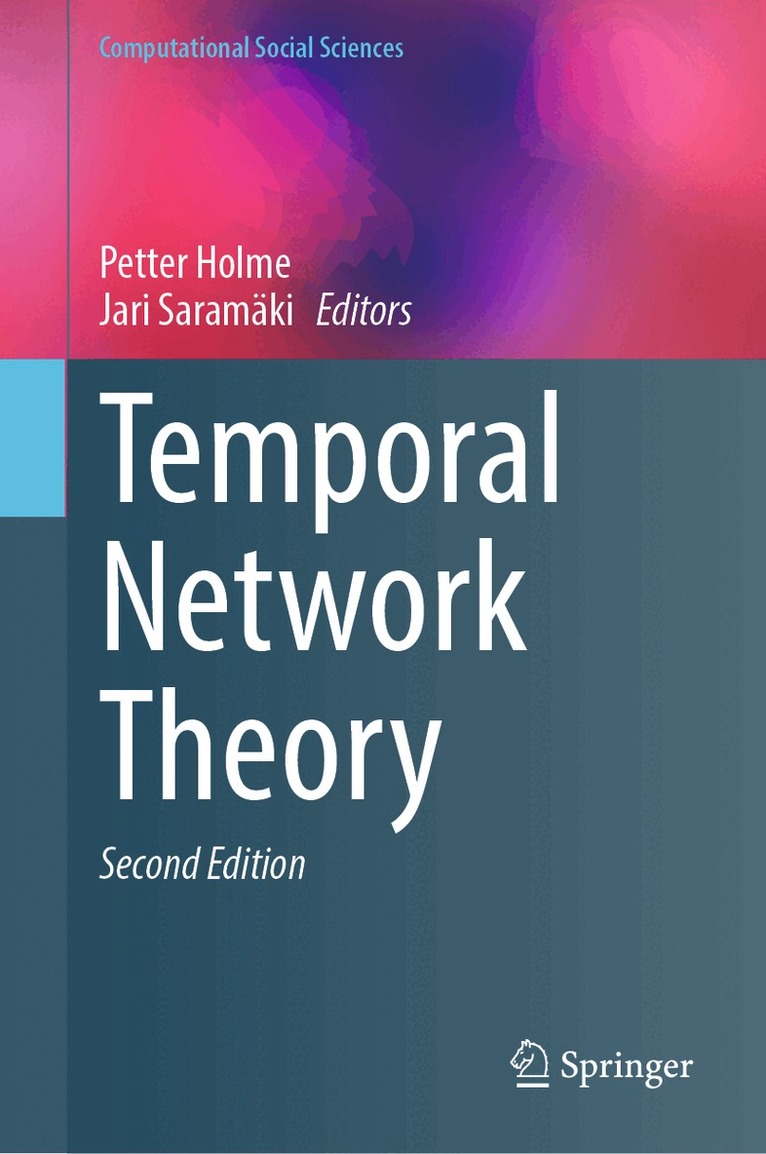
Inbunden, Engelska, 2023
1 623 kr
Skickas inom 10-15 vardagar
This book focuses on the theoretical side of temporal network research and gives an overview of the state of the art in the field. Curated by two pioneers in the field who have helped to shape it, the book contains contributions from many leading researchers. Temporal networks fill the border area between network science and time-series analysis and are relevant for epidemic modeling, optimization of transportation and logistics, as well as understanding biological phenomena.Over the past 20 years, network theory has proven to be one of the most powerful tools for studying and analyzing complex systems. Temporal network theory is perhaps the most recent significant development in the field in recent years, with direct applications to many of the “big data” sets. This book appeals to students, researchers, and professionals interested in theory and temporal networks—a field that has grown tremendously over the last decade.This second edition of Temporal NetworkTheory extends the first with three chapters highlighting recent developments in the interface with machine learning.
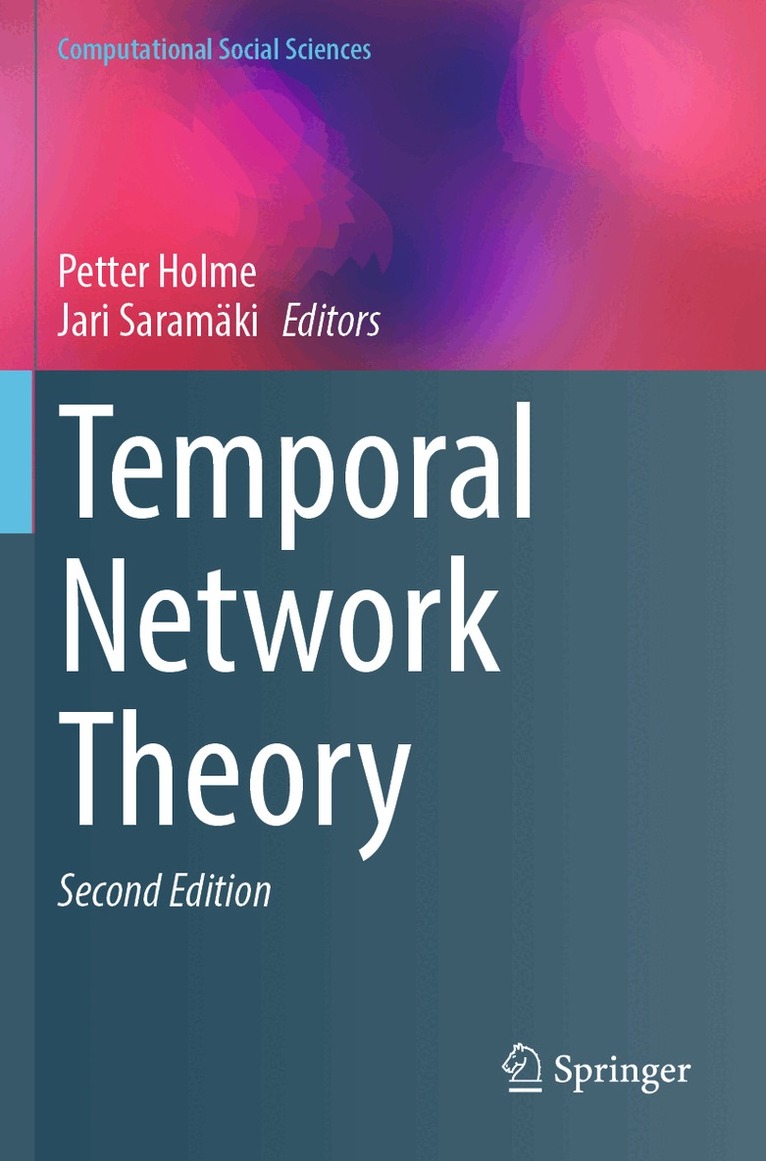
Häftad, Engelska, 2024
1 623 kr
Skickas inom 10-15 vardagar
This book focuses on the theoretical side of temporal network research and gives an overview of the state of the art in the field. Curated by two pioneers in the field who have helped to shape it, the book contains contributions from many leading researchers. Temporal networks fill the border area between network science and time-series analysis and are relevant for epidemic modeling, optimization of transportation and logistics, as well as understanding biological phenomena.Over the past 20 years, network theory has proven to be one of the most powerful tools for studying and analyzing complex systems. Temporal network theory is perhaps the most recent significant development in the field in recent years, with direct applications to many of the “big data” sets. This book appeals to students, researchers, and professionals interested in theory and temporal networks—a field that has grown tremendously over the last decade.This second edition of Temporal NetworkTheory extends the first with three chapters highlighting recent developments in the interface with machine learning.
Inbunden, Engelska, 2013
1 299 kr
Skickas inom 10-15 vardagar
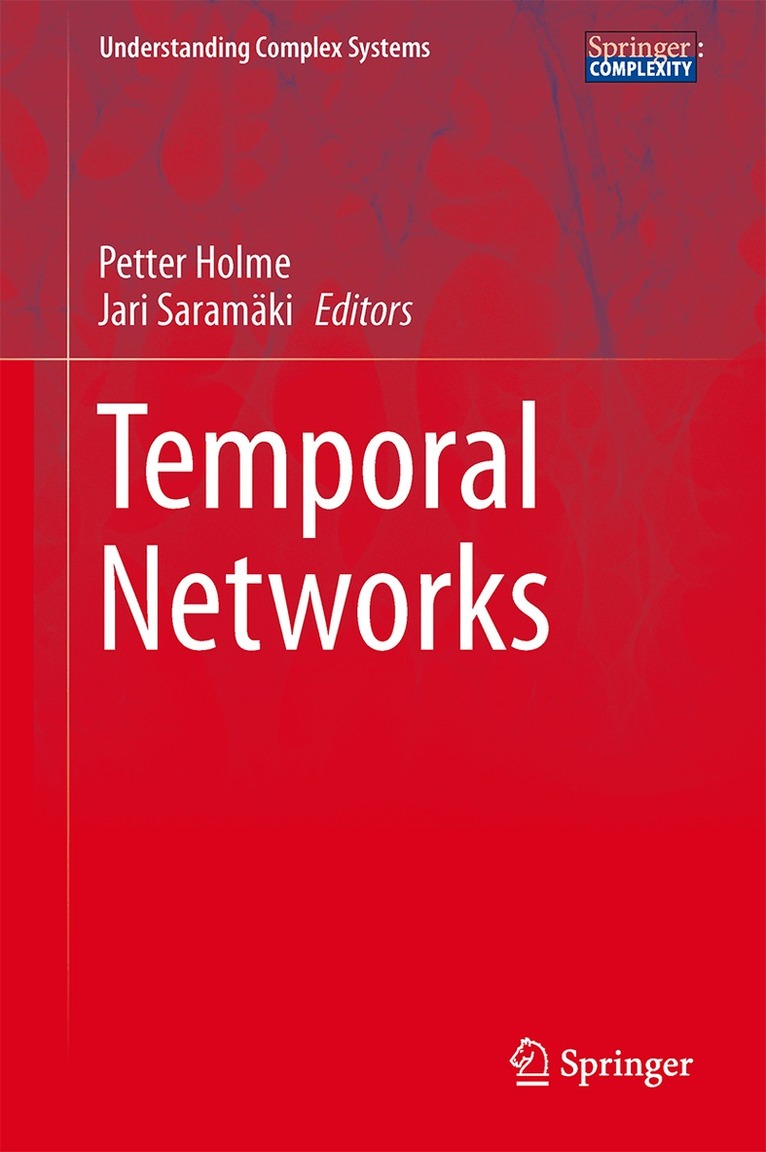
The concept of temporal networks is an extension of complex networks as a modeling framework to include information on when interactions between nodes happen. Many studies of the last decade examine how the static network structure affect dynamic systems on the network. In this traditional approach the temporal aspects are pre-encoded in the dynamic system model. Temporal-network methods, on the other hand, lift the temporal information from the level of system dynamics to the mathematical representation of the contact network itself. This framework becomes particularly useful for cases where there is a lot of structure and heterogeneity both in the timings of interaction events and the network topology. The advantage compared to common static network approaches is the ability to design more accurate models in order to explain and predict large-scale dynamic phenomena (such as, e.g., epidemic outbreaks and other spreading phenomena). On the other hand, temporal networkmethods are mathematically and conceptually more challenging. This book is intended as a first introduction and state-of-the art overview of this rapidly emerging field.
Häftad, Engelska, 2015
922 kr
Skickas inom 10-15 vardagar
The concept of temporal networks is an extension of complex networks as a modeling framework to include information on when interactions between nodes happen. Many studies of the last decade examine how the static network structure affect dynamic systems on the network. In this traditional approach the temporal aspects are pre-encoded in the dynamic system model. Temporal-network methods, on the other hand, lift the temporal information from the level of system dynamics to the mathematical representation of the contact network itself. This framework becomes particularly useful for cases where there is a lot of structure and heterogeneity both in the timings of interaction events and the network topology. The advantage compared to common static network approaches is the ability to design more accurate models in order to explain and predict large-scale dynamic phenomena (such as, e.g., epidemic outbreaks and other spreading phenomena). On the other hand, temporal networkmethods are mathematically and conceptually more challenging. This book is intended as a first introduction and state-of-the art overview of this rapidly emerging field.