JC Gaillard – författare
Visar alla böcker från författaren JC Gaillard. Handla med fri frakt och snabb leverans.
19 produkter
19 produkter
Häftad, Engelska, 2020
680 kr
Skickas inom 10-15 vardagar
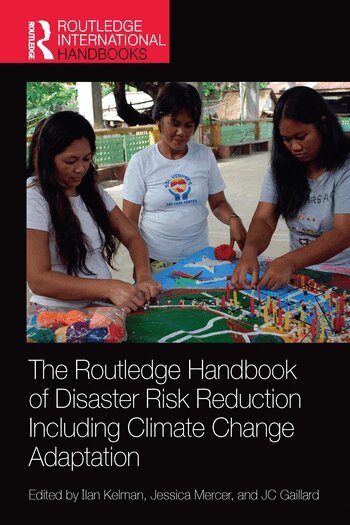
The Routledge Handbook of Disaster Risk Reduction Including Climate Change Adaptation aims to provide an overview and critique of the current state of knowledge, policy, and practice, encouraging engagement, and reflection on bringing the two sectors together. This long-awaited and welcomed volume makes a compelling case that a common research agenda and a series of practical policies and policy recommendations can and should be put in place.Over 40 contributions explore DRR including CCA in five parts. The first part presents and interrogates much of the typical vocabulary seen in DRR including CCA, not only pointing out the useful and not-so-useful dimensions, but also providing alternatives and positive examples. The second part explains how to move forward creating and supporting positive crossovers and connections, while the third one explores some aspects of multi-dimensional approaches to knowing and understanding. The fourth part argues for a balanced approach to governance, taking both governmental and non-governmental governance, as well as different scales of governance, into consideration. The final part of the Handbook emphasises DRR including CCA as an investment, rather than a cost, and connects its further implementation with livelihoods of people around the world.This handbook highlights the connections amongst the processes of dealing with disasters and dealing with climate change. It demonstrates how little climate change brings which is new and emphasises the strengths of placing climate change within wider contexts in order to draw on all our strengths while overcoming limitations with specialities. It will prove to be a valuable guide for graduate and advanced undergraduate students, academics, policy makers, and practitioners with an interest in disaster risk reduction and climate change.
Häftad, Engelska, 2011
1 093 kr
Skickas inom 10-15 vardagar
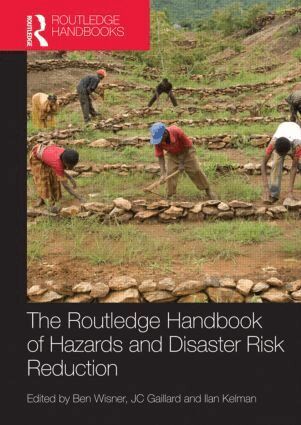
The Handbook provides a comprehensive statement and reference point for hazard and disaster research, policy making, and practice in an international and multi-disciplinary context. It offers critical reviews and appraisals of current state of the art and future development of conceptual, theoretical and practical approaches as well as empirical knowledge and available tools.Organized into five inter-related sections, this Handbook contains sixty-five contributions from leading scholars. Section one situates hazards and disasters in their broad political, cultural, economic, and environmental context. Section two contains treatments of potentially damaging natural events/phenomena organized by major earth system. Section three critically reviews progress in responding to disasters including warning, relief and recovery. Section four addresses mitigation of potential loss and prevention of disasters under two sub-headings: governance, advocacy and self-help, and communication and participation. Section five ends with a concluding chapter by the editors.The engaging international contributions reflect upon the politics and policy of how we think about and practice applied hazard research and disaster risk reduction. This Handbook provides a wealth of interdisciplinary information and will appeal to students and practitioners interested in Geography, Environment Studies and Development Studies.
Inbunden, Engelska, 2011
3 786 kr
Skickas inom 10-15 vardagar
The Handbook provides a comprehensive statement and reference point for hazard and disaster research, policy making, and practice in an international and multi-disciplinary context. It offers critical reviews and appraisals of current state of the art and future development of conceptual, theoretical and practical approaches as well as empirical knowledge and available tools.Organized into five inter-related sections, this Handbook contains sixty-five contributions from leading scholars. Section one situates hazards and disasters in their broad political, cultural, economic, and environmental context. Section two contains treatments of potentially damaging natural events/phenomena organized by major earth system. Section three critically reviews progress in responding to disasters including warning, relief and recovery. Section four addresses mitigation of potential loss and prevention of disasters under two sub-headings: governance, advocacy and self-help, and communication and participation. Section five ends with a concluding chapter by the editors.The engaging international contributions reflect upon the politics and policy of how we think about and practice applied hazard research and disaster risk reduction. This Handbook provides a wealth of interdisciplinary information and will appeal to students and practitioners interested in Geography, Environment Studies and Development Studies.
Häftad, Engelska, 2014
735 kr
Skickas inom 10-15 vardagar
There is a perennial gap between theory and practice, between academia and active professionals in the field of disaster management. This gap means that valuable lessons are not learned and people die or suffer as a result. This book opens a dialogue between theory and practice. It offers vital lessons to practitioners from scholarship on natural hazards, disaster risk management and reduction and developments studies, opening up new insights in accessible language with practical applications. It also offers to academics the insights of the enormous experience practitioners have accumulated, highlighting gaps in research and challenging assumptions and theories against the reality of experience. Disaster Management covers issues in all phases of the disaster cycle: preparedness, prevention, response and recovery. It also addresses cross-cutting issues including political, economic and social factors that influence differential vulnerability, and key areas of practice such as vulnerability mapping, early warning, infrastructure protection, emergency management, reconstruction, health care and education, and gender issues. The team of international authors combine their years of experience in research and the field to offer vital lessons for practitioners, academics and students alike.
Häftad, Engelska, 2023
584 kr
Skickas inom 10-15 vardagar
This theoretical contribution argues that the domination of Western knowledge in disaster scholarship has allowed normative policies and practices of disaster risk reduction to be imposed all over the world. It takes a postcolonial approach to unpack why scholars claim that disasters are social constructs while offering little but theories, concepts and methods supposed to be universal in understanding the unique and diverse experiences of millions of people across very different cultures. It further challenges forms of governments inherited from the Enlightenment that have been rolled out as standard and ultimate solutions to reduce the risk of disaster. Ultimately, the book encourages the emergence of a more diverse set of world views/senses and ways of knowing for both studying disasters and informing policy and practice of disaster risk reduction. Such pluralism is essential to better reflect local realities of what disasters actually are around the world.This book is an essential read for scholars and postgraduate students interested in disaster studies as well as policy-makers and practitioners of disaster risk reduction.
Inbunden, Engelska, 2025
2 137 kr
Skickas inom 10-15 vardagar
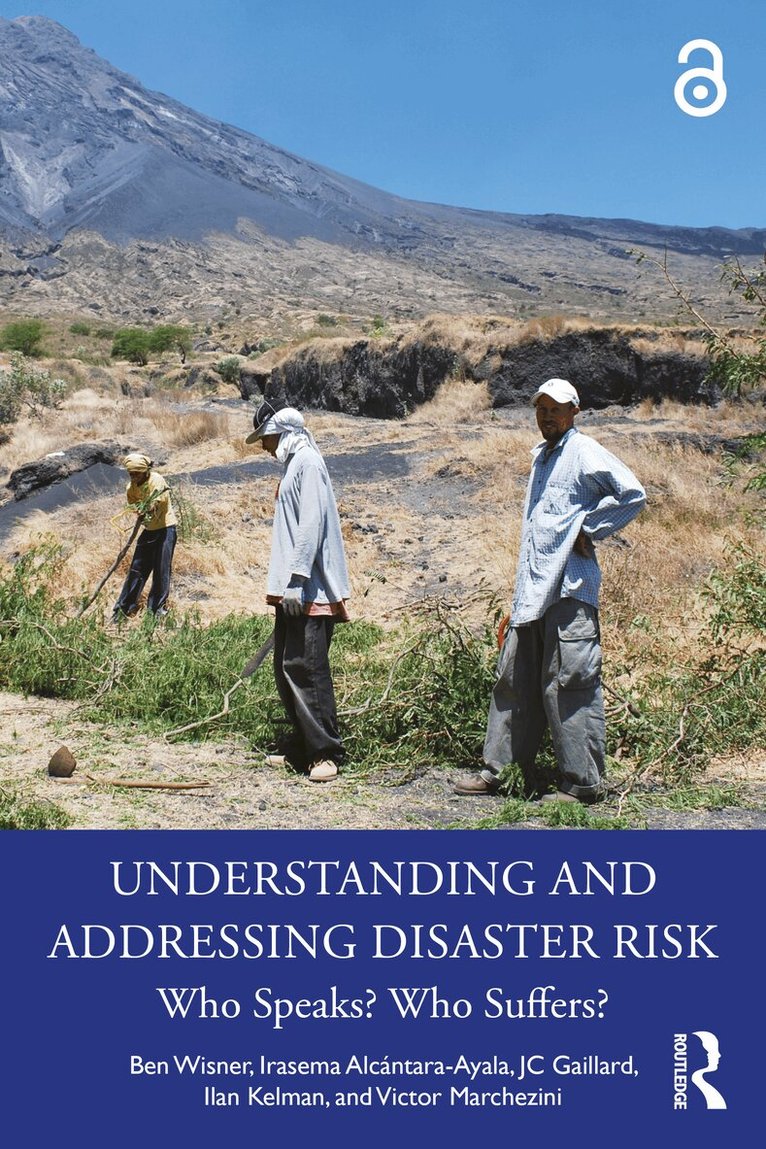
In Understanding and Addressing Disaster Risk, the authors explain how people modify the environment and exert power over each other in ways that make nature potentially harmful and put people in harm’s way. Opportunities and challenges faced by those engaging with disaster risk are explored.Across 11 chapters, the authors show that disasters are not natural, are not events, and do not happen quickly. Instead, they are the result of chronic societal processes emerging from the creation and perpetuation of vulnerabilities and limitations on people’s abilities to respond to hazards. The book also explores the environmental component of disaster risk through the lens of different natural elements and phenomena, including biological-ecological and water-weather-climate processes as well as geological and outer space dynamics. The authors explain the mutual influence of the different components of disasters in creating disaster risk across diverse regions of the world. They critique attempts to reduce disaster risk through top-down, siloed assumptions, attitudes, and values. The value of people’s knowledge of hazards – often ignored or dismissed by authorities – is a central theme. This book is original because of how it re-interprets and advances understanding of the disaster process through the study of such societal processes of vulnerability, risk creation, and power imbalances. It is also unique in diving further into “root causes” of disaster in order to place them within local histories and colonial legacies as well as contemporary, typically misdirected, agendas while upending previous “solutions” which have been shown to do more harm than good.Understanding and Addressing Disaster Risk is useful for and useable by decision-makers, policy makers, researchers, and students to shatter the vicious cycle of repeating known mistakes which compound detrimental outcomes.The Open Access version of this book, available at www.taylorfrancis.com, has been made available under a Creative Commons Attribution-Non Commercial-No Derivatives (CC-BY-NC-ND) 4.0 International license.
Häftad, Engelska, 2025
584 kr
Skickas inom 10-15 vardagar
In Understanding and Addressing Disaster Risk, the authors explain how people modify the environment and exert power over each other in ways that make nature potentially harmful and put people in harm’s way. Opportunities and challenges faced by those engaging with disaster risk are explored.Across 11 chapters, the authors show that disasters are not natural, are not events, and do not happen quickly. Instead, they are the result of chronic societal processes emerging from the creation and perpetuation of vulnerabilities and limitations on people’s abilities to respond to hazards. The book also explores the environmental component of disaster risk through the lens of different natural elements and phenomena, including biological-ecological and water-weather-climate processes as well as geological and outer space dynamics. The authors explain the mutual influence of the different components of disasters in creating disaster risk across diverse regions of the world. They critique attempts to reduce disaster risk through top-down, siloed assumptions, attitudes, and values. The value of people’s knowledge of hazards – often ignored or dismissed by authorities – is a central theme. This book is original because of how it re-interprets and advances understanding of the disaster process through the study of such societal processes of vulnerability, risk creation, and power imbalances. It is also unique in diving further into “root causes” of disaster in order to place them within local histories and colonial legacies as well as contemporary, typically misdirected, agendas while upending previous “solutions” which have been shown to do more harm than good.Understanding and Addressing Disaster Risk is useful for and useable by decision-makers, policy makers, researchers, and students to shatter the vicious cycle of repeating known mistakes which compound detrimental outcomes.The Open Access version of this book, available at www.taylorfrancis.com, has been made available under a Creative Commons Attribution-Non Commercial-No Derivatives (CC-BY-NC-ND) 4.0 International license.
Inbunden, Engelska, 2026
2 137 kr
Skickas inom 10-15 vardagar
Reimagining Disasters builds on the momentum gained by the 2019 Disaster Studies Manifesto, which aims to inspire and inform more respectful, reciprocal and genuine relationships between home and visiting researchers in disaster studies. The book challenges normative understandings of disaster and moves away from the hegemony of Western ontologies and epistemologies in understanding harm, hardship and suffering, that is, what we usually call ‘disaster’.It consists of one theoretical chapter and five case studies from Chile, the Philippines, Zimbabwe, India and Nepal. The initial theoretical chapter revisits and contests the concept of ‘natural hazard’ as an underpinning and universal prerequisite for disasters to occur. The subsequent empirical studies led by home and indigenous scholars draw upon local concepts and methodologies to revisit, challenge and contest the concept of ‘disaster’ and how people experience hardship, harm and suffering.Overall, this book shows that it is possible to conduct more just, grounded and relevant disaster studies that reflect local perspectives and priorities and challenge the established notions of power. It is an essential read for students and scholars interested in disaster and postcolonial studies.
Häftad, Engelska, 2026
584 kr
Skickas inom 10-15 vardagar
Reimagining Disasters builds on the momentum gained by the 2019 Disaster Studies Manifesto, which aims to inspire and inform more respectful, reciprocal and genuine relationships between home and visiting researchers in disaster studies. The book challenges normative understandings of disaster and moves away from the hegemony of Western ontologies and epistemologies in understanding harm, hardship and suffering, that is, what we usually call ‘disaster’.It consists of one theoretical chapter and five case studies from Chile, the Philippines, Zimbabwe, India and Nepal. The initial theoretical chapter revisits and contests the concept of ‘natural hazard’ as an underpinning and universal prerequisite for disasters to occur. The subsequent empirical studies led by home and indigenous scholars draw upon local concepts and methodologies to revisit, challenge and contest the concept of ‘disaster’ and how people experience hardship, harm and suffering.Overall, this book shows that it is possible to conduct more just, grounded and relevant disaster studies that reflect local perspectives and priorities and challenge the established notions of power. It is an essential read for students and scholars interested in disaster and postcolonial studies.
Inbunden, Engelska, 2025
2 137 kr
Skickas inom 10-15 vardagar
This book is a festschrift in tribute to Ben Wisner’s contributions to disaster studies and adjacent fields of scholarship such as political ecology, development and sustainability.This festschrift for Ben, and so The Benschrift, revitalises, promotes and critiques a selection of six foundational articles that span Ben’s 50-year career. Each article is reproduced integrally and followed by a commentary by an expert in the field and a response from Ben. As a result, this book not only introduces a lifetime’s work to the latest generation of researchers; it also contributes a meaningful dialogue across decades of scholarship, expressing contemporary reflections alongside the understanding of how to engage with and improve past research. Two fundamental truths stand out: the value of local knowledge and the necessity of seeking root causes and radical solutions.This book is an essential read for students, researchers, policy makers and practitioners interested in the development and evolution of disaster scholarship, political ecology, development and sustainability studies.
Häftad, Engelska, 2025
584 kr
Skickas inom 10-15 vardagar
This book is a festschrift in tribute to Ben Wisner’s contributions to disaster studies and adjacent fields of scholarship such as political ecology, development and sustainability.This festschrift for Ben, and so The Benschrift, revitalises, promotes and critiques a selection of six foundational articles that span Ben’s 50-year career. Each article is reproduced integrally and followed by a commentary by an expert in the field and a response from Ben. As a result, this book not only introduces a lifetime’s work to the latest generation of researchers; it also contributes a meaningful dialogue across decades of scholarship, expressing contemporary reflections alongside the understanding of how to engage with and improve past research. Two fundamental truths stand out: the value of local knowledge and the necessity of seeking root causes and radical solutions.This book is an essential read for students, researchers, policy makers and practitioners interested in the development and evolution of disaster scholarship, political ecology, development and sustainability studies.
Inbunden, Engelska, 2022
1 656 kr
Skickas inom 10-15 vardagar
The text offers a comprehensive and unique perspective on disaster risk associated with natural hazards. It covers a wide range of topics, reflecting the most recent debates but also older and pioneering discussions in the academic field of disaster studies as well as in the policy and practical areas of disaster risk reduction (DRR). This book will be of particular interest to undergraduate students studying geography and environmental studies/science. It will also be of relevance to students/professionals from a wide range of social and physical science disciplines, including public health and public policy, sociology, anthropology, political science and geology.
Häftad, Engelska, 2022
543 kr
Skickas inom 10-15 vardagar
The text offers a comprehensive and unique perspective on disaster risk associated with natural hazards. It covers a wide range of topics, reflecting the most recent debates but also older and pioneering discussions in the academic field of disaster studies as well as in the policy and practical areas of disaster risk reduction (DRR). This book will be of particular interest to undergraduate students studying geography and environmental studies/science. It will also be of relevance to students/professionals from a wide range of social and physical science disciplines, including public health and public policy, sociology, anthropology, political science and geology.
Inbunden, Engelska, 2021
2 137 kr
Skickas inom 10-15 vardagar
This theoretical contribution argues that the domination of Western knowledge in disaster scholarship has allowed normative policies and practices of disaster risk reduction to be imposed all over the world. It takes a postcolonial approach to unpack why scholars claim that disasters are social constructs while offering little but theories, concepts and methods supposed to be universal in understanding the unique and diverse experiences of millions of people across very different cultures. It further challenges forms of governments inherited from the Enlightenment that have been rolled out as standard and ultimate solutions to reduce the risk of disaster. Ultimately, the book encourages the emergence of a more diverse set of world views/senses and ways of knowing for both studying disasters and informing policy and practice of disaster risk reduction. Such pluralism is essential to better reflect local realities of what disasters actually are around the world.This book is an essential read for scholars and postgraduate students interested in disaster studies as well as policy-makers and practitioners of disaster risk reduction.
Inbunden, Engelska, 2017
3 237 kr
Skickas inom 10-15 vardagar
The Routledge Handbook of Disaster Risk Reduction Including Climate Change Adaptation aims to provide an overview and critique of the current state of knowledge, policy, and practice, encouraging engagement, and reflection on bringing the two sectors together. This long-awaited and welcomed volume makes a compelling case that a common research agenda and a series of practical policies and policy recommendations can and should be put in place.Over 40 contributions explore DRR including CCA in five parts. The first part presents and interrogates much of the typical vocabulary seen in DRR including CCA, not only pointing out the useful and not-so-useful dimensions, but also providing alternatives and positive examples. The second part explains how to move forward creating and supporting positive crossovers and connections, while the third one explores some aspects of multi-dimensional approaches to knowing and understanding. The fourth part argues for a balanced approach to governance, taking both governmental and non-governmental governance, as well as different scales of governance, into consideration. The final part of the Handbook emphasises DRR including CCA as an investment, rather than a cost, and connects its further implementation with livelihoods of people around the world.This handbook highlights the connections amongst the processes of dealing with disasters and dealing with climate change. It demonstrates how little climate change brings which is new and emphasises the strengths of placing climate change within wider contexts in order to draw on all our strengths while overcoming limitations with specialities. It will prove to be a valuable guide for graduate and advanced undergraduate students, academics, policy makers, and practitioners with an interest in disaster risk reduction and climate change.
Inbunden, Engelska, 2013
2 138 kr
Skickas inom 10-15 vardagar
There is a perennial gap between theory and practice, between academia and active professionals in the field of disaster management. This gap means that valuable lessons are not learned and people die or suffer as a result. This book opens a dialogue between theory and practice. It offers vital lessons to practitioners from scholarship on natural hazards, disaster risk management and reduction and developments studies, opening up new insights in accessible language with practical applications. It also offers to academics the insights of the enormous experience practitioners have accumulated, highlighting gaps in research and challenging assumptions and theories against the reality of experience. Disaster Management covers issues in all phases of the disaster cycle: preparedness, prevention, response and recovery. It also addresses cross-cutting issues including political, economic and social factors that influence differential vulnerability, and key areas of practice such as vulnerability mapping, early warning, infrastructure protection, emergency management, reconstruction, health care and education, and gender issues. The team of international authors combine their years of experience in research and the field to offer vital lessons for practitioners, academics and students alike.
Inbunden, Engelska, 2016
1 605 kr
Skickas inom 10-15 vardagar
The goal of this book is to explore disaster risk reduction (DRR), migration, climate change adaptation (CCA) and sustainable development linkages from a number of different geographical, social and natural science angles. Well-known scientists and practitioners present different perspectives regarding these inter-linkages from around the world, with theoretical discussions as well as field observations. This publication contributes in particular to the discussion on the Sendai Framework for Disaster Risk Reduction (SFDRR) 2015-2030 and the debate about how to improve DRR, including CCA, policies and practices, taking into account migration processes from a large perspective where both natural and social factors are crucial and mutually “alloyed”. Some authors see the SFDRR as a positive step forward in terms of embracing a multitude of issues, others doubting that the agreement will lead to much concrete action toward real action on the ground. This book is a timely contribution for researchers, students and policy makers in the fields of environment, human geography, migration, disaster and climate change studies who seek a more comprehensive grasp of contemporary development issues.
Häftad, Engelska, 2018
1 605 kr
Skickas inom 10-15 vardagar
The goal of this book is to explore disaster risk reduction (DRR), migration, climate change adaptation (CCA) and sustainable development linkages from a number of different geographical, social and natural science angles.
Del 1 - World Scientific Book Series In Extreme Events
Risk Analyses And Actions: A Wspc Reference On Disasters And Dangers (In 4 Volumes)
Inbunden, Engelska, 2026
16 570 kr
Skickas inom 11-20 vardagar
Risk Analyses and Actions: A WSPC Reference on Disasters and Dangers, connects and integrates the perils, threats, exposures, and hazards that permeate humanity's existence on Planet Earth. The chapters bring together the difficulties and challenges faced by individuals and collectives — both hourly and across millennia — with outcomes often realized as disasters, emergencies, tragedies, calamities, crises, and catastrophes.The underlying ethos throughout, and the unifying theme across the four volumes, is that the vast majority of these problems are human-made and need not exist. Vulnerabilities are created, perpetuated, and sustained, rather than being tackled, managed, and reduced. The authors demonstrate how dangers and disasters are expressions of the actions and analyses that humanity fails to undertake in order to acknowledge, address, and rectify risks. They also show that when humanity chooses appropriate and proactive pathways, the rewards can be both immediate and long-lasting.Volume 1: Introduction to Principles and ConceptsThis volume introduces, explores, and critically examines key concepts and principles that underpin disaster scholarship and practice. It also challenges readers to reflect on ideas that are often overlooked or undervalued, encouraging engagement with creative and poetic interludes woven throughout the text. By inviting readers to look beyond conventional theories, concepts, and methods, the volume promotes a deeper appreciation of the unique and diverse experiences of people across different cultural and social contexts — highlighting that what is often assumed to be universal may not be so in practice.Volume 2: Policy and Governance in Preventing and Mitigating Disasters and DangersThis volume explores the diverse and interconnected approaches needed for effective policy and governance in addressing today's complex crises — ranging from climate change and natural hazards to conflict and epidemics. Featuring contributions from 31 experts, it presents a rich tapestry of perspectives on disaster risk governance, community resilience, migration, and legal frameworks. The chapters critically examine current practices, offering both foundational insights and bold critiques of existing systems. Common threads include the intersections of climate change with migration, disaster risk reduction, and human rights. Emphasizing inclusive, adaptable, and forward-thinking policy frameworks, this volume advocates for continuous innovation and responsiveness in managing emerging global risks.Volume 3: Actions Towards Disaster Risk ReductionThis volume foregrounds the complexity of local contexts, lived experiences, and diverse worldviews that shape how disasters are understood and addressed. It introduces readers to both longstanding and emerging challenges in disaster risk reduction (DRR), while outlining a range of tools, strategies, and approaches available for tackling them. Rather than offering one-size-fits-all solutions, the volume underscores the need for context-sensitive action, acknowledging potential obstacles to implementation. Serving as both a practical resource and a reflective guide, it calls for action rooted in inclusivity, adaptability, and respect for local realities — highlighting the importance of navigating complexity with clarity and care.Volume 4: Living in Anticipation of Disastrous Futures and Everyday Processes of Disaster Risk CreationThis final volume delves into how past and future disasters shape the present, focusing on the temporal dimensions of risk and vulnerability. It examines how societies anticipate crises, experience disaster temporalities, and live with the slow creation of everyday risk. Organized around four themes — Disastrous Futures and Anticipations, Disaster Temporalities, Disaster (Risk) and Everyday Life, and Processes of Disaster Risk — this collection reveals the intricate relationships between uncertainty, perception, and daily existence. Through conceptual analysis and case studies, the chapters challenge static notions of disaster and emphasize the entanglement of time, lived experience, and systemic risk. The volume offers critical insights for rethinking disaster readiness, response, and leadership in an era marked by compounding crises.This essential four-volume resource challenges conventional thinking about risk and resilience, offering new perspectives on how to better understand, analyze, and act in the face of uncertainty and danger.