Jean-François Laslier - Böcker
Visar alla böcker från författaren Jean-François Laslier. Handla med fri frakt och snabb leverans.
8 produkter
8 produkter
1 763 kr
Tillfälligt slut
This book presents a range of papers by philosophers and economists who consider the definition and value of liberty; freedom in rights and equality of opportunity. Until recently freedom has played no explicit role in the conceptual framework of economists, however freedom seems to be at the heart of economics. The book provides a substantial contribution to the fruitful dialogue between the philosophy and economics in this area. Each chapter is integrated being followed by comments which explore the underlying debates. Contributors are French economists, philosophers and political scientists, as well as authors from Belgium and the Netherlands.
749 kr
Skickas inom 10-15 vardagar
This book presents a range of papers by philosophers and economists who consider the definition and value of liberty; freedom in rights and equality of opportunity. Until recently freedom has played no explicit role in the conceptual framework of economists, however freedom seems to be at the heart of economics. The book provides a substantial contribution to the fruitful dialogue between the philosophy and economics in this area. Each chapter is integrated being followed by comments which explore the underlying debates. Contributors are French economists, philosophers and political scientists, as well as authors from Belgium and the Netherlands.
Future of Economic Design
The Continuing Development of a Field as Envisioned by Its Researchers
Inbunden, Engelska, 2019
1 798 kr
Skickas inom 10-15 vardagar
This collection of essays represents responses by over eighty scholars to an unusual request: give your high level assessment of the field of economic design, as broadly construed. Where do we come from? Where do we go from here? The book editors invited short, informal reflections expressing deeply felt but hard to demonstrate opinions, unsupported speculation, and controversial views of a kind one might not normally risk submitting for review. The contributors – both senior researchers who have shaped the field and promising, younger researchers – responded with a diverse collection of provocative pieces, including: retrospective assessments or surveys of the field; opinion papers; reflections on critical points for the development of the discipline; proposals for the immediate future; "science fiction"; and many more. The readers should have fun reading these unusual pieces – as much as the contributors enjoyed writing them.
Future of Economic Design
The Continuing Development of a Field as Envisioned by Its Researchers
Häftad, Engelska, 2020
1 798 kr
Skickas inom 10-15 vardagar
The contributors – both senior researchers who have shaped the field and promising, younger researchers – responded with a diverse collection of provocative pieces, including: retrospective assessments or surveys of the field;
1 133 kr
Skickas inom 10-15 vardagar
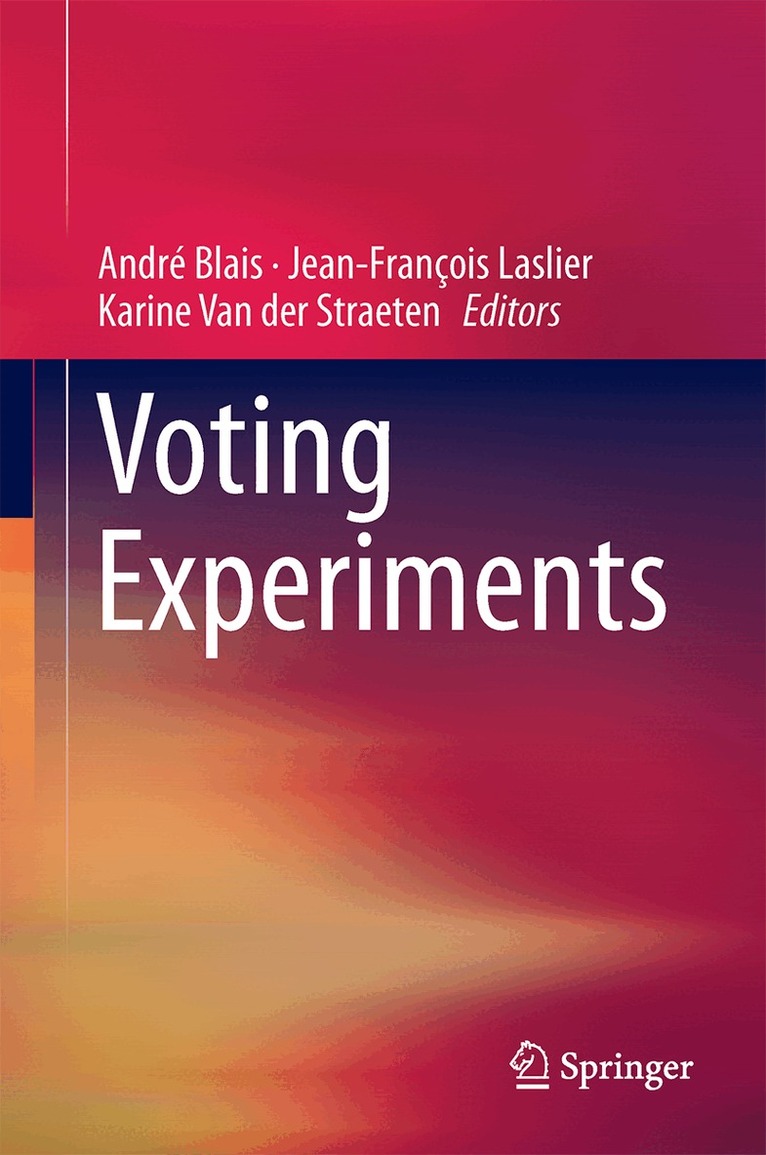
Experimental methods include laboratory experiments in the tradition of political psychology, laboratory experiments with monetary incentives, in the economic tradition, survey experiments (varying survey, question wording, framing or content), as well as various kinds of field experimentation.
1 166 kr
Skickas inom 10-15 vardagar
Experimental methods include laboratory experiments in the tradition of political psychology, laboratory experiments with monetary incentives, in the economic tradition, survey experiments (varying survey, question wording, framing or content), as well as various kinds of field experimentation.
1 798 kr
Skickas inom 10-15 vardagar
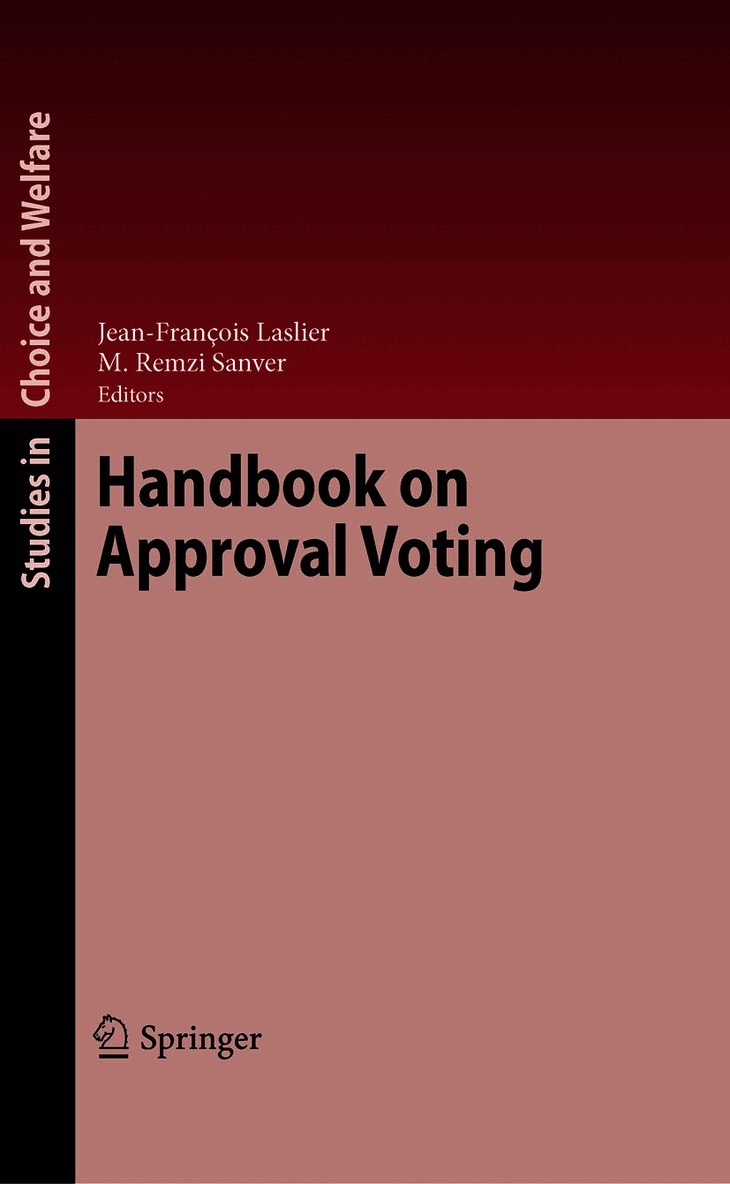
I am honoredto write a prefaceto this remarkablybroadand comprehensivevolume on approval voting (AV). It has been almost 35 years since Peter C. Fishburn and I met in 1976 and began research on AV. Besides my 30-year collaboration with Fishburn, I have collaborated with several other scholars - including D. Marc Kilgour,SamuelMerrill,JackH.Nagel,M.RemziSanver,andWilliamS.Zwicker- on AV-related research. Over these years there has been a profusion of articles and books reporting on empirical and theoretical aspects of AV and their normative implications. This volume touches on all aspects of this research and will be a very helpful sourcebook to scholars who want to carry this research forward. In Brams and Fishburn (1983/2007, p. 172), Fishburn and I were unabashed in our support of AV: Approval voting strikes at the heart of how political debate is resolved. It offers a new approach to the realization of democratic principles by rede ning what constitutes a de- cratic choice.Indeed, the foundation on which representative government is built is periodic elections, and the central problem of elections today is how to translate voter preferences, with as little distortion as possible, into consensus choices in multicandidate races. We believe that approval voting is the best practical way for amalgamating these preferences, fairlyand impartially,toproduce awinnerand thereby amelioratethemulticandateproblem.
1 798 kr
Skickas inom 10-15 vardagar
I am honoredto write a prefaceto this remarkablybroadand comprehensivevolume on approval voting (AV). It has been almost 35 years since Peter C. Fishburn and I met in 1976 and began research on AV. Besides my 30-year collaboration with Fishburn, I have collaborated with several other scholars - including D. Marc Kilgour,SamuelMerrill,JackH.Nagel,M.RemziSanver,andWilliamS.Zwicker- on AV-related research. Over these years there has been a profusion of articles and books reporting on empirical and theoretical aspects of AV and their normative implications. This volume touches on all aspects of this research and will be a very helpful sourcebook to scholars who want to carry this research forward. In Brams and Fishburn (1983/2007, p. 172), Fishburn and I were unabashed in our support of AV: Approval voting strikes at the heart of how political debate is resolved. It offers a new approach to the realization of democratic principles by rede ning what constitutes a de- cratic choice.Indeed, the foundation on which representative government is built is periodic elections, and the central problem of elections today is how to translate voter preferences, with as little distortion as possible, into consensus choices in multicandidate races. We believe that approval voting is the best practical way for amalgamating these preferences, fairlyand impartially,toproduce awinnerand thereby amelioratethemulticandateproblem.