Jean-Jacques Fry – författare
1 057 kr
Läs direkt efter köp
2 806 kr
Skickas inom 10-15 vardagar
4 299 kr
Läs direkt efter köp
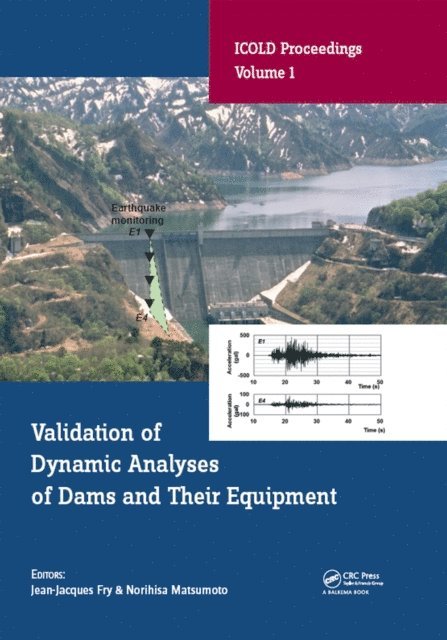
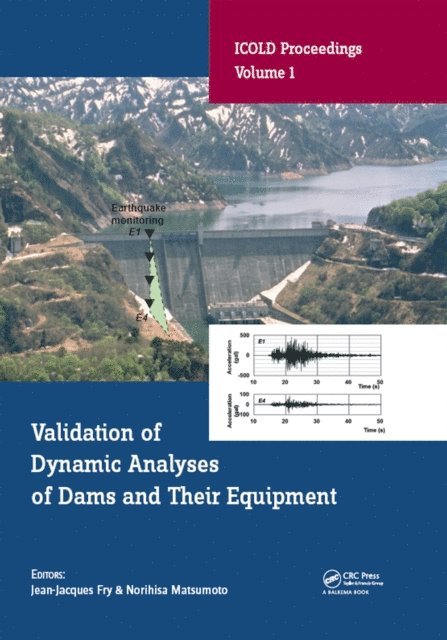
Validation of Dynamic Analyses of Dams and Their Equipment is the outcome of a three year cooperation program between CFBR (Comite Francais des Barrages et Reservoirs or French Committee on Large dams) and JCOLD (Japan Commission on Large Dams), and focusses on the dynamic behavior of concrete and embankment dams analyzed based on acceleration records of the JCOLD data base. The book covers a broad range of topics, including simplified and detailed methods of dynamic analysis for the seismic response of concrete and embankment dams compared with measured behavior. The response of embankment dams subjected to a 1.0 g foundation acceleration time history is computed by several analytical methods and compared. The modelling of stress-strain behavior of compacted soils for seismic stability analysis of earth-fill dams and its application for a failed earthfill dam is described. The cracking of the face slab of four faced rockfill dams during earthquakes is analyzed. The seismic behavior of concrete arch dams is discussed by the comparison of numerical and experimental results. Displacement-based seismic assessment of concrete dams is presented. Finally the book contains a comparison between the Japanese and French design criteria of gates and a comparison of the analysis of gates and field measurements.
Validation of Dynamic Analyses of Dams and Their Equipment will be useful to professional and academics involved or interested in dam engineering.
4 299 kr
Läs direkt efter köp
Validation of Dynamic Analyses of Dams and Their Equipment is the outcome of a three year cooperation program between CFBR (Comite Francais des Barrages et Reservoirs or French Committee on Large dams) and JCOLD (Japan Commission on Large Dams), and focusses on the dynamic behavior of concrete and embankment dams analyzed based on acceleration records of the JCOLD data base. The book covers a broad range of topics, including simplified and detailed methods of dynamic analysis for the seismic response of concrete and embankment dams compared with measured behavior. The response of embankment dams subjected to a 1.0 g foundation acceleration time history is computed by several analytical methods and compared. The modelling of stress-strain behavior of compacted soils for seismic stability analysis of earth-fill dams and its application for a failed earthfill dam is described. The cracking of the face slab of four faced rockfill dams during earthquakes is analyzed. The seismic behavior of concrete arch dams is discussed by the comparison of numerical and experimental results. Displacement-based seismic assessment of concrete dams is presented. Finally the book contains a comparison between the Japanese and French design criteria of gates and a comparison of the analysis of gates and field measurements.
Validation of Dynamic Analyses of Dams and Their Equipment will be useful to professional and academics involved or interested in dam engineering.
3 244 kr
Läs direkt efter köp
3 716 kr
Skickas inom 10-15 vardagar
3 244 kr
Läs direkt efter köp
837 kr
Skickas inom 10-15 vardagar
Dry stone retaining structures are structures made of individual decimeter stone blocks in contact. One advantage of this construction technology lies in the weak amount of embodied energy required for their construction, and uses only local materials. This technology may be a positive answer to the challenges brought by sustainable policies in civil engineering.
Many of these structures are older than one hundred years and sustain damage due to ageing; this places the owners in front of a challenging issue. Usual scientific tools cannot address the specific behavior of such structures. Due to the discrete nature of the system, a large amount of energy can be dissipated at contact level before failure of the structure. The shape, arrangement and possible breakage of blocks may play a major role in their overall behavior, specific to these structures. This book brings an overview of the DEM technique to model the behavior of discrete civil engineering structures. Physical models, modeling and site measurements are all explored, helping the civil engineer evaluate the behavior of unique structures.
The only DEM technique to model the behavior of discrete civil engineering structures A specific and sophisticated tool to address the general features observed on site Details physical models, modeling and site measurements