Jean Petitot - Böcker
Visar alla böcker från författaren Jean Petitot. Handla med fri frakt och snabb leverans.
7 produkter
7 produkter
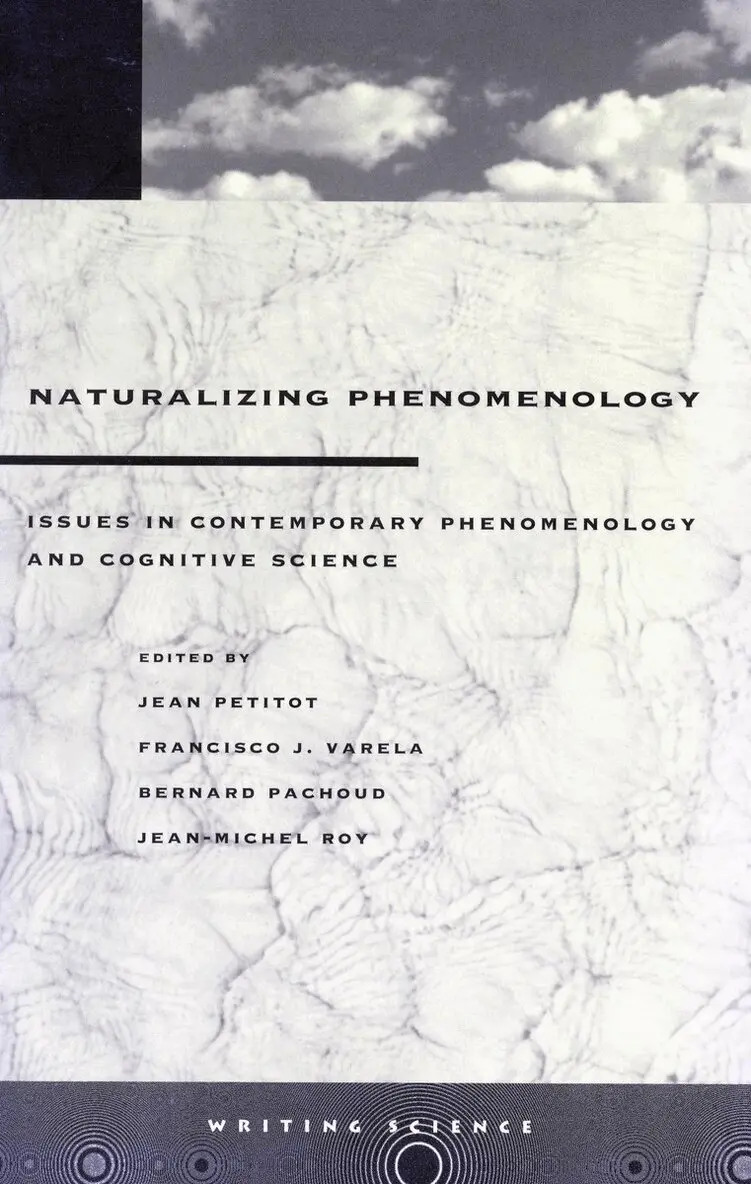
Naturalizing Phenomenology
Issues in Contemporary Phenomenology and Cognitive Science
Inbunden, Engelska, 2000
2 091 kr
Skickas inom 10-15 vardagar
This ambitious work aims to shed new light on the relations between Husserlian phenomenology and the present-day efforts toward a scientific theory of cognition—with its complex structure of disciplines, levels of explanation, and conflicting hypotheses.The book's primary goal is not to present a new exegesis of Husserl's writings, although it does not dismiss the importance of such interpretive and critical work. Rather, the contributors assess the extent to which the kind of phenomenological investigation Husserl initiated favors the construction of a scientific theory of cognition, particularly in contributing to specific contemporary theories either by complementing or by questioning them. What clearly emerges is that Husserlian phenomenology cannot become instrumental in developing cognitive science without undergoing a substantial transformation. Therefore, the central concern of this book is not only the progress of contemporary theories of cognition but also the reorientation of Husserlian phenomenology.Because a single volume could never encompass the numerous facets of this dual aim, the contributors focus on the issue of naturalization. This perspective is far-reaching enough to allow for the coverage of a great variety of topics, ranging from general structures of intentionality, to the nature of the founding epistemological and ontological principles of cognitive science, to analyses of temporality and perception and the mathematical modeling of their phenomenological description.This book, then, is a collective reflection on the possibility of utilizing a naturalized Husserlian phenomenology to contribute to a scientific theory of cognition that fills the explanatory gap between the phenomenological mind and brain.
Naturalizing Phenomenology
Issues in Contemporary Phenomenology and Cognitive Science
Häftad, Engelska, 2000
507 kr
Skickas inom 7-10 vardagar
This ambitious work aims to shed new light on the relations between Husserlian phenomenology and the present-day efforts toward a scientific theory of cognition—with its complex structure of disciplines, levels of explanation, and conflicting hypotheses.The book's primary goal is not to present a new exegesis of Husserl's writings, although it does not dismiss the importance of such interpretive and critical work. Rather, the contributors assess the extent to which the kind of phenomenological investigation Husserl initiated favors the construction of a scientific theory of cognition, particularly in contributing to specific contemporary theories either by complementing or by questioning them. What clearly emerges is that Husserlian phenomenology cannot become instrumental in developing cognitive science without undergoing a substantial transformation. Therefore, the central concern of this book is not only the progress of contemporary theories of cognition but also the reorientation of Husserlian phenomenology.Because a single volume could never encompass the numerous facets of this dual aim, the contributors focus on the issue of naturalization. This perspective is far-reaching enough to allow for the coverage of a great variety of topics, ranging from general structures of intentionality, to the nature of the founding epistemological and ontological principles of cognitive science, to analyses of temporality and perception and the mathematical modeling of their phenomenological description.This book, then, is a collective reflection on the possibility of utilizing a naturalized Husserlian phenomenology to contribute to a scientific theory of cognition that fills the explanatory gap between the phenomenological mind and brain.
2 625 kr
Skickas inom 10-15 vardagar
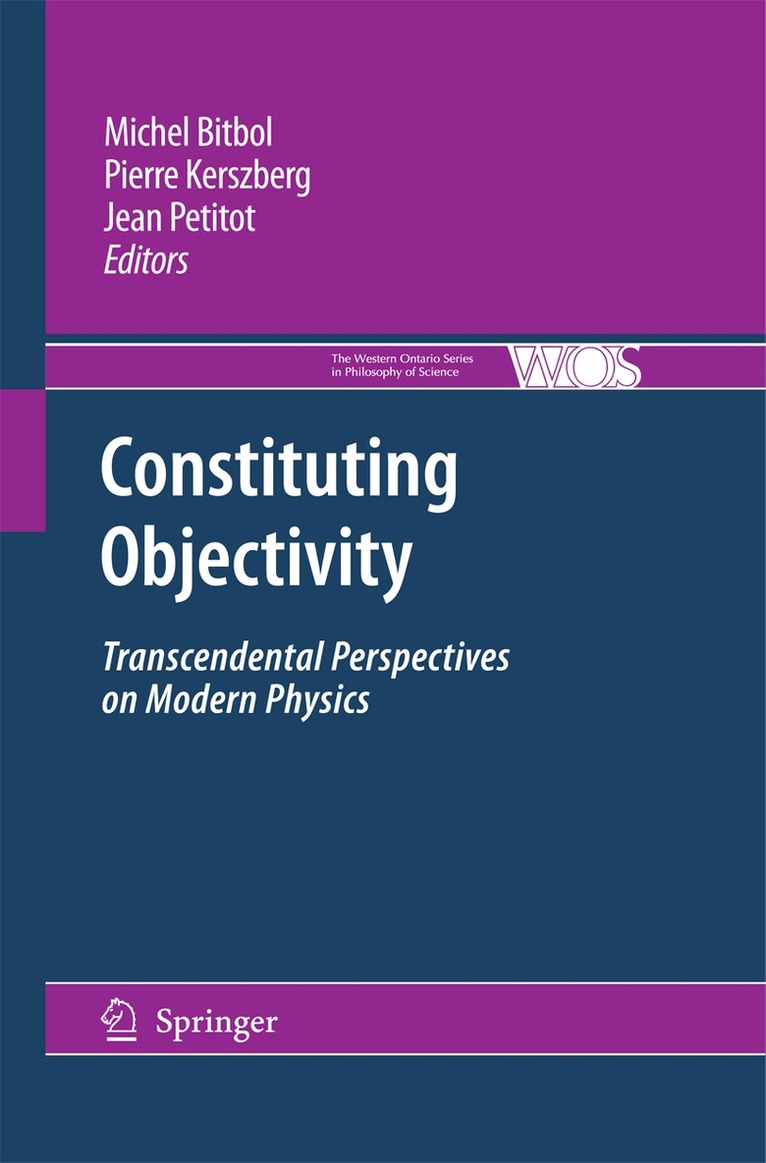
In recent years, many philosophers of modern physics came to the conclusion that the problem of how objectivity is constituted (rather than merely given) can no longer be avoided, and therefore that a transcendental approach in the spirit of Kant is now philosophically relevant. The usual excuse for skipping this task is that the historical form given by Kant to transcendental epistemology has been challenged by Relativity and Quantum Physics. However, the true challenge is not to force modern physics into a rigidly construed static version of Kant’s philosophy, but to provide Kant’s method with flexibility and generality.In this book, the top specialists of the field pin down the methodological core of transcendental epistemology that must be used in order to throw light on the foundations of modern physics. First, the basic tools Kant used for his transcendental reading of Newtonian Mechanics are examined, and then early transcendental approaches of Relativistic and Quantum Physics are revisited. Transcendental procedures are also applied to contemporary physics, and this renewed transcendental interpretation is finally compared with structural realism and constructive empiricism. The book will be of interest to scientists, historians and philosophers who are involved in the foundational problems of modern physics.
Del 11 - European Semiotics/Semiotiques Europeennes
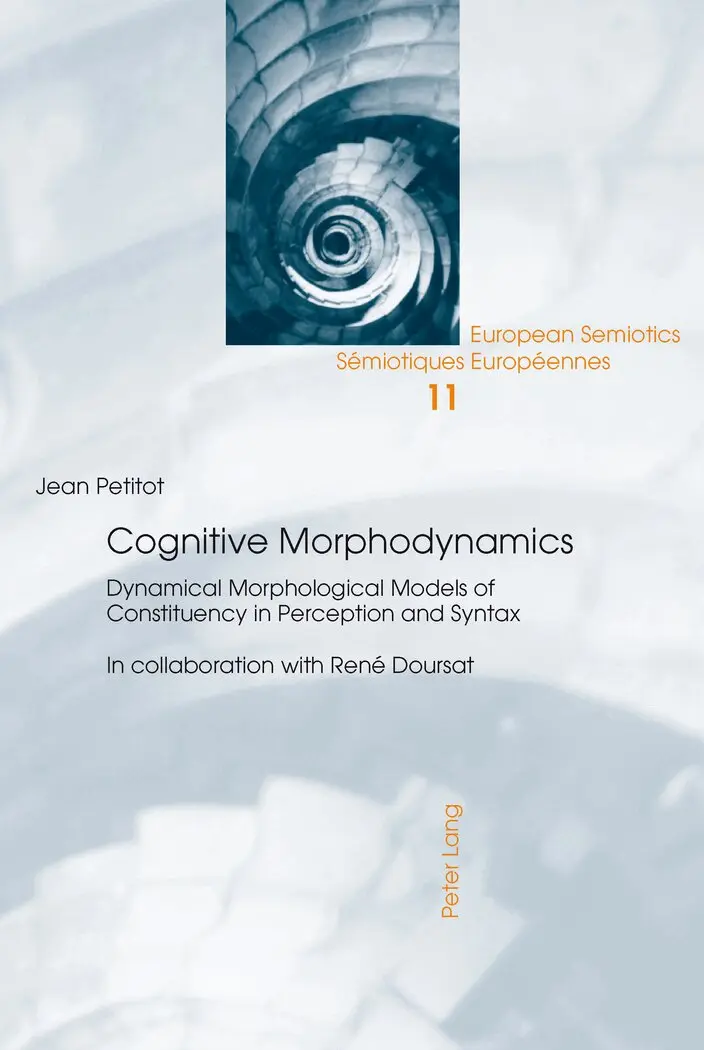
Cognitive Morphodynamics
Dynamical Morphological Models of Constituency in Perception and Syntax
Häftad, Engelska, 2011
967 kr
Skickas inom 5-8 vardagar
This book – written in collaboration with René Doursat, director of the Complex Systems Institute, Paris – adds a new dimension to Cognitive Grammars. It provides a rigorous, operational mathematical foundation, which draws from topology, geometry and dynamical systems to model iconic «image-schemas» and «conceptual archetypes». It defends the thesis that René Thom’s morphodynamics is especially well suited to the task and allows to transform the morphological structures of perception into Gestalt-like, abstract, proto-linguistic schemas that can act as inputs into higher-level specific linguistic routines.Cognitive Grammars have drawn upon the view that the deep syntactic and semantic structures of language, such as prepositions and case roles, are grounded in perception and action. This study raises difficult problems, which thus far have not been addressed as a mathematical challenge. Cognitive Morphodynamics shows how this gap can be filled.
1 381 kr
Skickas inom 10-15 vardagar
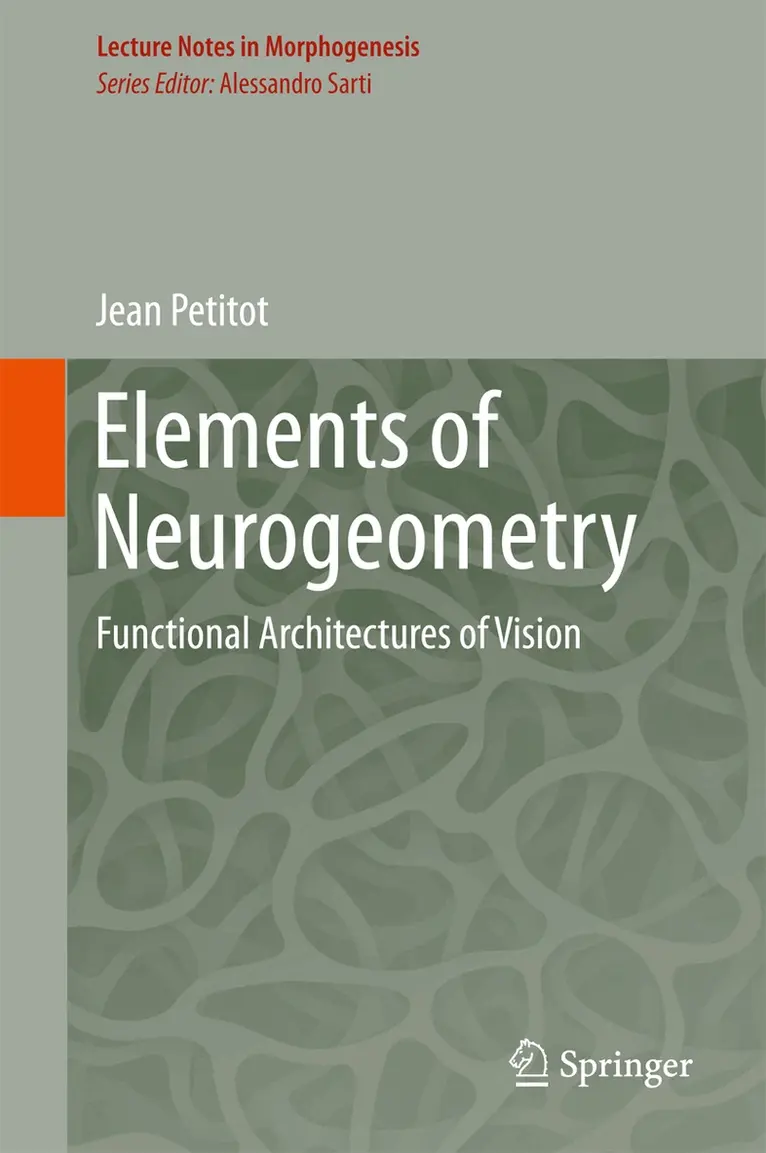
This book describes several mathematical models of the primary visual cortex, referring them to a vast ensemble of experimental data and putting forward an original geometrical model for its functional architecture, that is, the highly specific organization of its neural connections. The book spells out the geometrical algorithms implemented by this functional architecture, or put another way, the “neurogeometry” immanent in visual perception. Focusing on the neural origins of our spatial representations, it demonstrates three things: firstly, the way the visual neurons filter the optical signal is closely related to a wavelet analysis; secondly, the contact structure of the 1-jets of the curves in the plane (the retinal plane here) is implemented by the cortical functional architecture; and lastly, the visual algorithms for integrating contours from what may be rather incomplete sensory data can be modelled by the sub-Riemannian geometry associated with this contact structure. As such, it provides readers with the first systematic interpretation of a number of important neurophysiological observations in a well-defined mathematical framework. The book’s neuromathematical exploration appeals to graduate students and researchers in integrative-functional-cognitive neuroscience with a good mathematical background, as well as those in applied mathematics with an interest in neurophysiology.
1 381 kr
Skickas inom 10-15 vardagar
This book describes several mathematical models of the primary visual cortex, referring them to a vast ensemble of experimental data and putting forward an original geometrical model for its functional architecture, that is, the highly specific organization of its neural connections.
2 625 kr
Skickas inom 10-15 vardagar
In recent years, many philosophers of modern physics came to the conclusion that the problem of how objectivity is constituted (rather than merely given) can no longer be avoided, and therefore that a transcendental approach in the spirit of Kant is now philosophically relevant. The usual excuse for skipping this task is that the historical form given by Kant to transcendental epistemology has been challenged by Relativity and Quantum Physics. However, the true challenge is not to force modern physics into a rigidly construed static version of Kant’s philosophy, but to provide Kant’s method with flexibility and generality.In this book, the top specialists of the field pin down the methodological core of transcendental epistemology that must be used in order to throw light on the foundations of modern physics. First, the basic tools Kant used for his transcendental reading of Newtonian Mechanics are examined, and then early transcendental approaches of Relativistic and Quantum Physics are revisited. Transcendental procedures are also applied to contemporary physics, and this renewed transcendental interpretation is finally compared with structural realism and constructive empiricism. The book will be of interest to scientists, historians and philosophers who are involved in the foundational problems of modern physics.