Jeanne-Marie Membre – författare
Visar alla böcker från författaren Jeanne-Marie Membre. Handla med fri frakt och snabb leverans.
5 produkter
5 produkter
693 kr
Läs direkt efter köp
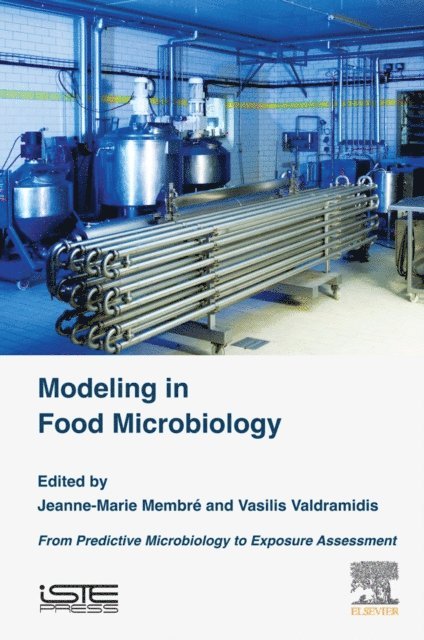
Predictive microbiology primarily deals with the quantitative assessment of microbial responses at a macroscopic or microscopic level, but also involves the estimation of how likely an individual or population is to be exposed to a microbial hazard.This book provides an overview of the major literature in the area of predictive microbiology, with a special focus on food. The authors tackle issues related to modeling approaches and their applications in both microbial spoilage and safety.Food spoilage is presented through applications of best-before-date determination and commercial sterility. Food safety is presented through applications of risk-based safety management. The different modeling aspects are introduced through probabilistic and stochastic approaches, including model and data uncertainty, but also biological variability.- Features an extensive review of modelling terminology- Presents examples of all available microbial models (i.e., growth, inactivation, growth/no growth) and applicable software- Revisits all statistical aspects related to exposure assessment- Describes realistic examples of implementing microbial spoilage and safety modeling approaches
E-bok
PDF, Engelska, 20221 909 kr
Läs direkt efter köp
According to the World Health Organization, one in every ten people worldwide falls ill from eating contaminated food every year, with 550 million cases of diarrheal diseases. Microbiological risk assessment aims to characterize the nature and probability of harm resulting from human exposure to the biological agents that are present in foodstuffs. This assessment must take into account all stages of the chain: from the production of raw materials to consumption. After briefly introducing food safety and risk assessment, this book details the four major steps of microbiological risk assessment. The contributors first present hazard identification and then exposure assessment, which is subdivided into methods for the detection and enumeration of pathogens and for the quantification of the level of exposure. Then, hazard characterization is subdivided into pathogenicity mechanisms and quantification of the dose–response relationship. Finally a guide for microbiological risk characterization is provided. The conclusion presents possible development avenues for microbiological risk assessment, particularly its integration into a holistic assessment of food systems.
E-bok
Engelska, 20221 966 kr
Läs direkt efter köp
According to the World Health Organization, one in every ten people worldwide falls ill from eating contaminated food every year, with 550 million cases of diarrheal diseases. Microbiological risk assessment aims to characterize the nature and probability of harm resulting from human exposure to the biological agents that are present in foodstuffs. This assessment must take into account all stages of the chain: from the production of raw materials to consumption. After briefly introducing food safety and risk assessment, this book details the four major steps of microbiological risk assessment. The contributors first present hazard identification and then exposure assessment, which is subdivided into methods for the detection and enumeration of pathogens and for the quantification of the level of exposure. Then, hazard characterization is subdivided into pathogenicity mechanisms and quantification of the dose–response relationship. Finally a guide for microbiological risk characterization is provided. The conclusion presents possible development avenues for microbiological risk assessment, particularly its integration into a holistic assessment of food systems.
Inbunden, Engelska, 2022
1 685 kr
Skickas inom 5-8 vardagar
According to the World Health Organization, one in every ten people worldwide falls ill from eating contaminated food every year, with 550 million cases of diarrheal diseases. Microbiological risk assessment aims to characterize the nature and probability of harm resulting from human exposure to the biological agents that are present in foodstuffs. This assessment must take into account all stages of the chain: from the production of raw materials to consumption. After briefly introducing food safety and risk assessment, this book details the four major steps of microbiological risk assessment. The contributors first present hazard identification and then exposure assessment, which is subdivided into methods for the detection and enumeration of pathogens and for the quantification of the level of exposure. Then, hazard characterization is subdivided into pathogenicity mechanisms and quantification of the dose–response relationship. Finally a guide for microbiological risk characterization is provided. The conclusion presents possible development avenues for microbiological risk assessment, particularly its integration into a holistic assessment of food systems.
Inbunden, Franska, 2023
2 412 kr
Skickas inom 5-8 vardagar