Jeff Gray – författare
Visar alla böcker från författaren Jeff Gray. Handla med fri frakt och snabb leverans.
9 produkter
9 produkter
E-bok
Engelska44 kr
Läs direkt efter köp
E-bok
Engelska, 2022175 kr
Läs direkt efter köp
"e;Come Watch the Nighttime Breathe "e; is the first novel in a series written by Jeff Gray that follows a young man named Tristan Wallace as he comes of age and begins his journey to learn the meaning of life and more specifically - the meaning of his life. Tristan was born and raised in a small, Midwest town in the 1970's by a middle-class family, enriched in Catholic values. His safeguarded upbringing never allowed him to adapt properly. As a result, as Tristan comes of age, his desire to gain understanding on the meaning of life and his meaning in life is raised by more than just curiosity and desire, it is heightened with an inner torment. Follow along as his journey begins in this captivating novel. As Tristan grows, ages, and seeks to forge his own path, he is influenced by Catholicism, inspired by Buddhism, yet tormented by a restlessness from deep within him. By chance, Tristan becomes acquainted with four rebellious and reckless men. Unbeknownst to them, they will serve as his life's guides. The night comes alive, these men introduce Tristan to a new world, his curiosity is captured, and the journey begins to drift from the path of Buddha, and he ventures down the paths seldom traveled - paths that are well hidden within the shadows of the night, filled with alcohol, forbidden desires, exploration, and sex.
Häftad, Engelska, 2008
562 kr
Skickas inom 10-15 vardagar
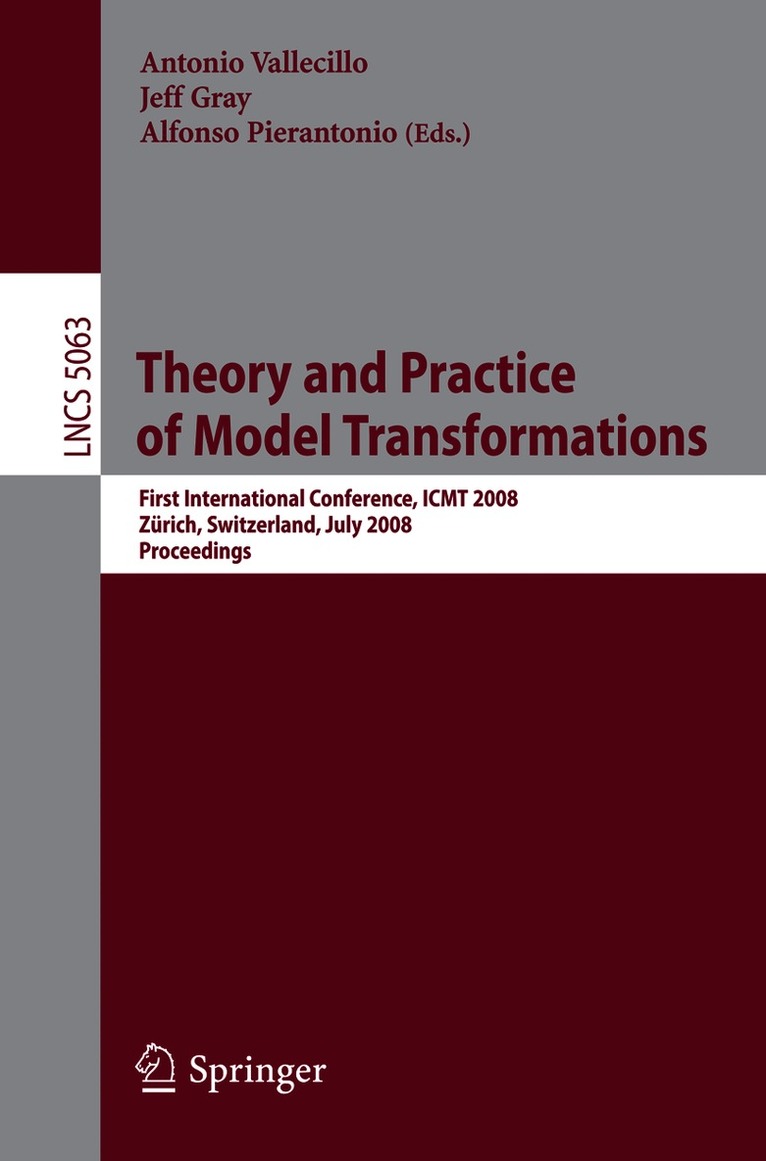
Models have become essential for dealing with the numerous aspects involved in developing and maintaining complex IT systems. Models allow capturing of the relevant aspects of a system from a given perspective, and at a precise level of abstraction. In addition to models, the transformations between them are other key elements in model-driven engineering. Model transformations allow the de?nition and implementation of the operations on models, and also provide achainthatenablestheautomateddevelopmentofasystemfromitscorrespo- ing models. Furthermore, model transformations may be realized using models, and are, therefore, an integral part of any model-driven approach. There are already several proposals for model transformation speci?cation, implementation and execution, which are beginning to be used by modeling practitioners. However, model transformations need specialized support in s- eral aspects in order to realize their full potential. The problem goes beyond having speci?c languages to represent model transformations; we also need to understandtheirfoundations,suchasthekeyconceptsandoperatorssupporting those languages, their semantics, and their structuring mechanisms and pr- erties (e. g. , modularity, composability and parametrization). In addition, model transformations can be stored in repositories as reusable assets, where they can be managed, discovered and reused. There is also a need to chain and combine model transformations in order to produce new and more powerful transfor- tions, and to be able to implement new operations on models. Finally, model transformations need methodology support, i. e. , they need to be integrated into software development methodologies supported by appropriate tools and en- ronments. These issues and concerns de?nethe focus of these proceedings.
E-bok
PDF, Engelska, 2008734 kr
Läs direkt efter köp
Models have become essential for dealing with the numerous aspects involved in developing and maintaining complex IT systems. Models allow capturing of the relevant aspects of a system from a given perspective, and at a precise level of abstraction. In addition to models, the transformations between them are other key elements in model-driven engineering. Model transformations allow the de?nition and implementation of the operations on models, and also provide achainthatenablestheautomateddevelopmentofasystemfromitscorrespo- ing models. Furthermore, model transformations may be realized using models, and are, therefore, an integral part of any model-driven approach. There are already several proposals for model transformation speci?cation, implementation and execution, which are beginning to be used by modeling practitioners. However, model transformations need specialized support in s- eral aspects in order to realize their full potential. The problem goes beyond having speci?c languages to represent model transformations; we also need to understandtheirfoundations,suchasthekeyconceptsandoperatorssupporting those languages, their semantics, and their structuring mechanisms and pr- erties (e. g. , modularity, composability and parametrization). In addition, model transformations can be stored in repositories as reusable assets, where they can be managed, discovered and reused. There is also a need to chain and combine model transformations in order to produce new and more powerful transfor- tions, and to be able to implement new operations on models. Finally, model transformations need methodology support, i. e. , they need to be integrated into software development methodologies supported by appropriate tools and en- ronments. These issues and concerns de?nethe focus of these proceedings.
Häftad, Engelska, 2010
562 kr
Skickas inom 10-15 vardagar
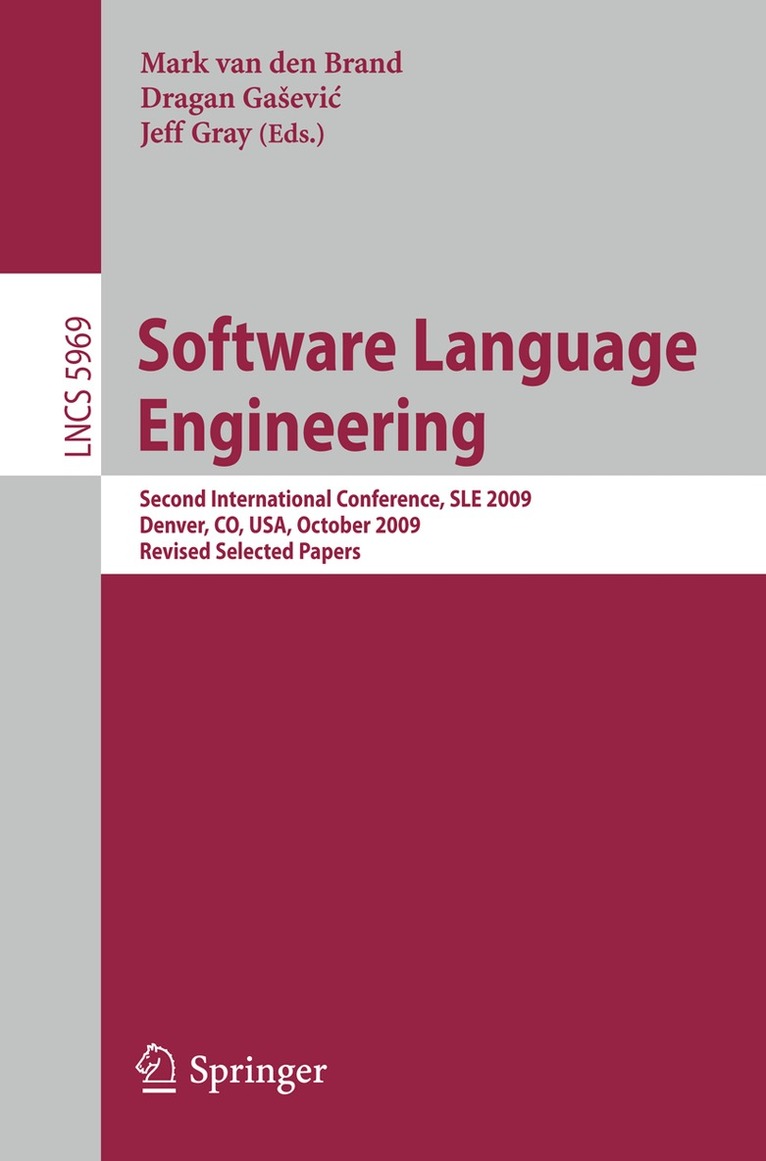
We are pleased to present the proceedings of the Second International Conf- ence on Software LanguageEngineering (SLE 2009). The conference was held in Denver, Colorado (USA) during October 5-6, 2009 and was co-located with the th 12 IEEE/ACM International Conference on Model-Driven Engineering L- th guages and Systems (MODELS 2009) and the 8 ACM International Conf- ence on Generative Programming and Component Engineering (GPCE 2009). TheSLEconferenceseriesisdevotedtoawiderangeoftopicsrelatedtoarti?cial languages in software engineering. SLE is an international research forum that brings together researchers and practitioners from both industry and academia to expand the frontiers of software language engineering. SLE'sforemostmissionis to encourageand organizecommunicationbetween communities that have traditionally looked at software languagesfrom di?erent, more specialized, and yet complementary perspectives. SLE emphasizes the f- damental notion of languages, as opposed to any realization in speci?c technical spaces. In this context, the term "software language" comprises all sorts of - ti?cial languages used in software development, including general-purpose p- gramming languages, domain-speci?c languages, modeling and meta-modeling languages, data models, and ontologies. Software language engineering is the application of a systematic, disciplined, quanti?able approach to the devel- ment,use,andmaintenanceoftheselanguages. TheSLEconferenceisconcerned with all phases of the lifecycle of software languages; these include the design, implementation, documentation, testing, deployment, evolution, recovery, and retirement of languages. Of special interest are tools, techniques, methods, and formalisms that support these activities. In particular, tools are often based on, or automatically generated from, a formal description of the language.
E-bok
PDF, Engelska, 2010708 kr
Läs direkt efter köp
Häftad, Engelska, 2013
562 kr
Skickas inom 10-15 vardagar
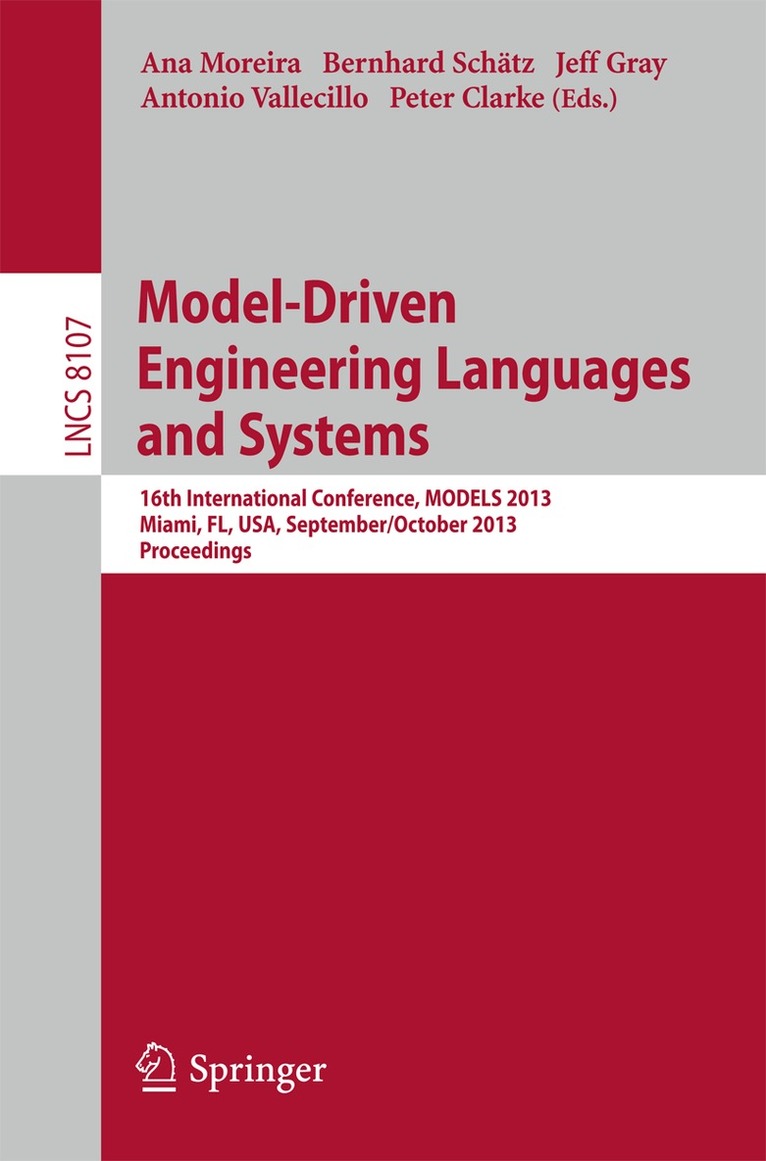
This book constitutes the refereed proceedings of the 16th International Conference on Model Driven Engineering Languages and Systems, MODELS 2013, held in Miami, FL, USA, in September/October 2013. The 47 full papers presented in this volume were carefully reviewed and selected from a total of 180 submissions. They are organized in topical sections named: tool support; dependability; comprehensibility; testing; evolution; verification; product lines; semantics; domain-specific modeling languages; models@RT; design and architecture; model transformation; model analysis; and system synthesis.
E-bok
PDF, Engelska, 2013708 kr
Läs direkt efter köp
This book constitutes the refereed proceedings of the 16th International Conference on Model Driven Engineering Languages and Systems, MODELS 2013, held in Miami, FL, USA, in September/October 2013. The 47 full papers presented in this volume were carefully reviewed and selected from a total of 180 submissions. They are organized in topical sections named: tool support; dependability; comprehensibility; testing; evolution; verification; product lines; semantics; domain-specific modeling languages; models@RT; design and architecture; model transformation; model analysis; and system synthesis.
Inbunden, Engelska, 2020
323 kr
Tillfälligt slut