Jeffrey K. Olick – författare
Visar alla böcker från författaren Jeffrey K. Olick. Handla med fri frakt och snabb leverans.
15 produkter
In the House of the Hangman
The Agonies of German Defeat, 1943-1949
Häftad, 2013
264 kr
Lägg i varukorg
The central question for both the victors and the vanquished of World War II was just how widely the stain of guilt would spread over Germany. Political leaders and intellectuals on both sides of the conflict debated whether support for National Socialism tainted Germany's entire population and …
The Collective Memory Reader
Av OLICK, Jeffrey K. Olick m. fl.
Inbunden, 2011
2765 kr
Lägg i varukorg
There are few terms or concepts that have, in the last twenty or so years, rivaled "collective memory" for attention in the humanities and social sciences. Indeed, use of the term has extended far beyond scholarship to the realm of politics and journalism, where it has appeared in speeches at the …
The Collective Memory Reader
Av Jeffrey K. Olick, Vered Vinitzky-Seroussi m. fl.
Häftad, 2011
1003 kr
Lägg i varukorg
There are few terms or concepts that have, in the last twenty or so years, rivaled "collective memory" for attention in the humanities and social sciences. Indeed, use of the term has extended far beyond scholarship to the realm of politics and journalism, where it has appeared in speeches at the …
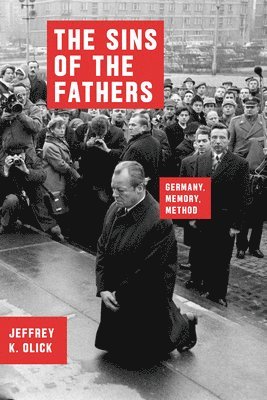
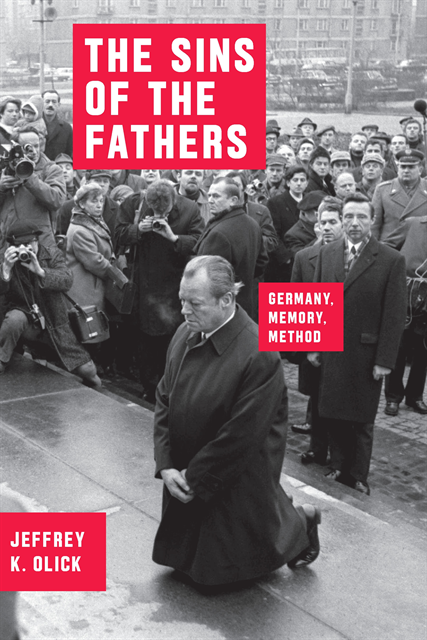
Sins of the Fathers
Germany, Memory, Method
Inbunden, 2016
485 kr
Lägg i varukorg
National identity and political legitimacy always involve a delicate balance between remembering and forgetting. All nations have elements in their past that they would prefer to pass over the catalog of failures, injustices, and horrors committed in the name of nations, if fully acknowledged, …
Sins of the Fathers
Germany, Memory, Method
E-bok, 2016
1054 kr
Lägg i varukorg
National identity and political legitimacy always involve a delicate balance between remembering and forgetting. All nations have elements in their past that they would prefer to pass over—the catalog of failures, injustices, and horrors committed in the name of nations, if fully acknowledged, …
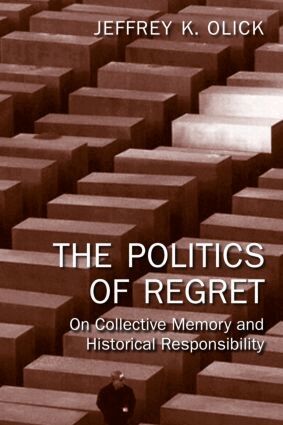
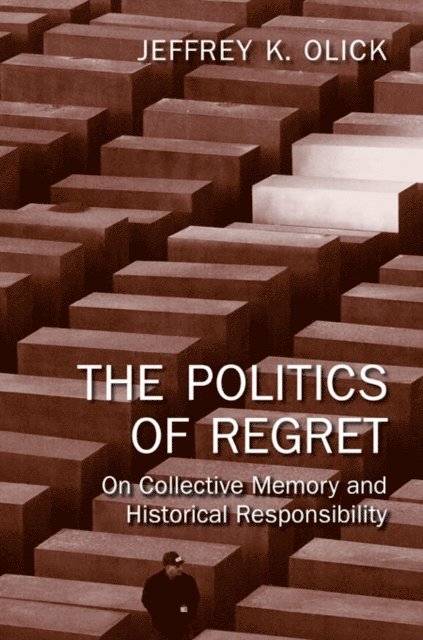
Politics of Regret
On Collective Memory and Historical Responsibility
Inbunden, 2007
2586 kr
Lägg i varukorg
In the past decade, Jeffrey Olick has established himself as one of the world’s pre-eminent sociologists of memory (and, related to this, both cultural sociology and social theory). His recent book on memory in postwar Germany, In the House of the Hangman (University of Chicago Press, 2005) has …
Politics of Regret
On Collective Memory and Historical Responsibility
Häftad, 2007
817 kr
Lägg i varukorg
In the past decade, Jeffrey Olick has established himself as one of the world’s pre-eminent sociologists of memory (and, related to this, both cultural sociology and social theory). His recent book on memory in postwar Germany, In the House of the Hangman (University of Chicago Press, 2005) has …
Guilt and Defense
On the Legacies of National Socialism in Postwar Germany
Av Theodor W. Adorno, Jeffrey K. Olick
Inbunden, 2010
554 kr
Lägg i varukorg
Beginning in 1949, Theodor W. Adorno and other members of the reconstituted Frankfurt Institute for Social Research undertook a massive empirical study of German opinions about the legacies of the Nazis, applying and modifying techniques they had learned during their U.S. exile. They published …
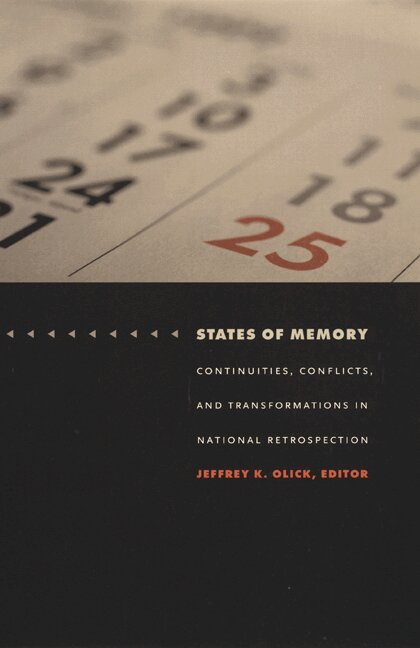
States of Memory
Continuities, Conflicts, and Transformations in National Retrospection
Häftad, 2003
441 kr
Lägg i varukorg
States of Memory illuminates the construction of national memory from a comparative perspective. The essays collected here emphasize that memory itself has a history: not only do particular meanings change, but the very faculty of memory-its place in social relations and the forms it takes-varies …
States of Memory
Continuities, Conflicts, and Transformations in National Retrospection
E-bok, 2003
633 kr
Lägg i varukorg
States of Memory illuminates the construction of national memory from a comparative perspective. The essays collected here emphasize that memory itself has a history: not only do particular meanings change, but the very faculty of memory—its place in social relations and the forms it takes—varies …
Politics of Regret
On Collective Memory and Historical Responsibility
E-bok, 2013
933 kr
Lägg i varukorg
In the past decade, Jeffrey Olick has established himself as one of the world’s pre-eminent sociologists of memory (and, related to this, both cultural sociology and social theory). His recent book on memory in postwar Germany, In the House of the Hangman (University of Chicago Press, 2005) has …
Politics of Regret
On Collective Memory and Historical Responsibility
E-bok, 2013
963 kr
Lägg i varukorg
In the past decade, Jeffrey Olick has established himself as one of the world’s pre-eminent sociologists of memory (and, related to this, both cultural sociology and social theory). His recent book on memory in postwar Germany, In the House of the Hangman (University of Chicago Press, 2005) has …
Cultural History of Memory
Av Stefan Berger, Jeffrey K. Olick
2024
2388 kr
Lägg i varukorg
How has understanding of memory evolved over the past 2,500 years? How has our collective memory been influenced and expressed by politics, culture, philosophy and science? In a work that spans over 2,500 years, these ambitious questions are addressed by 64 experts, each contributing their overview …
Cultural History of Memory
Av Stefan Berger, Jeffrey K. Olick
2020
8107 kr
Lägg i varukorg
How has understanding of memory evolved over the past 2,500 years? How has our collective memory been influenced and expressed by politics, culture, philosophy and science? In a work that spans over 2,500 years, these ambitious questions are addressed by 64 experts, each contributing their overview …
In the House of the Hangman
The Agonies of German Defeat, 1943-1949
Inbunden, 2005
302 kr
Tillfälligt slut
The central question for both the victors and the vanquished of World War II was just how widely the stain of guilt would spread over Germany. Political leaders and intellectuals on both sides of the conflict debated whether support for National Socialism tainted Germany's entire population and …