Jeffrey Kahn – författare
2 624 kr
Skickas inom 5-8 vardagar
600 kr
Läs direkt efter köp
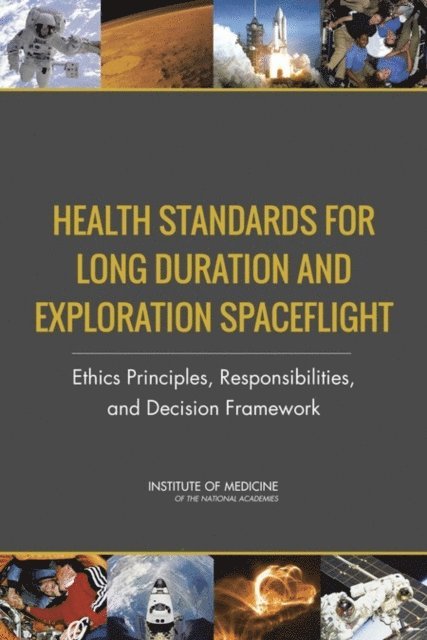
Since its inception, the U.S. human spaceflight program has grown from launching a single man into orbit to an ongoing space presence involving numerous crewmembers. As the U.S. space program evolves, propelled in part by increasing international and commercial collaborations, long duration or exploration spaceflights - such as extended stays on the International Space Station or missions to Mars - become more realistic. These types of missions will likely expose crews to levels of known risk that are beyond those allowed by current health standards, as well as to a range of risks that are poorly characterized, uncertain, and perhaps unforeseeable. As the National Aeronautics and Space Administration (NASA) and Congress discuss the next generation of NASA''s missions and the U.S. role in international space efforts, it is important to understand the ethical factors that drive decision making about health standards and mission design for NASA activities.
NASA asked the Institute of Medicine to outline the ethics principles and practices that should guide the agency''s decision making for future long duration or exploration missions that fail to meet existing health standards. Health Standards for Long Duration and Exploration Spaceflight identifies an ethics framework, which builds on the work of NASA and others, and presents a set of recommendations for ethically assessing and responding to the challenges associated with health standards for long duration and exploration spaceflight.As technologies improve and longer and more distant spaceflight becomes feasible, NASA and its international and commercial partners will continue to face complex decisions about risk acceptability.This report provides a roadmap for ethically assessing and responding to the challenges associated with NASA''s health standards for long duration and exploration missions. Establishing and maintaining a firmly grounded ethics framework for this inherently risky activity is essential to guide NASA''s decisions today and to create a strong foundation for decisions about future challenges and opportunities.
785 kr
Läs direkt efter köp
Mitochondrial replacement techniques (MRTs) are designed to prevent the transmission of mitochondrial DNA (mtDNA) diseases from mother to child. While MRTs, if effective, could satisfy a desire of women seeking to have a genetically related child without the risk of passing on mtDNA disease, the technique raises significant ethical and social issues. It would create offspring who have genetic material from two women, something never sanctioned in humans, and would create mitochondrial changes that could be heritable (in female offspring), and therefore passed on in perpetuity. The manipulation would be performed on eggs or embryos, would affect every cell of the resulting individual, and once carried out this genetic manipulation is not reversible.
Mitochondrial Replacement Techniques considers the implications of manipulating mitochondrial content both in children born to women as a result of participating in these studies and in descendants of any female offspring. This study examines the ethical and social issues related to MRTs, outlines principles that would provide a framework and foundation for oversight of MRTs, and develops recommendations to inform the Food and Drug Administration''s consideration of investigational new drug applications.
423 kr
Skickas inom 5-8 vardagar
263 kr
Skickas inom 5-8 vardagar
408 kr
Tillfälligt slut
526 kr
Tillfälligt slut