Jennifer D. Ortegren – författare
Visar alla böcker från författaren . Handla med fri frakt och snabb leverans.
4 produkter
4 produkter
Inbunden, Engelska, 2023
1 098 kr
Skickas inom 5-8 vardagar
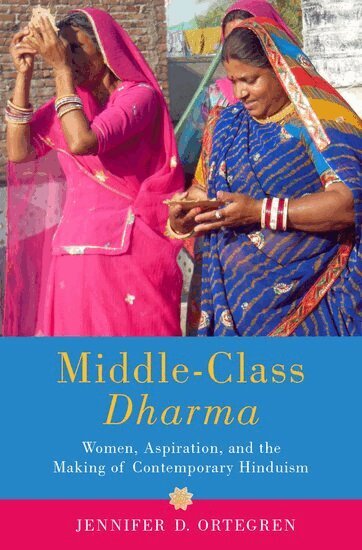
Middle-Class Dharma is a contemporary ethnography of class mobility among Hindus in Udaipur, Rajasthan, India. Focusing on women in Pulan, an emerging middle-class neighborhood of Udaipur, Jennifer D. Ortegren argues that upward class mobility is not just a socio-economic process, but also a religious one. Central to Hindu women's upward class mobility is negotiating dharma, the moral and ethical groundings of Hindu worlds. As women experiment with middle-class consumer and lifestyle practices, they navigate tensions around what is possible and what is appropriate--that is, what is dharmic--as middle-class Hindu women. Ortegren shows how these women strategically align emerging middle-class desires with more traditional religious obligations in ways that enable them to generate new dharmic boundaries and religious selfhoods in the middle classes. Such transitions can be as joyful as they are difficult and disorienting. Middle-Class Dharma explores how contemporary Hindu women's everyday practices reimagine and reshape Hindu traditions. By developing dharma as an analytical category and class as a dharmic category, Ortegren pushes for expanding definitions of religion in academia, both within and beyond the study of Hinduism in South Asia.
E-bok
PDF, Engelska, 2023977 kr
Läs direkt efter köp
Middle-Class Dharma is a contemporary ethnography of class mobility among Hindus in Udaipur, Rajasthan, India. Focusing on women in Pulan, an emerging middle-class neighborhood of Udaipur, Jennifer D. Ortegren argues that upward class mobility is not just a socio-economic process, but also a religious one. Central to Hindu women''s upward class mobility is negotiating dharma, the moral and ethical groundings of Hindu worlds. As women experiment with middle-class consumer and lifestyle practices, they navigate tensions around what is possible and what is appropriate--that is, what is dharmic--as middle-class Hindu women. Ortegren shows how these women strategically align emerging middle-class desires with more traditional religious obligations in ways that enable them to generate new dharmic boundaries and religious selfhoods in the middle classes. Such transitions can be as joyful as they are difficult and disorienting. Middle-Class Dharma explores how contemporary Hindu women''s everyday practices reimagine and reshape Hindu traditions. By developing dharma as an analytical category and class as a dharmic category, Ortegren pushes for expanding definitions of religion in academia, both within and beyond the study of Hinduism in South Asia.
977 kr
Läs direkt efter köp
Middle-Class Dharma is a contemporary ethnography of class mobility among Hindus in Udaipur, Rajasthan, India. Focusing on women in Pulan, an emerging middle-class neighborhood of Udaipur, Jennifer D. Ortegren argues that upward class mobility is not just a socio-economic process, but also a religious one. Central to Hindu women''s upward class mobility is negotiating dharma, the moral and ethical groundings of Hindu worlds. As women experiment with middle-class consumer and lifestyle practices, they navigate tensions around what is possible and what is appropriate--that is, what is dharmic--as middle-class Hindu women. Ortegren shows how these women strategically align emerging middle-class desires with more traditional religious obligations in ways that enable them to generate new dharmic boundaries and religious selfhoods in the middle classes. Such transitions can be as joyful as they are difficult and disorienting. Middle-Class Dharma explores how contemporary Hindu women''s everyday practices reimagine and reshape Hindu traditions. By developing dharma as an analytical category and class as a dharmic category, Ortegren pushes for expanding definitions of religion in academia, both within and beyond the study of Hinduism in South Asia.
Inbunden, Engelska, 2027
1 098 kr
Kommande
Foregrounds the centrality of women across diverse Hindu traditions spanning time and geographyWomen in Hindu Traditions showcases the centrality of women in the ritual and artistic traditions, religious institutions, and literature of Hindu traditions. It considers women's roles as everyday practitioners, gurus, epic protagonists, poet-saints, and performers across time and geography.The volume shows that Hindu women have long reworked elite theologies, scriptures, and rituals in ways that may perpetuate, challenge, and/or innovate upon so-called normative traditions. In this vein, the book is careful to include discussions about Hindu women from various caste and class backgrounds in multiple regions of the Indian subcontinent, as well as the global diaspora.In illuminating the many ways in which women are represented in and have contributed to Hindu traditions, Women in Hindu Traditions emphasizes the flexibility and fluidity of Hinduism more broadly. It discusses elite practices and texts—such as ancient Sanskrit narratives attributed to male authors—in conversation with vernacular texts and practices performed and authored by women in both historical and contemporary contexts. These discussions include an exploration of rituals that reveal women's roles in domestic, public, and temple spaces in India and beyond, poem-songs in devotion to various gods and goddesses, and different iterations of female-authored epics, such as retellings of the Ramayana and Mahabharata.Women in Hindu Traditions displays the incredible multiplicity of Hindu traditions, arguing for the value of comprehending religious traditions through women's narratives and lives.