Jennifer L. Bayuk – författare
1 196 kr
Skickas inom 5-8 vardagar
1 336 kr
Läs direkt efter köp
Drawing upon a wealth of experience from academia, industry, and government service, Cyber Security Policy Guidebook details and dissects, in simple language, current organizational cyber security policy issues on a global scale—taking great care to educate readers on the history and current approaches to the security of cyberspace. It includes thorough descriptions—as well as the pros and cons—of a plethora of issues, and documents policy alternatives for the sake of clarity with respect to policy alone. The Guidebook also delves into organizational implementation issues, and equips readers with descriptions of the positive and negative impact of specific policy choices.
Inside are detailed chapters that:
Explain what is meant by cyber security and cyber security policy Discuss the process by which cyber security policy goals are set Educate the reader on decision-making processes related to cyber security Describe a new framework and taxonomy for explaining cyber security policy issues Show how the U.S. government is dealing with cyber security policy issuesWith a glossary that puts cyber security language in layman''s terms—and diagrams that help explain complex topics—Cyber Security Policy Guidebook gives students, scholars, and technical decision-makers the necessary knowledge to make informed decisions on cyber security policy.
1 336 kr
Läs direkt efter köp
Drawing upon a wealth of experience from academia, industry, and government service, Cyber Security Policy Guidebook details and dissects, in simple language, current organizational cyber security policy issues on a global scale—taking great care to educate readers on the history and current approaches to the security of cyberspace. It includes thorough descriptions—as well as the pros and cons—of a plethora of issues, and documents policy alternatives for the sake of clarity with respect to policy alone. The Guidebook also delves into organizational implementation issues, and equips readers with descriptions of the positive and negative impact of specific policy choices.
Inside are detailed chapters that:
Explain what is meant by cyber security and cyber security policy Discuss the process by which cyber security policy goals are set Educate the reader on decision-making processes related to cyber security Describe a new framework and taxonomy for explaining cyber security policy issues Show how the U.S. government is dealing with cyber security policy issuesWith a glossary that puts cyber security language in layman''s terms—and diagrams that help explain complex topics—Cyber Security Policy Guidebook gives students, scholars, and technical decision-makers the necessary knowledge to make informed decisions on cyber security policy.
1 042 kr
Skickas inom 5-8 vardagar
1 163 kr
Läs direkt efter köp
Authoritative resource delivering the professional practice of cybersecurity from the perspective of enterprise governance and risk management.
Stepping Through Cybersecurity Risk Management covers the professional practice of cybersecurity from the perspective of enterprise governance and risk management. It describes the state of the art in cybersecurity risk identification, classification, measurement, remediation, monitoring and reporting. It includes industry standard techniques for examining cybersecurity threat actors, cybersecurity attacks in the context of cybersecurity-related events, technology controls, cybersecurity measures and metrics, cybersecurity issue tracking and analysis, and risk and control assessments.
The text provides precise definitions for information relevant to cybersecurity management decisions and recommendations for collecting and consolidating that information in the service of enterprise risk management. The objective is to enable the reader to recognize, understand, and apply risk-relevant information to the analysis, evaluation, and mitigation of cybersecurity risk. A well-rounded resource, the text describes both reports and studies that improve cybersecurity decision support.
Composed of 10 chapters, the author provides learning objectives, exercises and quiz questions per chapter in an appendix, with quiz answers and exercise grading criteria available to professors.
Written by a highly qualified professional with significant experience in the field, Stepping Through Cybersecurity Risk Management includes information on:
Threat actors and networks, attack vectors, event sources, security operations, and CISO risk evaluation criteria with respect to this activity Control process, policy, standard, procedures, automation, and guidelines, along with risk and control self assessment and compliance with regulatory standards Cybersecurity measures and metrics, and corresponding key risk indicators The role of humans in security, including the “three lines of defense” approach, auditing, and overall human risk management Risk appetite, tolerance, and categories, and analysis of alternative security approaches via reports and studiesProviding comprehensive coverage on the topic of cybersecurity through the unique lens of perspective of enterprise governance and risk management, Stepping Through Cybersecurity Risk Management is an essential resource for professionals engaged in compliance with diverse business risk appetites, as well as regulatory requirements such as FFIEC, HIIPAA, and GDPR, as well as a comprehensive primer for those new to the field.
A complimentary forward by Professor Gene Spafford explains why “This book will be helpful to the newcomer as well as to the hierophants in the C-suite. The newcomer can read this to understand general principles and terms. The C-suite occupants can use the material as a guide to check that their understanding encompasses all it should.”
1 163 kr
Läs direkt efter köp
Authoritative resource delivering the professional practice of cybersecurity from the perspective of enterprise governance and risk management.
Stepping Through Cybersecurity Risk Management covers the professional practice of cybersecurity from the perspective of enterprise governance and risk management. It describes the state of the art in cybersecurity risk identification, classification, measurement, remediation, monitoring and reporting. It includes industry standard techniques for examining cybersecurity threat actors, cybersecurity attacks in the context of cybersecurity-related events, technology controls, cybersecurity measures and metrics, cybersecurity issue tracking and analysis, and risk and control assessments.
The text provides precise definitions for information relevant to cybersecurity management decisions and recommendations for collecting and consolidating that information in the service of enterprise risk management. The objective is to enable the reader to recognize, understand, and apply risk-relevant information to the analysis, evaluation, and mitigation of cybersecurity risk. A well-rounded resource, the text describes both reports and studies that improve cybersecurity decision support.
Composed of 10 chapters, the author provides learning objectives, exercises and quiz questions per chapter in an appendix, with quiz answers and exercise grading criteria available to professors.
Written by a highly qualified professional with significant experience in the field, Stepping Through Cybersecurity Risk Management includes information on:
Threat actors and networks, attack vectors, event sources, security operations, and CISO risk evaluation criteria with respect to this activity Control process, policy, standard, procedures, automation, and guidelines, along with risk and control self assessment and compliance with regulatory standards Cybersecurity measures and metrics, and corresponding key risk indicators The role of humans in security, including the “three lines of defense” approach, auditing, and overall human risk management Risk appetite, tolerance, and categories, and analysis of alternative security approaches via reports and studiesProviding comprehensive coverage on the topic of cybersecurity through the unique lens of perspective of enterprise governance and risk management, Stepping Through Cybersecurity Risk Management is an essential resource for professionals engaged in compliance with diverse business risk appetites, as well as regulatory requirements such as FFIEC, HIIPAA, and GDPR, as well as a comprehensive primer for those new to the field.
A complimentary forward by Professor Gene Spafford explains why “This book will be helpful to the newcomer as well as to the hierophants in the C-suite. The newcomer can read this to understand general principles and terms. The C-suite occupants can use the material as a guide to check that their understanding encompasses all it should.”
1 180 kr
Kommande
550 kr
Skickas inom 3-6 vardagar
786 kr
Läs direkt efter köp
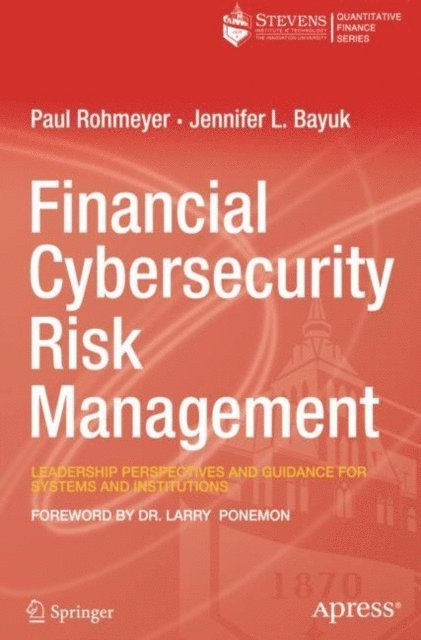
Financial Cybersecurity Risk Management explores a range of cybersecurity topics impacting financial enterprises. This includes the threat and vulnerability landscape confronting the financial sector, risk assessment practices and methodologies, and cybersecurity data analytics. Governance perspectives, including executive and board considerations, are analyzed as are the appropriate control measures and executive risk reporting.
What You’ll Learn
Analyze the threat and vulnerability landscape confronting the financial sectorImplement effective technology risk assessment practices and methodologiesCraft strategies to treat observed risks in financial systemsImprove the effectiveness of enterprise cybersecurity capabilitiesEvaluate critical aspects of cybersecurity governance, including executive and board oversightIdentify significant cybersecurity operational challengesConsider the impact of the cybersecurity mission across the enterpriseLeverage cybersecurity regulatory and industry standards to help manage financial services risksUse cybersecurity scenarios to measure systemic risks in financial systems environmentsApply key experiences from actual cybersecurity events to develop more robust cybersecurity architecturesWho This Book Is For
Decision makers, cyber leaders, and front-line professionals, including: chief risk officers, operational risk officers, chief information security officers, chief security officers, chief information officers, enterprise risk managers, cybersecurity operations directors, technology and cybersecurity risk analysts, cybersecurity architects and engineers, and compliance officers