Jeroen Tromp - Böcker
Visar alla böcker från författaren Jeroen Tromp. Handla med fri frakt och snabb leverans.
3 produkter
3 produkter
948 kr
Skickas inom 7-10 vardagar
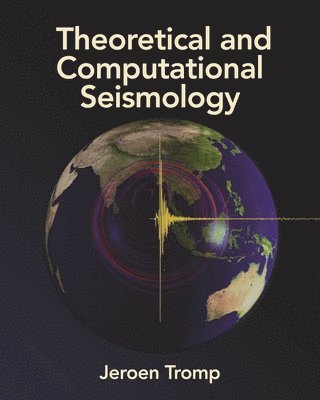
After every major earthquake, the Earth rings like a bell for several days. These free oscillations of the Earth and the related propagating body and surface waves are routinely detected at broad-band seismographic stations around the world. In this book, F. A. Dahlen and Jeroen Tromp present an advanced theoretical treatment of global seismology, describing the normal-mode, body-wave, and surface-wave methods employed in the determination of the Earth's three-dimensional internal structure and the source mechanisms of earthquakes. The authors provide a survey of both the history of global seismological research and the major theoretical and observational advances made in the past decade. The book is divided into three parts. In the first, "Foundations," Dahlen and Tromp give an extensive introduction to continuum mechanics and discuss the representation of seismic sources and the free oscillations of a completely general Earth model. The resulting theory should provide the basis for future scientific discussions of the elastic-gravitational deformation of the Earth. The second part, "The Spherical Earth," is devoted to the free oscillations of a spherically symmetric Earth.In the third part, "The Aspherical Earth," the authors discuss methods of dealing with the Earth's three-dimensional heterogeneity. The book is concerned primarily with the forward problem of global seismology--detailing how synthetic seismograms and spectra may be calculated and interpreted. As a long-needed unification of theories in global seismology, the book will be important to graduate students and to professional seismologists, geodynamicists, and geomagnetists, as well as to astronomers who study the free oscillations of the Sun and other stars.
712 kr
Skickas inom 7-10 vardagar
An authoritative, self-contained reference text on theoretical and computational seismologyOver the past several decades, computational advances have revolutionized seismology, making it possible to simulate seismic wave propagation in complex Earth models and create detailed images of the planet’s interior. This cutting-edge text introduces students and scholars to the fundamentals, techniques, and applications of this exciting field of research and discovery.After establishing a strong foundation in continuum mechanics, the book presents the fundamentals of theoretical seismology, providing a basis for subsequent forward and inverse modeling grounded in numerical methods, and then focuses on computational seismology, investigating numerical solutions to seismic wave equations. The adjoint-state method is covered next, along with applications of this technique to waveform inversions across scales, after which the book concludes with a set of appendixes that provide a primer to differential geometry and tensor calculus, which are used throughout the book to explain the fundamental concepts of deformation, strain, and stress from both Eulerian and Lagrangian perspectives. Including over 150 student-tested exercises, the book is an essential resource for motivated students and scholars seeking to master the state of the art of theoretical and computational seismology.Establishes a strong foundation through a geometric analysis of continuum mechanicsReveals how linearizing the resulting equations of motion enables the simulation of seismic wave propagation across nine decades of frequencies and wavelengthsDemonstrates how to leverage the capabilities of simulations to create detailed tomographic images from the information embedded in seismographic recordingsCovers diverse application areas, including seismology, helioseismology, underwater acoustics, medical imaging, and nondestructive testingFeatures a wealth of exercises (with online solutions)Includes a comprehensive set of appendixes on differential geometry and tensor calculusAn ideal textbook for graduate students studying theoretical seismology, computational seismology, or optimization and inverse problemsAn essential reference for researchers and scholars
399 kr
Skickas inom 7-10 vardagar
An authoritative, self-contained introduction to geometrical tensor calculus for scientists and engineersTensors are widely used in physics and engineering to describe physical properties that have multiple dimensions and magnitudes. In recent years, they have become increasingly important for data analytics and machine learning, allowing for the representation and processing of data in neural networks and the modeling of complex relationships in multidimensional spaces. This incisive book provides a geometrical understanding of tensors and their calculus from the point of view of a physicist. With a wealth of examples presented in visually engaging boxes, it takes readers through all aspects of geometrical continuum mechanics and the field and dynamic equations of Einstein, Einstein-Cartan, and metric-affine theories of general relativity. A Geometrical Introduction to Tensor Calculus gives graduate students, advanced undergraduates, and researchers a powerful and mathematically elegant tool for comprehending the behavior and applications of tensors across an array of fields.Offers a physicist’s perspective on geometrical tensor calculusIncludes dozens of examples that illustrate the geometrical use of tensors in continuum mechanics and general relativityCan serve as the basis for a course in tensor calculus for physicists and engineersInvaluable as a supplementary guide for anyone studying areas of physics that rely on tensor calculus, such as electrodynamics, geophysics, fluid and continuum mechanics, and general relativity