J.H. Erik Andriessen – författare
Visar alla böcker från författaren J.H. Erik Andriessen. Handla med fri frakt och snabb leverans.
5 produkter
5 produkter
E-bok
PDF, Engelska, 2012708 kr
Läs direkt efter köp
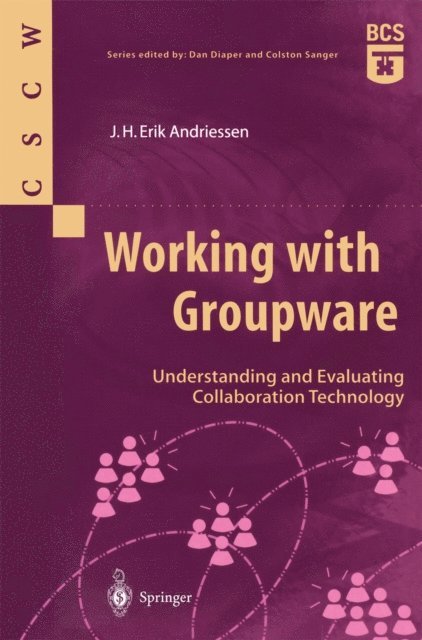
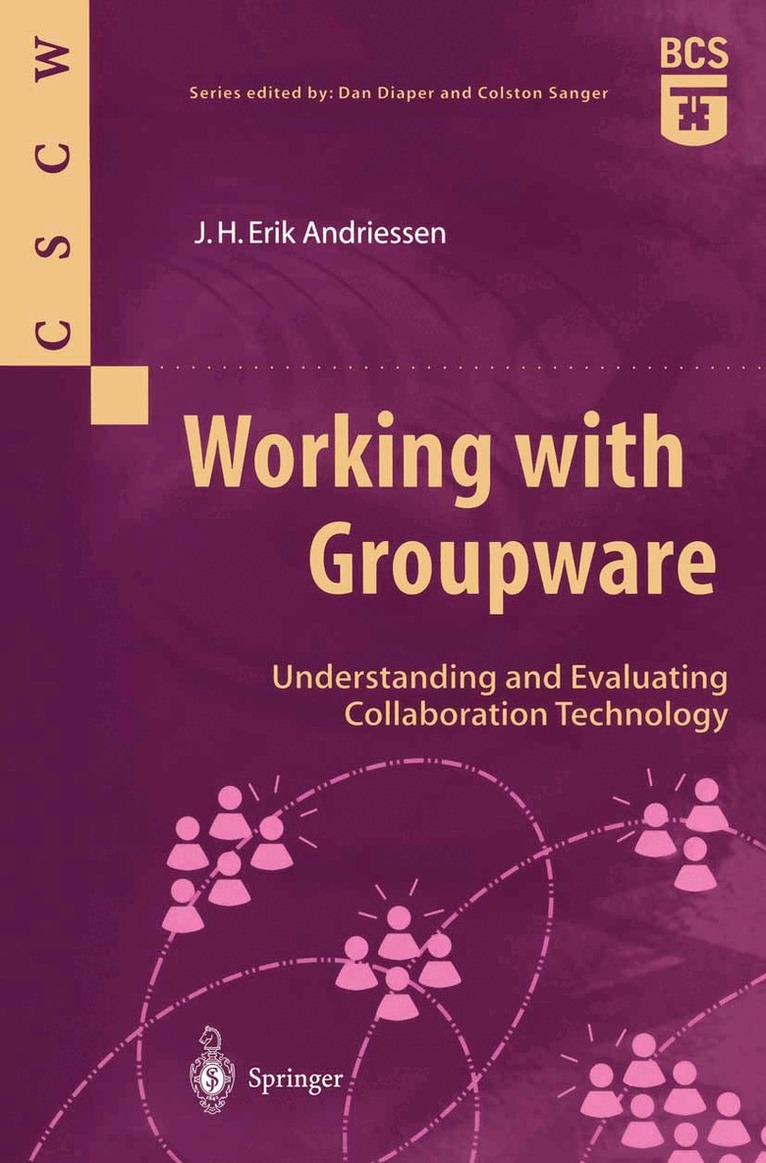
This publication has grown out of two frustrations. One is the experience that so many applications in the area of information and communication technology (lCT) are built without an eye to what the users can handle or need for their work, systematic user oriented evaluation of new tools is therefore limited. The video recorder provides a good general example of this phenomenon, but more worryingly so do many software tools designed for use in organisations. The other frustration arises from the fact that the people and the theories that can be used to provide this much needed user orientation are scattered over many disciplines and communities. There is considerable knowledge available about task performance, human communication and group interaction and the way in which new ICT -tools can be used to support these processes, but scientists do not know each other, the studies, theories, journals and conferences are produced by different communities in isolation and little cross fertilisation takes place. In this book I have tried to bring together knowledge from various disciplines, as the basis for constructing a design oriented evaluation approach that hopefully contributes to providing a user orientation for new (technical) systems.
Häftad, Engelska, 2002
565 kr
Skickas inom 10-15 vardagar
This publication has grown out of two frustrations. One is the experience that so many applications in the area of information and communication technology (lCT) are built without an eye to what the users can handle or need for their work, systematic user oriented evaluation of new tools is therefore limited. The video recorder provides a good general example of this phenomenon, but more worryingly so do many software tools designed for use in organisations. The other frustration arises from the fact that the people and the theories that can be used to provide this much needed user orientation are scattered over many disciplines and communities. There is considerable knowledge available about task performance, human communication and group interaction and the way in which new ICT -tools can be used to support these processes, but scientists do not know each other, the studies, theories, journals and conferences are produced by different communities in isolation and little cross fertilisation takes place. In this book I have tried to bring together knowledge from various disciplines, as the basis for constructing a design oriented evaluation approach that hopefully contributes to providing a user orientation for new (technical) systems.
Inbunden, Engelska, 2005
1 634 kr
Skickas inom 10-15 vardagar
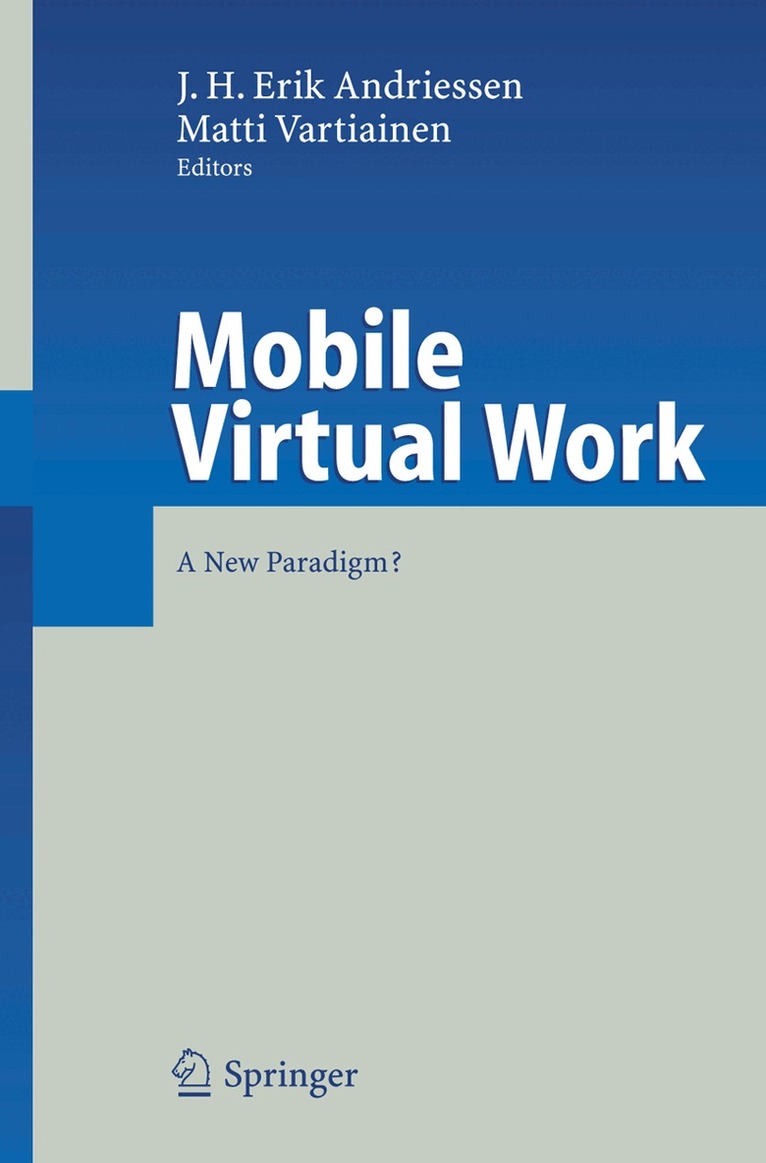
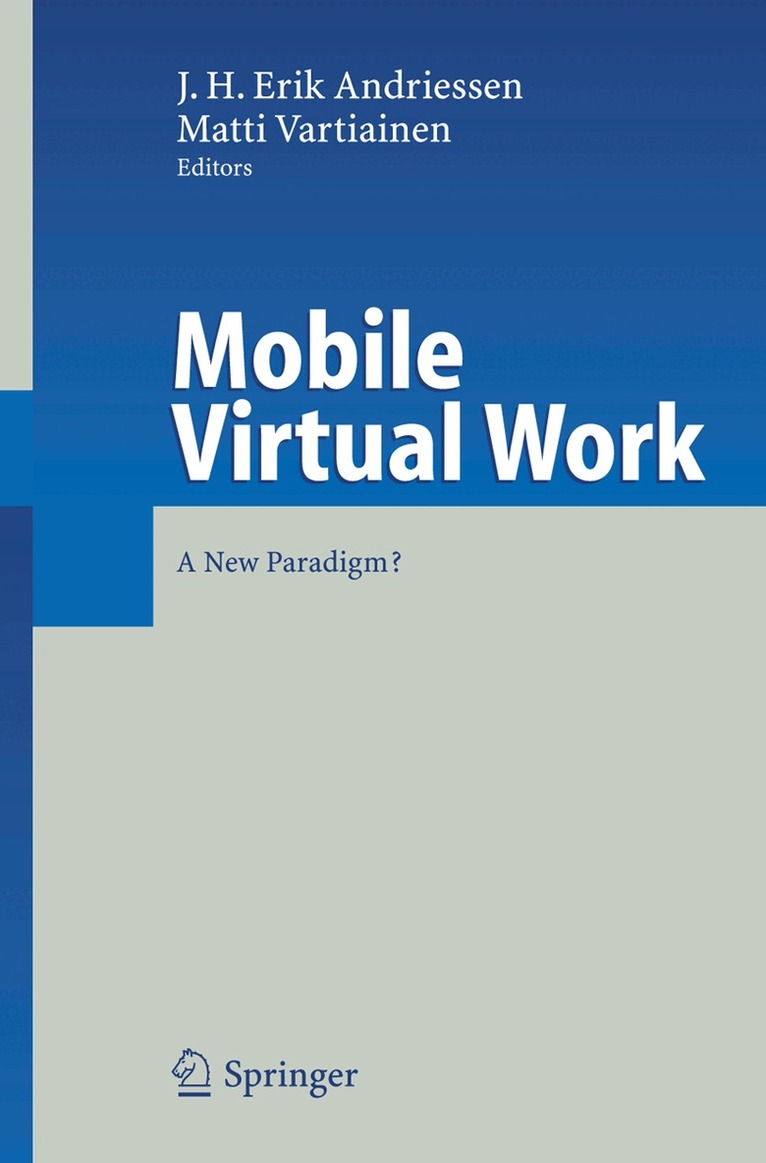
Dear Reader This is a book about mobile virtual work. It aims at clarifying the basic concepts and showing present practices and future challenges. The roots of the book are in the collaboration of few European practitioners and - searchers, who met each other under the umbrella of the Swedish SALTSA programme (see next page) in January 2002 in Stockholm. The group was first called ‘ICT, Mobility and Work Organisation’ but redefined itself quickly as ‘Mobile Virtual Cooperative Work’ group. The change of the name reflects the development of reasoning in the group. We could not find much material on mobile work, certainly not systematic studies, - though a growing interest in mobile technologies and services could be found. Practices of telework and virtual organizations were better known, but we were convinced that the combination with mobile work was so- thing different and new. Our main target became to understand what it was all about. The next step was an expert meeting in October 2004 at Rånäs Castle again in Sweden. A wider group of experts was invited to present their views on mobile virtual work and ideas about book chapters from different perspectives of working life. Some of the expertise could be found through the network of the AMI@Work family created by the New Working En- ronments unit of the European Commission’s Information Society Dir- torate-General. Also close collaboration was developed with the related MOSAIC program.
E-bok
PDF, Engelska, 20051 977 kr
Läs direkt efter köp
Dear Reader This is a book about mobile virtual work. It aims at clarifying the basic concepts and showing present practices and future challenges. The roots of the book are in the collaboration of few European practitioners and - searchers, who met each other under the umbrella of the Swedish SALTSA programme (see next page) in January 2002 in Stockholm. The group was first called ‘ICT, Mobility and Work Organisation’ but redefined itself quickly as ‘Mobile Virtual Cooperative Work’ group. The change of the name reflects the development of reasoning in the group. We could not find much material on mobile work, certainly not systematic studies, - though a growing interest in mobile technologies and services could be found. Practices of telework and virtual organizations were better known, but we were convinced that the combination with mobile work was so- thing different and new. Our main target became to understand what it was all about. The next step was an expert meeting in October 2004 at Rånäs Castle again in Sweden. A wider group of experts was invited to present their views on mobile virtual work and ideas about book chapters from different perspectives of working life. Some of the expertise could be found through the network of the AMI@Work family created by the New Working En- ronments unit of the European Commission’s Information Society Dir- torate-General. Also close collaboration was developed with the related MOSAIC program.
Häftad, Engelska, 2010
1 634 kr
Skickas inom 10-15 vardagar
Dear Reader This is a book about mobile virtual work. It aims at clarifying the basic concepts and showing present practices and future challenges. The roots of the book are in the collaboration of few European practitioners and - searchers, who met each other under the umbrella of the Swedish SALTSA programme (see next page) in January 2002 in Stockholm. The group was first called ‘ICT, Mobility and Work Organisation’ but redefined itself quickly as ‘Mobile Virtual Cooperative Work’ group. The change of the name reflects the development of reasoning in the group. We could not find much material on mobile work, certainly not systematic studies, - though a growing interest in mobile technologies and services could be found. Practices of telework and virtual organizations were better known, but we were convinced that the combination with mobile work was so- thing different and new. Our main target became to understand what it was all about. The next step was an expert meeting in October 2004 at Rånäs Castle again in Sweden. A wider group of experts was invited to present their views on mobile virtual work and ideas about book chapters from different perspectives of working life. Some of the expertise could be found through the network of the AMI@Work family created by the New Working En- ronments unit of the European Commission’s Information Society Dir- torate-General. Also close collaboration was developed with the related MOSAIC program.