Jian-Xin Xu - Böcker
Visar alla böcker från författaren Jian-Xin Xu. Handla med fri frakt och snabb leverans.
10 produkter
10 produkter
1 578 kr
Skickas inom 10-15 vardagar
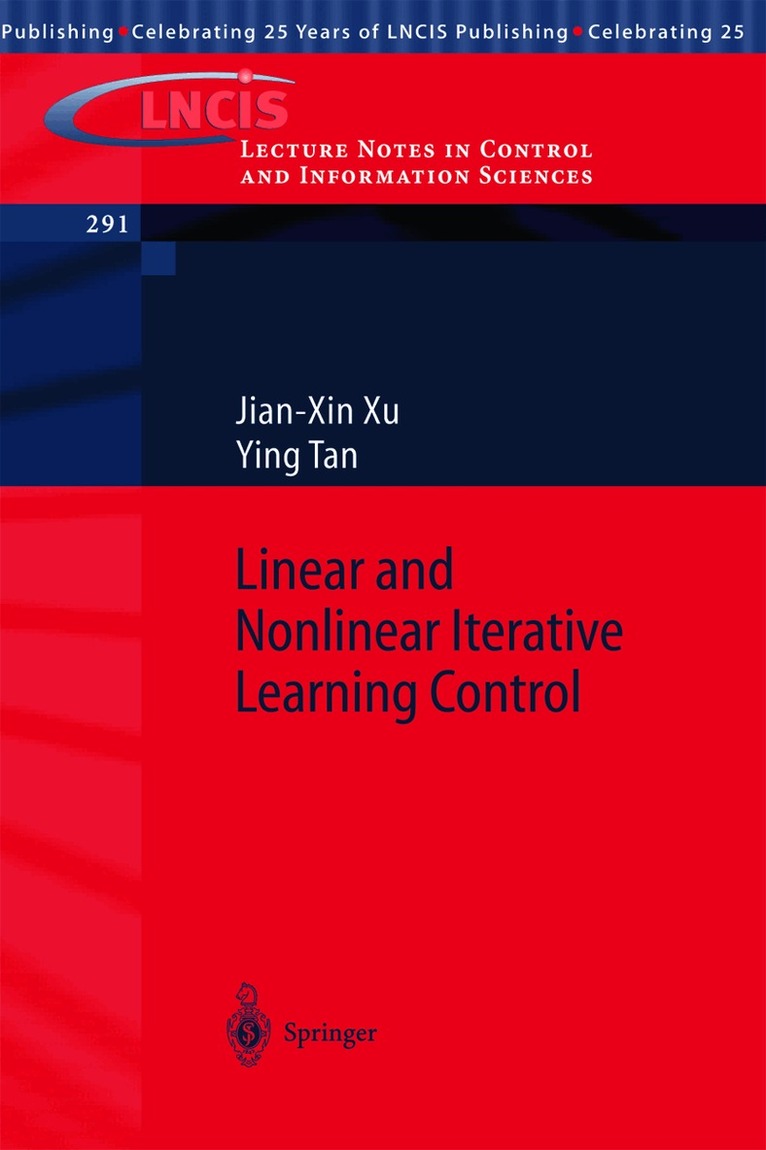
This overview of iterative learning control theory and techniques is relevant to industrial automation, and focuses on research directions for the 21st century. It examines the important aspects of this emerging technology, and provides coverage of ILC's history, its expanding real-world applications, and its robustness and convergence. Also included are sampled-data and discrete-time issues, design guidelines and quadratic criterion, the ability of dynamic systems to learn, time-delay problems, integration (with neural network, fuzzy logic and wavelet), direct learning, and identification, in addition to ILC's possible applications to batch and welding processes, neuromuscular stimulation, and other fast-changing fields. This volume should be of interest to researchers and engineers in robotics, automation, systems and control, and signal processing.
1 429 kr
Skickas inom 7-10 vardagar
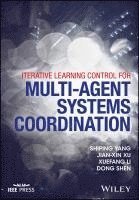
A timely guide using iterative learning control (ILC) as a solution for multi-agent systems (MAS) challenges, showcasing recent advances and industrially relevant applications Explores the synergy between the important topics of iterative learning control (ILC) and multi-agent systems (MAS)Concisely summarizes recent advances and significant applications in ILC methods for power grids, sensor networks and control processesCovers basic theory, rigorous mathematics as well as engineering practice
1 578 kr
Skickas inom 10-15 vardagar
Iterative Learning Control (ILC) differs from most existing control methods in the sense that, it exploits every possibility to incorporate past control informa tion, such as tracking errors and control input signals, into the construction of the present control action. There are two phases in Iterative Learning Control: first the long term memory components are used to store past control infor mation, then the stored control information is fused in a certain manner so as to ensure that the system meets control specifications such as convergence, robustness, etc. It is worth pointing out that, those control specifications may not be easily satisfied by other control methods as they require more prior knowledge of the process in the stage of the controller design. ILC requires much less information of the system variations to yield the desired dynamic be haviors. Due to its simplicity and effectiveness, ILC has received considerable attention and applications in many areas for the past one and half decades. Most contributions have been focused on developing new ILC algorithms with property analysis. Since 1992, the research in ILC has progressed by leaps and bounds. On one hand, substantial work has been conducted and reported in the core area of developing and analyzing new ILC algorithms. On the other hand, researchers have realized that integration of ILC with other control techniques may give rise to better controllers that exhibit desired performance which is impossible by any individual approach.
1 064 kr
Skickas inom 10-15 vardagar
Real-time Iterative Learning Control demonstrates how the latest advances in iterative learning control (ILC) can be applied to a number of plants widely encountered in practice. The book gives a systematic introduction to real-time ILC design and source of illustrative case studies for ILC problem solving; the fundamental concepts, schematics, configurations and generic guidelines for ILC design and implementation are enhanced by a well-selected group of representative, simple and easy-to-learn example applications. Key issues in ILC design and implementation in linear and nonlinear plants pervading mechatronics and batch processes are addressed, in particular: ILC design in the continuous- and discrete-time domains; design in the frequency and time domains; design with problem-specific performance objectives including robustness and optimality; design in a modular approach by integration with other control techniques; and design by means of classical tools based on Bode plots and state space.
1 064 kr
Skickas inom 10-15 vardagar
Real-time Iterative Learning Control demonstrates how the latest advances in iterative learning control (ILC) can be applied to a number of plants widely encountered in practice. The book gives a systematic introduction to real-time ILC design and source of illustrative case studies for ILC problem solving; the fundamental concepts, schematics, configurations and generic guidelines for ILC design and implementation are enhanced by a well-selected group of representative, simple and easy-to-learn example applications. Key issues in ILC design and implementation in linear and nonlinear plants pervading mechatronics and batch processes are addressed, in particular: ILC design in the continuous- and discrete-time domains; design in the frequency and time domains; design with problem-specific performance objectives including robustness and optimality; design in a modular approach by integration with other control techniques; and design by means of classical tools based on Bode plots and state space.
1 473 kr
Skickas inom 10-15 vardagar
This monograph summarizes the recent achievements made in the field of iterative learning control. The book is self-contained in theoretical analysis and can be used as a reference or textbook for a graduate level course as well as for self-study. It opens a new avenue towards a new paradigm in deterministic learning control theory accompanied by detailed examples.
1 578 kr
Skickas inom 10-15 vardagar
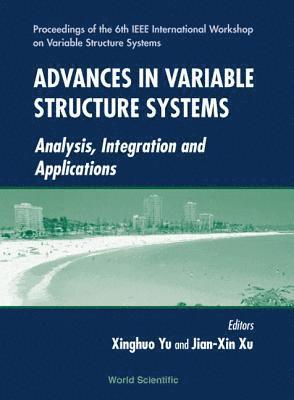
The book is a collection of papers concerning the theories, applications and perspectives of Variable Structure Systems (VSS), which have been a main control design methodology. The 20th century has seen the formation and consolidation of VSS theory and its applications. It has also seen an emerging trend of cross-fertilization and integration of VSS with other control and non-control areas such as feedback linearization, flatness, passivity based control, adaptive and learning control, system identification, pulse width modulation, geometric and algebraic methods, artificial intelligence, modeling and optimization, neural networks, fuzzy logic, to name just a few. To reflect these major developments in the 20th century, this book includes specially invited surveys and contributions from well-known experts in VSS as well as selected extended papers from the 6th International Workshop on VSS held on the Gold Coast, Australia 7-9 December 2000.
Advances In Variable Structure Systems: Analysis, Integration And Application - Proceedings Of The 6th Ieee International Workshop On Variable Structure Systems
Inbunden, Engelska, 2000
3 358 kr
Tillfälligt slut
The last of such a workshop in the 20th Century, this workshop aims not only to summarize the state-of-the-art developments in VSS theory and applications, but also identify new promising directions perceived as being important for VSS in the 21st century. The 20th Century has witnessed the formation and consolidation of VSS theory and its applications. It has also witnessed an emerging trend of cross-fertilization and integration of VSS with other control and non-control areas such as feedback linearization, flatness, passivity based control, adaptive control, system identification, pulse width modulation, Hinf, geometric and algebraic methods, artificial intelligence, modelling and optimisation, neural networks, fuzzy logic, etc. This trend will continue and flourish in the new millennium.Special features of the book include a survey paper entitled “VSS Premise of XX Century: Evidences of a Witness” by the father of VSS theory Professor Vadim Utkin and other articles by many authoritative experts in VSS.
1 064 kr
Skickas inom 10-15 vardagar
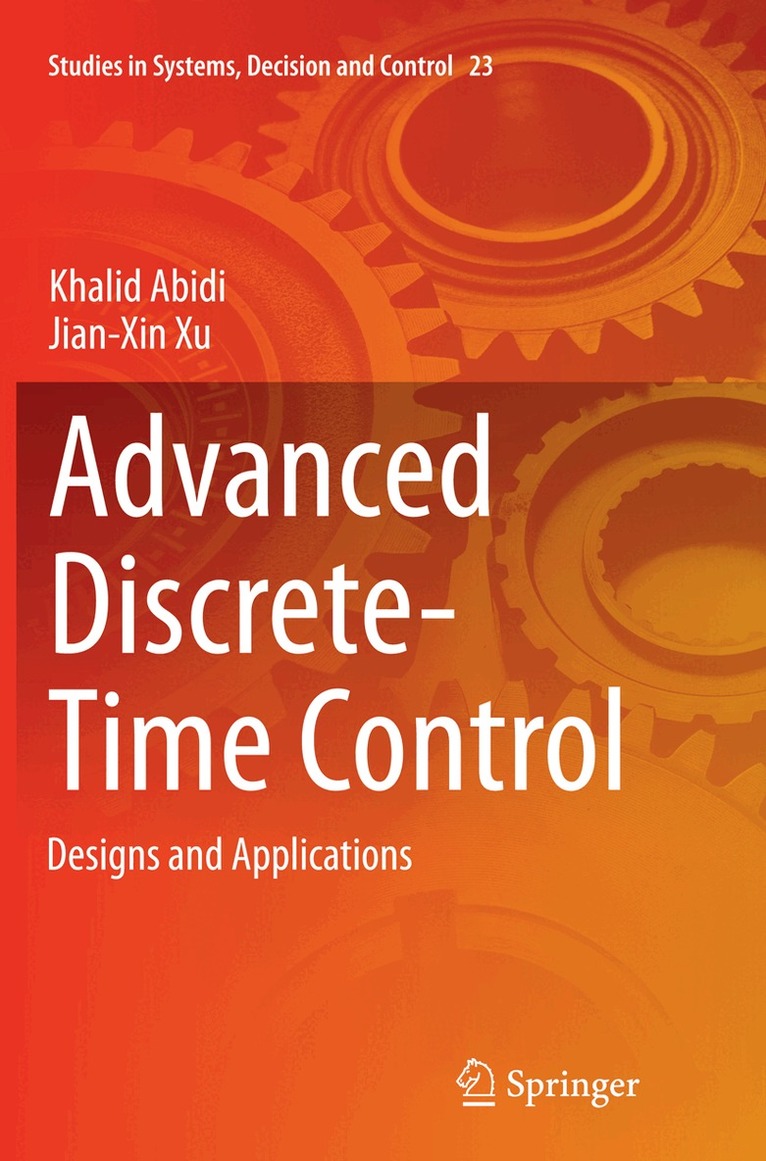
This book covers a wide spectrum of systems such as linear and nonlinear multivariable systems as well as control problems such as disturbance, uncertainty and time-delays. The purpose of this book is to provide researchers and practitioners a manual for the design and application of advanced discrete-time controllers. The book presents six different control approaches depending on the type of system and control problem. The first and second approaches are based on Sliding Mode control (SMC) theory and are intended for linear systems with exogenous disturbances. The third and fourth approaches are based on adaptive control theory and are aimed at linear/nonlinear systems with periodically varying parametric uncertainty or systems with input delay. The fifth approach is based on Iterative learning control (ILC) theory and is aimed at uncertain linear/nonlinear systems with repeatable tasks and the final approach is based on fuzzy logic control (FLC) and is intended for highly uncertain systems with heuristic control knowledge. Detailed numerical examples are provided in each chapter to illustrate the design procedure for each control method. A number of practical control applications are also presented to show the problem solving process and effectiveness with the advanced discrete-time control approaches introduced in this book.
1 064 kr
Skickas inom 10-15 vardagar
This book covers a wide spectrum of systems such as linear and nonlinear multivariable systems as well as control problems such as disturbance, uncertainty and time-delays. The purpose of this book is to provide researchers and practitioners a manual for the design and application of advanced discrete-time controllers. The book presents six different control approaches depending on the type of system and control problem. The first and second approaches are based on Sliding Mode control (SMC) theory and are intended for linear systems with exogenous disturbances. The third and fourth approaches are based on adaptive control theory and are aimed at linear/nonlinear systems with periodically varying parametric uncertainty or systems with input delay. The fifth approach is based on Iterative learning control (ILC) theory and is aimed at uncertain linear/nonlinear systems with repeatable tasks and the final approach is based on fuzzy logic control (FLC) and is intended for highly uncertain systems with heuristic control knowledge. Detailed numerical examples are provided in each chapter to illustrate the design procedure for each control method. A number of practical control applications are also presented to show the problem solving process and effectiveness with the advanced discrete-time control approaches introduced in this book.