Joao Labrincha - Böcker
Visar alla böcker från författaren Joao Labrincha. Handla med fri frakt och snabb leverans.
3 produkter
3 produkter
Eco-efficient Construction and Building Materials
Life Cycle Assessment (LCA), Eco-Labelling and Case Studies
Inbunden, Engelska, 2013
2 508 kr
Skickas inom 7-10 vardagar
Eco-efficient Construction and Building Materials reviews ways of assessing the environmental impact of construction and building materials. Part one discusses the application of life cycle assessment (LCA) methodology to building materials as well as eco-labeling. Part two includes case studies showing the application of LCA methodology to different types of building material, from cement and concrete to wood and adhesives used in building. Part three includes case studies applying LCA methodology to particular structures and components. Reviews ways of assessing the environmental impact of construction and building materials Provides a thorough overview, including strengths and shortcomings, of the life cycle assessment (LCA) and eco-labeling of eco-efficient construction and building materials Includes case studies showing the application of LCA methodology to different types of building material, from cement and concrete to wood and adhesives used in building
2 995 kr
Skickas inom 7-10 vardagar
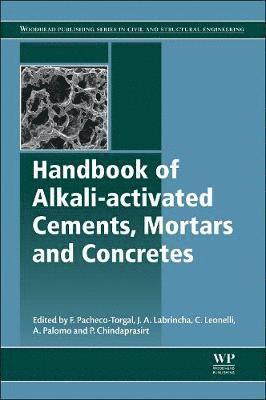
This book provides an updated state-of-the-art review on new developments in alkali-activation. The main binder of concrete, Portland cement, represents almost 80% of the total CO2 emissions of concrete which are about 6 to 7% of the Planet's total CO2 emissions. This is particularly serious in the current context of climate change and it could get even worse because the demand for Portland cement is expected to increase by almost 200% by 2050 from 2010 levels, reaching 6000 million tons/year. Alkali-activated binders represent an alternative to Portland cement having higher durability and a lower CO2 footprint. Reviews the chemistry, mix design, manufacture and properties of alkali-activated cement-based concrete binders Considers performance in adverse environmental conditions. Offers equal emphasis on the science behind the technology and its use in civil engineering.
2 691 kr
Skickas inom 7-10 vardagar
Masonry walls constitute the interface between the building's interior and the outdoor environment. Masonry walls are traditionally composed of fired-clay bricks (solid or perforated) or blocks (concrete or earth-based), but in the past (and even in the present) they were often associated as needing an extra special thermal and acoustical insulation layer. However, over more recent years investigations on thermal and acoustical features has led to the development of new improved bricks and blocks that no longer need these insulation layers. Traditional masonry units (fired-clay bricks, concrete or earth-based blocks) that don't offer improved performance in terms of thermal and acoustical insulation are a symbol of a low-technology past, that are far removed from the demands of sustainable construction.This book provides an up-to-date state-of-the-art review on the eco-efficiency of masonry units, particular emphasis is placed on the design, properties, performance, durability and LCA of these materials. Since masonry units are also an excellent way to reuse bulk industrial waste the book will be important in the context of the Revised Waste Framework Directive 2008/98/EC which states that the minimum reuse and recycling targets for construction and demolition waste (CDW) should be at least 70% by 2020. On the 9th of March 2011 the European Union approved the Regulation (EU) 305/2011, known as the Construction Products Regulation (CPR) and it will be enforced after the 1st of July 2013. The future commercialization of construction materials in Europe makes their environmental assessment mandatory meaning that more information related to the environmental performance of building materials is much needed. Provides an authoritative guide to the eco-efficiency of masonry units Examines the reuse of waste materials Covers a range of materials including, clay, cement, earth and pumice