Joe Finney – författare
Visar alla böcker från författaren Joe Finney. Handla med fri frakt och snabb leverans.
4 produkter
4 produkter
Häftad, Engelska, 2001
565 kr
Skickas inom 10-15 vardagar
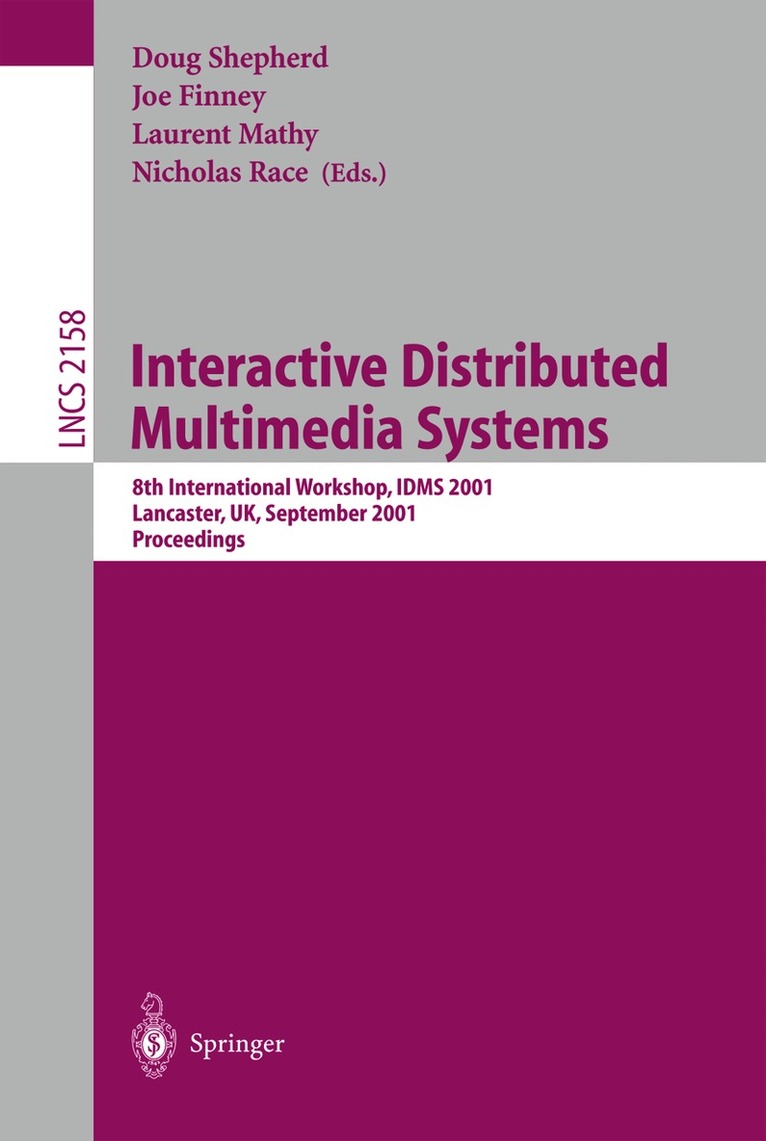
th We are very happy to present the proceedings of the 8 International Workshop on Interactive Distributed Multimedia Systems IDMS 2001, in co-operation with ACM SIGCOMM and SIGMM. These proceedings contain the technical programme for IDMS 2001, held September 4 7, 2001 in Lancaster, UK. For the technical programme this year we received 48 research papers from both a- demic and industrial institutions all around the world. After the review process, 15 were accepted as full papers for publication, and a further 8 as short positional papers, intended to provoke debate. The technical programme was complimented by three invited papers: QoS for Multimedia What’s Going to Make It Pay? by Derek McAuley, E nabling the Internet to Provide Multimedia Services by Markus H- mann, and MPEG-21 Standard: Why an Open Multimedia Framework? by Fernando Pereira. The organisers are very grateful for the help they received to make IDMS 2001 a successful event. In particular, we would like to thank the PC for their first class - views of papers, particularly considering the tight reviewing deadlines this year. Also, we would like to acknowledge the support from Agilent, BTexact Technologies, Hewlett Packard, Microsoft Research, Orange, and Sony Electronics without whom IDMS 2001 would not have been such a memorable event. We hope that readers will find these proceedings helpful in their future research, and that IDMS will continue to be an active forum for the discussion of distributed mul- media research for years to come.
E-bok
PDF, Engelska, 2003708 kr
Läs direkt efter köp
th We are very happy to present the proceedings of the 8 International Workshop on Interactive Distributed Multimedia Systems IDMS 2001, in co-operation with ACM SIGCOMM and SIGMM. These proceedings contain the technical programme for IDMS 2001, held September 4 7, 2001 in Lancaster, UK. For the technical programme this year we received 48 research papers from both a- demic and industrial institutions all around the world. After the review process, 15 were accepted as full papers for publication, and a further 8 as short positional papers, intended to provoke debate. The technical programme was complimented by three invited papers: QoS for Multimedia What’s Going to Make It Pay? by Derek McAuley, E nabling the Internet to Provide Multimedia Services by Markus H- mann, and MPEG-21 Standard: Why an Open Multimedia Framework? by Fernando Pereira. The organisers are very grateful for the help they received to make IDMS 2001 a successful event. In particular, we would like to thank the PC for their first class - views of papers, particularly considering the tight reviewing deadlines this year. Also, we would like to acknowledge the support from Agilent, BTexact Technologies, Hewlett Packard, Microsoft Research, Orange, and Sony Electronics without whom IDMS 2001 would not have been such a memorable event. We hope that readers will find these proceedings helpful in their future research, and that IDMS will continue to be an active forum for the discussion of distributed mul- media research for years to come.
Häftad, Engelska, 2007
548 kr
Skickas inom 10-15 vardagar
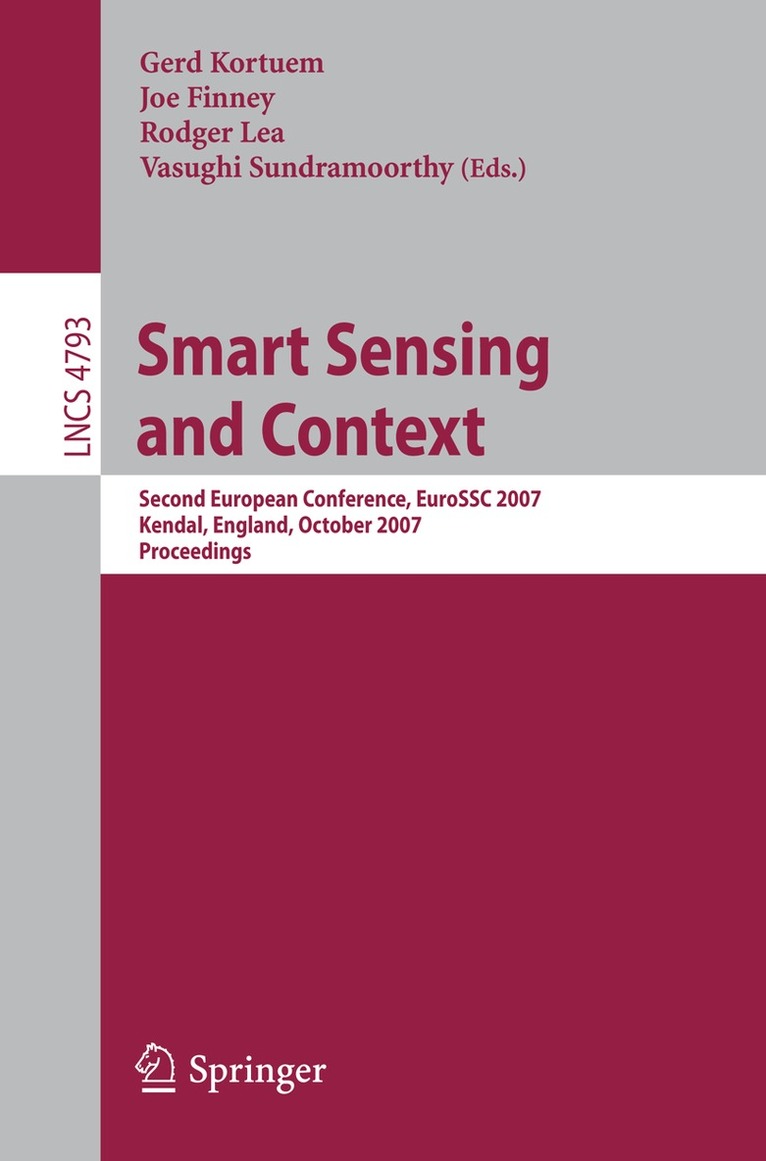
On behalf of the organizing committee for EuroSSC 2007, we would like to welcome you to the proceedings of the second European Conference on Smart Sensing and Context. Although only in its second year, EuroSSC has already begun to attract significant interest from researchers in the rapidly evolving area of embedded sensing and intelligent objects in support of smart surroundings. Building on the success of the previous conference held in Enschede, The Netherlands, EuroSSC 2007 aimed to reflect two complementary viewpoints: a technology-driven viewpoint which encompasses the diversity of intelligent sensing and associated information processing and a user-driven viewpoint exploring scenarios, applications and interaction methods as they relate to smart surroundings. This year the conference received a total of 51 paper submissions. These represented contributions from 21 countries from Europe, the Middle East, and Africa (69%); Asia (21%); and North America (10%). This obviously reflects the European origins of the conference. However we were particularly pleased by the high number of submissions from Asia reflecting the range and diversity of relevant work in that region. From these the program committee selected 17 papers (33%) for presentation at the conference after a rigorous review process. Every paper received at least three independent reviews, most received four and some five reviews.
E-bok
PDF, Engelska, 2007708 kr
Läs direkt efter köp
On behalf of the organizing committee for EuroSSC 2007, we would like to welcome you to the proceedings of the second European Conference on Smart Sensing and Context. Although only in its second year, EuroSSC has already begun to attract significant interest from researchers in the rapidly evolving area of embedded sensing and intelligent objects in support of smart surroundings. Building on the success of the previous conference held in Enschede, The Netherlands, EuroSSC 2007 aimed to reflect two complementary viewpoints: a technology-driven viewpoint which encompasses the diversity of intelligent sensing and associated information processing and a user-driven viewpoint exploring scenarios, applications and interaction methods as they relate to smart surroundings. This year the conference received a total of 51 paper submissions. These represented contributions from 21 countries from Europe, the Middle East, and Africa (69%); Asia (21%); and North America (10%). This obviously reflects the European origins of the conference. However we were particularly pleased by the high number of submissions from Asia reflecting the range and diversity of relevant work in that region. From these the program committee selected 17 papers (33%) for presentation at the conference after a rigorous review process. Every paper received at least three independent reviews, most received four and some five reviews.