Joel Frykholm – författare
Visar alla böcker från författaren Joel Frykholm. Handla med fri frakt och snabb leverans.
5 produkter
5 produkter
E-bok
PDF, Engelska, 2020139 kr
Läs direkt efter köp
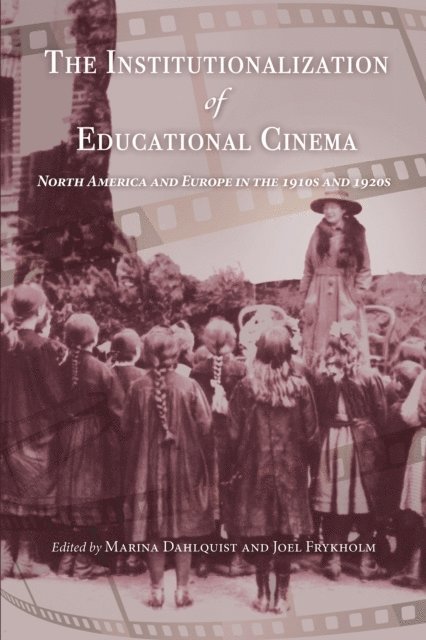
Essays by scholars on how film has been used by schools, libraries, governments, and organizations for educational purposes. The potential of films to educate has been crucial for the development of cinema intended to influence culture, and is as important as conceptions of film as a form of art, science, industry, or entertainment. Using the concept of institutionalization as a heuristic for generating new approaches to the history of educational cinema, contributors to this volume study the co-evolving discourses, cultural practices, technical standards, and institutional frameworks that transformed educational cinema from a convincing idea into an enduring genre. The Institutionalization of Educational Cinema examines the methods of production, distribution, and exhibition established for the use of educational films within institutions such as schools, libraries, and industrial settings in various national and international contexts and takes a close look at the networks of organizations, individuals, and government agencies that were created as a result of these films' circulation. Through case studies of educational cinemas in different North American and European countries that explore various modes of institutionalization of educational film, this book highlights the wide range of vested interests that framed the birth of educational and nontheatrical cinema.
E-bok
Engelska, 20191 473 kr
Läs direkt efter köp
George Kleine was a New York City optician who moved to Chicago in 1893 to set up an optical store. In 1896 he branched out and began selling motion picture equipment and films. Within a few years he becameAmerica''s largest film distributor and a pivotal figure in the movie business. In chronicling the career of this motion picture pioneer – including his rapid rise to fame and fortune, but also his gradual downfall after 1915 as the era of Hollywood began – Joel Frykholm provides an in-depth account of the emergence of the motion picture business in the United States and its development throughout the silent era. Through the lens of Kleine''s fascinating career, this book explores how motion pictures gradually transformed from a novelty into an economic and cultural institution central to both American life and an increasingly globalised culture of mass entertainment.
Inbunden, Engelska, 2015
1 407 kr
Skickas inom 10-15 vardagar
George Kleine was a New York City optician who moved to Chicago in 1893 to set up an optical store. In 1896 he branched out and began selling motion picture equipment and films. Within a few years he becameAmerica's largest film distributor and a pivotal figure in the movie business.In chronicling the career of this motion picture pioneer – including his rapid rise to fame and fortune, but also his gradual downfall after 1915 as the era of Hollywood began – Joel Frykholm provides an in-depth account of the emergence of the motion picture business in the United States and its development throughout the silent era. Through the lens of Kleine's fascinating career, this book explores how motion pictures gradually transformed from a novelty into an economic and cultural institution central to both American life and an increasingly globalised culture of mass entertainment.
E-bok
PDF, Engelska, 20151 473 kr
Läs direkt efter köp
George Kleine was a New York City optician who moved to Chicago in 1893 to set up an optical store. In 1896 he branched out and began selling motion picture equipment and films. Within a few years he becameAmerica''s largest film distributor and a pivotal figure in the movie business. In chronicling the career of this motion picture pioneer – including his rapid rise to fame and fortune, but also his gradual downfall after 1915 as the era of Hollywood began – Joel Frykholm provides an in-depth account of the emergence of the motion picture business in the United States and its development throughout the silent era. Through the lens of Kleine''s fascinating career, this book explores how motion pictures gradually transformed from a novelty into an economic and cultural institution central to both American life and an increasingly globalised culture of mass entertainment.
Häftad, Engelska, 2015
177 kr
Skickas inom 5-8 vardagar
This dissertation addresses the breakthrough of the multi-reel feature film in the United States, and the significance of this process within the wider context of the American film industry and culture in the 1910s. The purpose is to provide a new, and more comprehensive analytical framing of the topic, and to enhance our understanding of how a new central commodity, i.e. the multi-reel feature film, changed the conditions for film exhibition and reception. The introduction links the breakthrough of the multi-reel feature film to an array of film-historical transformations unfolding in the US around the same time. A critical assessment of previous scholarly work dealing with the early feature is also provided. Part I analyzes how the breakthrough of the multi-reel feature film was negotiated within the trade and by contemporary commentators. The result is a multi-perspective framing of the topic that highlights the complexity of these cultural negotiations and the uncertainty over cinema's possible futures. Part II shifts attention to film culture and film exhibition in Philadelphia around 1914. The objective of this case study, largely based on newspaper sources, is to examine how the increasingly common multi-reel feature film was integrated into and/or changed the existing film culture in the city. The main conclusion is that experimentation and diversity rather than smooth transitions characterized the local response to the emergence of features. Part III deepens the investigation of local diversity by offering a case study of one particular film: The Spoilers (Selig Polyscope Co., 1914). The conditions of the film's historical reception are outlined, and particular attention is given to the film's role in the Americanization of the feature film market.