Joel Weinsheimer – författare
Visar alla böcker från författaren Joel Weinsheimer. Handla med fri frakt och snabb leverans.
4 produkter
4 produkter
819 kr
Skickas inom 5-8 vardagar
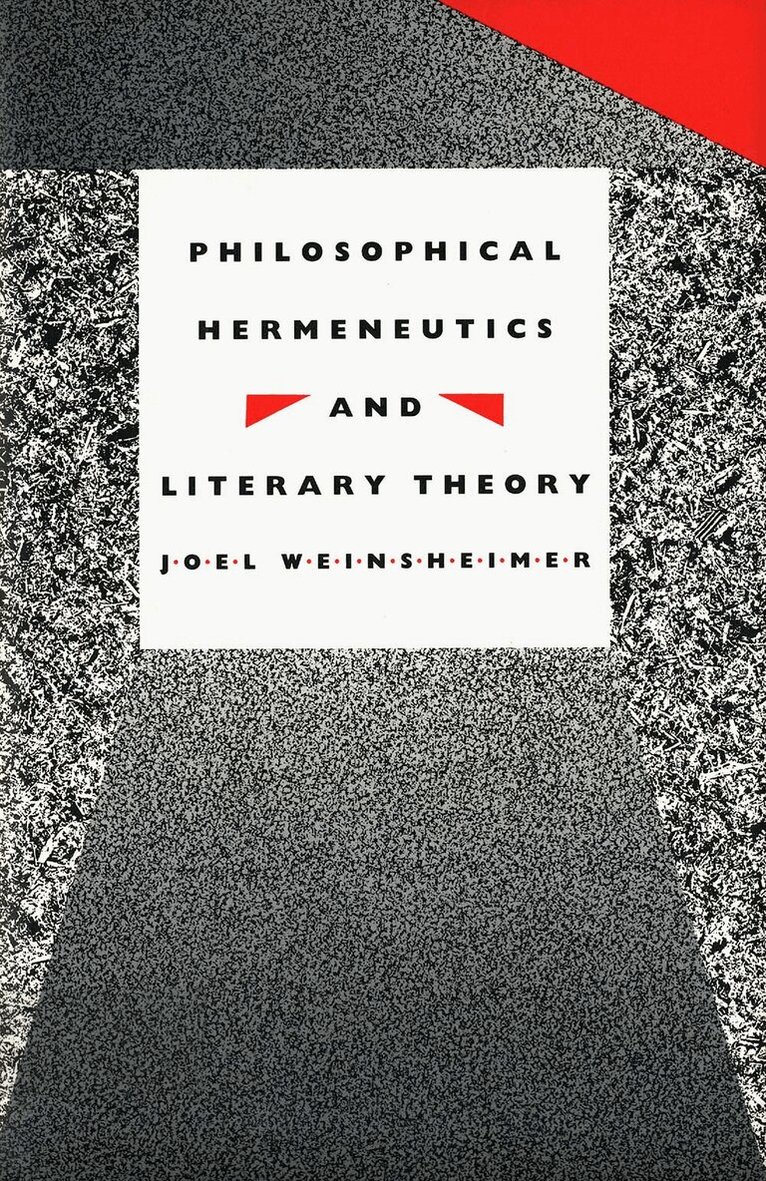
In this lucid and elegantly written book, Joel Weinsheimer discusses how the insights of Hans-Georg Gadamer alter our understanding of literary theory and interpretation. Weinsheimer begins by surveying modern hermeneutics from Schleiermacher to Riocoeur, showing that Gadamer’s work is situated in the middle of an ongoing dialogue. Gadamer’s hermeneutics, says Weinsheimer, is specifically philosophical for it explores how understanding occurs at all, not how it should be regulated in order to function more rigorously or effectively. According to Weinsheimer, Gadamer views understanding as an effect of history, not an action but a passion, something that happens to the interpreter. Gadamer offers a new model of historical understanding that is based on metaphor: it fuses the different into the same but, like metaphor, does not repress difference. Similarly, Gadamer’s critique of the semiotic conception of language redresses the balance between difference and sameness in the relation of word and world. The common thread in the contributions of philosophical hermeneutics to literary theory is the multifaceted tension between the one and the many, between sameness and difference. This appears in metaphor and application, in the complex dialogue between the past and present, and between the interpretation and the interpreted generally. In the final chapter of the book, “The Question of the Classic,” Weinsheimer explores the implications of this analysis of Gadamer’s hermeneutics for the current debate concerning the study of the canon and the classic.
161 kr
Skickas inom 5-8 vardagar
2 508 kr
Skickas inom 10-15 vardagar
In this book, first published in 1984, Joel Weinsheimer advocates revitalizing the practice of imitating literature as a mode appropriate for literary critics as well as artists. The book is not only about imitation; it is itself an imitation, specifically of Samuel Johnson. As both the focus and mode of presentation, imitation is presented not merely as a kind of poetry that once flourished in the eighteenth century but also as a kind of criticism particularly relevant today. Applying arguments from philosophy of science, deconstruction, psycho-analysis, literary theory, semiotics and hermeneutics, Weinsheimer shows that the three main currents of thought responsible for forcing imitation underground were empiricism, originalism and historicism. The three central chapters of the book concentrate on their representatives: John Locke, Edward Young and Thomas Warton. The author then applies Johnsonian arguments – supported by those of Gadamer Peirce – to challenge those objections and re-establish imitation as an intellectually defensible mode of writing.
664 kr
Skickas inom 10-15 vardagar
In this book, first published in 1984, Joel Weinsheimer advocates revitalizing the practice of imitating literature as a mode appropriate for literary critics as well as artists. The book is not only about imitation; it is itself an imitation, specifically of Samuel Johnson. As both the focus and mode of presentation, imitation is presented not merely as a kind of poetry that once flourished in the eighteenth century but also as a kind of criticism particularly relevant today. Applying arguments from philosophy of science, deconstruction, psycho-analysis, literary theory, semiotics and hermeneutics, Weinsheimer shows that the three main currents of thought responsible for forcing imitation underground were empiricism, originalism and historicism. The three central chapters of the book concentrate on their representatives: John Locke, Edward Young and Thomas Warton. The author then applies Johnsonian arguments – supported by those of Gadamer Peirce – to challenge those objections and re-establish imitation as an intellectually defensible mode of writing.