Ronald W. Sousa – författare
Visar alla böcker från författaren Ronald W. Sousa. Handla med fri frakt och snabb leverans.
6 produkter
6 produkter
E-bok
PDF, Engelska, 2000193 kr
Läs direkt efter köp
Recognized as a turning point in Brazilian literature, this entertaining novel of urban manners follows the ne''er-do-well Leonardo through his various romantic liaisons and frequent scrapes with the law. First printed in weekly installments in 1852, and later published in two volumes in 1854-55, Memoirs of a Militia Sergeant comprises a series of humorous vignettes held together by the adventures and misfortunes of this young rogue--who matures from a handful of a toddler into a ruffian of a boy and an idler of a young man--and his father, also named Leonardo. Manuel Antônio De Almeida tells a story in everyday language that is rich in detail of life on the streets and the modest circumstances of the free poor of Rio de Janeiro. Through satirical accounts of the escapades of characters who always seem close to the brink of some personal crisis or social misstep, yet who manage to pull through by hook or by crook, Almeida makes a subtle and incisive comment on Brazilian urban society and culture of the nineteenth century. Now available in a new and lively translation, Memoirs of a Military Sergeant occupies an important position in the satirical literature of Brazil and the world.
E-bok
Engelska, 2000193 kr
Läs direkt efter köp
Recognized as a turning point in Brazilian literature, this entertaining novel of urban manners follows the ne''er-do-well Leonardo through his various romantic liaisons and frequent scrapes with the law. First printed in weekly installments in 1852, and later published in two volumes in 1854-55, Memoirs of a Militia Sergeant comprises a series of humorous vignettes held together by the adventures and misfortunes of this young rogue--who matures from a handful of a toddler into a ruffian of a boy and an idler of a young man--and his father, also named Leonardo. Manuel Antônio De Almeida tells a story in everyday language that is rich in detail of life on the streets and the modest circumstances of the free poor of Rio de Janeiro. Through satirical accounts of the escapades of characters who always seem close to the brink of some personal crisis or social misstep, yet who manage to pull through by hook or by crook, Almeida makes a subtle and incisive comment on Brazilian urban society and culture of the nineteenth century. Now available in a new and lively translation, Memoirs of a Military Sergeant occupies an important position in the satirical literature of Brazil and the world.
E-bok
Engelska, 2006193 kr
Läs direkt efter köp
In the eight pieces that make up Land Without History, first published in Portuguese in 1909, Euclides da Cunha offers a rare look into twentieth century Amazonia, and the consolidation of South American nation states. Mixing scientific jargon and poetic language, the essays in Land Without History provide breathtaking descriptions of the Amazonian rivers and the ever-changing nature that surrounds them. Brilliantly translated by Ronald Sousa, Land Without History offers a view of the ever changing ecology of the Amazon, and a compelling testimony to the Brazilian colonial enterprise, and its imperialist tendencies with regard to neighboring nation-states.
Häftad, Engelska, 2014
562 kr
Skickas inom 10-15 vardagar
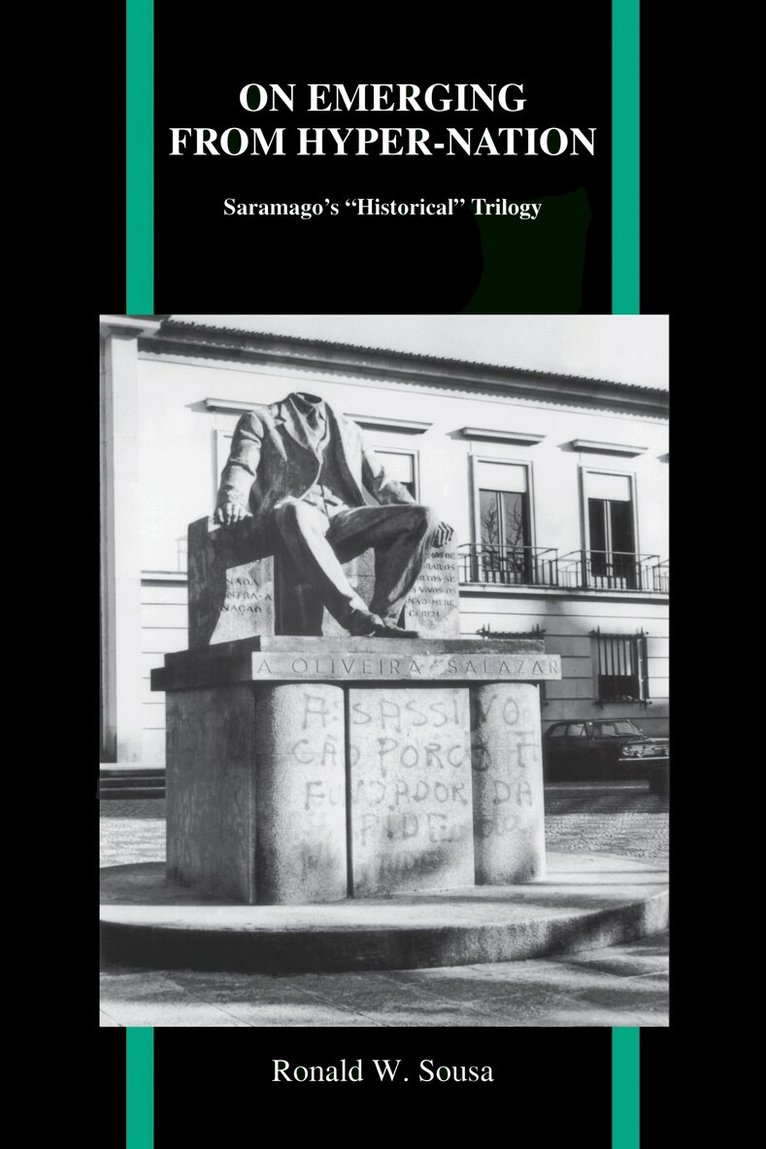
On Emerging from Hyper-Nation represents Ronald W. Sousa’s attempt to answer the question, “Why do I smile on reading one of Saramago’s ‘historical’ novels?” Why that reaction of emotional release? To answer the “smile question” the book engages in a critical mode that could be described as “discourse analysis.” It combines several critical strains and relies on basic concepts from Freudian and Lacanian psychoanalysis, Adlerian psychology, and contemporary cognitive psychology for their discourse-analytical value rather than as entrées into psychoanalytical reading per se.The introductory chapter presents some of the concepts that underlie that compound analytical modality and sets out an overview of twentieth-century Portuguese social and economic history. Then, with an eye to answering the “smile question,” the book reads Nobel Laureate José Saramago’s three novels, Baltasar and Blimunda (1982), The Year of the Death of Ricardo Reis (1984), and The History of the Siege of Lisbon (1989). Or, better, it seeks to read Sousa’s own reading of the three works, since focus falls on how each novel seeks to construct both its own reading and also Sousa as its reader.The discussion brings to light a number of textual phenomena that bear upon the “smile question.” Among them are that the novels invoke, often subtly, the fascist hermeneutical heritage remaining from before the revolution of 1974 as a constituent part of their communication with the reader; that they summon up historical trauma; that they function as Freudian-style “tendentious jokes”; and that, through these various invocations, they seek to constitute a postrevolutionary Portuguese subject. The reading of Sousa’s reading, then, ends up being a reading of some of the cultural forces at work in postrevolutionary Portugal.
E-bok
PDF, Engelska, 2015685 kr
Läs direkt efter köp
On Emerging from Hyper-Nation represents Ronald W. Sousa’s attempt to answer the question, “Why do I smile on reading one of Saramago’s ‘historical’ novels?” Why that reaction of emotional release? To answer the “smile question” the book engages in a critical mode that could be described as “discourse analysis.” It combines several critical strains and relies on basic concepts from Freudian and Lacanian psychoanalysis, Adlerian psychology, and contemporary cognitive psychology for their discourse-analytical value rather than as entrées into psychoanalytical reading per se. The introductory chapter presents some of the concepts that underlie that compound analytical modality and sets out an overview of twentieth-century Portuguese social and economic history. Then, with an eye to answering the “smile question,” the book reads Nobel Laureate José Saramago’s three novels, Baltasar and Blimunda (1982), The Year of the Death of Ricardo Reis (1984), and The History of the Siege of Lisbon (1989). Or, better, it seeks to read Sousa’s own reading of the three works, since focus falls on how each novel seeks to construct both its own reading and also Sousa as its reader. The discussion brings to light a number of textual phenomena that bear upon the “smile question.” Among them are that the novels invoke, often subtly, the fascist hermeneutical heritage remaining from before the revolution of 1974 as a constituent part of their communication with the reader; that they summon up historical trauma; that they function as Freudian-style “tendentious jokes”; and that, through these various invocations, they seek to constitute a postrevolutionary Portuguese subject. The reading of Sousa’s reading, then, ends up being a reading of some of the cultural forces at work in postrevolutionary Portugal.
E-bok
Engelska, 2015685 kr
Läs direkt efter köp
On Emerging from Hyper-Nation represents Ronald W. Sousa’s attempt to answer the question, “Why do I smile on reading one of Saramago’s ‘historical’ novels?” Why that reaction of emotional release? To answer the “smile question” the book engages in a critical mode that could be described as “discourse analysis.” It combines several critical strains and relies on basic concepts from Freudian and Lacanian psychoanalysis, Adlerian psychology, and contemporary cognitive psychology for their discourse-analytical value rather than as entrées into psychoanalytical reading per se. The introductory chapter presents some of the concepts that underlie that compound analytical modality and sets out an overview of twentieth-century Portuguese social and economic history. Then, with an eye to answering the “smile question,” the book reads Nobel Laureate José Saramago’s three novels, Baltasar and Blimunda (1982), The Year of the Death of Ricardo Reis (1984), and The History of the Siege of Lisbon (1989). Or, better, it seeks to read Sousa’s own reading of the three works, since focus falls on how each novel seeks to construct both its own reading and also Sousa as its reader. The discussion brings to light a number of textual phenomena that bear upon the “smile question.” Among them are that the novels invoke, often subtly, the fascist hermeneutical heritage remaining from before the revolution of 1974 as a constituent part of their communication with the reader; that they summon up historical trauma; that they function as Freudian-style “tendentious jokes”; and that, through these various invocations, they seek to constitute a postrevolutionary Portuguese subject. The reading of Sousa’s reading, then, ends up being a reading of some of the cultural forces at work in postrevolutionary Portugal.