Johanna Winant - Böcker
Visar alla böcker från författaren Johanna Winant. Handla med fri frakt och snabb leverans.
4 produkter
4 produkter
2 278 kr
Skickas inom 3-6 vardagar
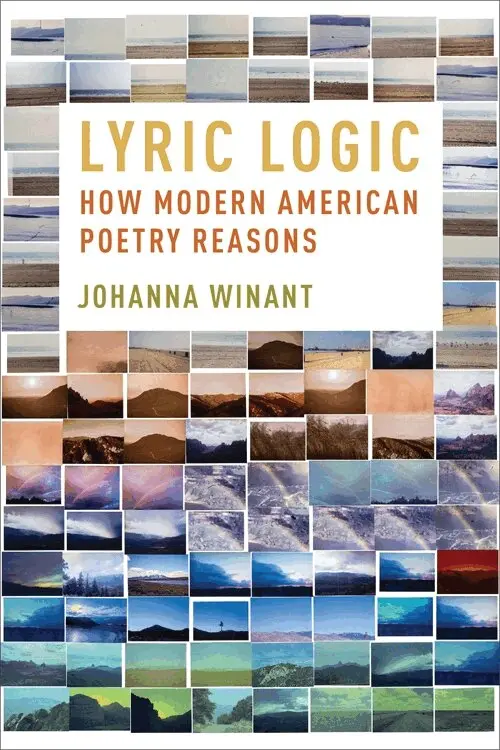
Between the Civil War and the Cold War, American literary modernism and philosophy both grappled with the challenge of novelty and the chance to make it new. Bringing together modern poetry’s aesthetic experimentation and modern philosophy’s attention to the problem of induction, Lyric Logic argues that poems use logical form as literary form. The modern poem can be characterized by its logic: details that appear fragmentary add up to sense-making.Johanna Winant recasts the poetics of central figures as modeling and defending inductive reasoning: Walt Whitman makes lists, Emily Dickinson constructs analogies, Gertrude Stein presents facts, Marianne Moore investigates predictions, Elizabeth Bishop draws inferences, and Gwendolyn Brooks tests the limits of deduction. Winant offers in-depth close readings of canonical poems that show the sophistication of their philosophic logic. Although philosophers tend to see induction as flawed and unreliable, these poets display its strengths. Their work demonstrates how to make sense of the unpredictable modern world.
359 kr
Skickas
Between the Civil War and the Cold War, American literary modernism and philosophy both grappled with the challenge of novelty and the chance to make it new. Bringing together modern poetry’s aesthetic experimentation and modern philosophy’s attention to the problem of induction, Lyric Logic argues that poems use logical form as literary form. The modern poem can be characterized by its logic: details that appear fragmentary add up to sense-making.Johanna Winant recasts the poetics of central figures as modeling and defending inductive reasoning: Walt Whitman makes lists, Emily Dickinson constructs analogies, Gertrude Stein presents facts, Marianne Moore investigates predictions, Elizabeth Bishop draws inferences, and Gwendolyn Brooks tests the limits of deduction. Winant offers in-depth close readings of canonical poems that show the sophistication of their philosophic logic. Although philosophers tend to see induction as flawed and unreliable, these poets display its strengths. Their work demonstrates how to make sense of the unpredictable modern world.
1 522 kr
Skickas inom 3-6 vardagar
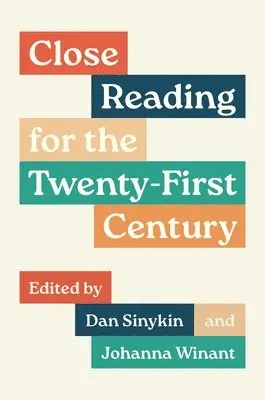
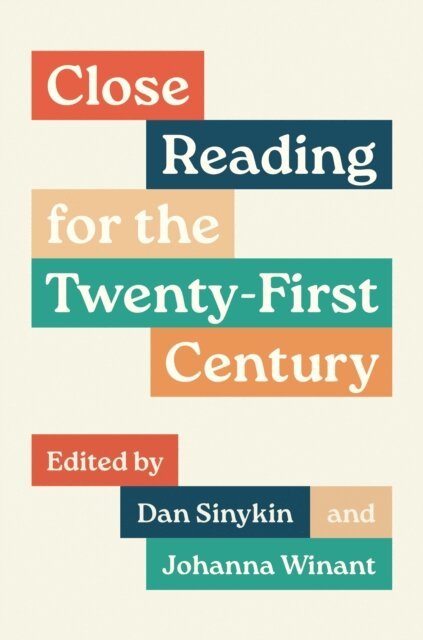
A user’s guide to the fundamental practice of literary studies, providing context, examples, and practical exercises Close reading—making an argument based in close attention to a text—is the foundation of literary studies. This book offers a guide to close reading, treating it as a skill that can be taught and practiced. It first explains what close reading is, what it does, and how it has been used across theoretical schools ranging from affect studies to Black studies to queer theory to Marxism. It then presents a series of master classes in the practice, with original contributions by scholars from a range of different institutions. Finally, it provides practical materials, worksheets, and suggested activities for instructors to use in the classroom. The tone throughout is encouraging and accessible, inviting readers of all backgrounds to hone their craft.The book divides the practice of close reading into five steps, coining a term for each step: scene setting, noticing, local claiming, regional argumentation, and global theorizing. It traces the roots of close reading, showing how it has spread far beyond its origins in practical criticism and New Criticism. In twenty-one short chapters, contemporary scholars discuss close readings by such prominent literary critics as Erich Auerbach and Helen Vendler, describing how their arguments work and how to achieve similar results. An essential resource for instructors and students at the undergraduate level and beyond, this book shows how understanding close reading can make us better readers, thinkers, and writers.
276 kr
Skickas inom 7-10 vardagar
A user’s guide to the fundamental practice of literary studies, providing context, examples, and practical exercises Close reading—making an argument based in close attention to a text—is the foundation of literary studies. This book offers a guide to close reading, treating it as a skill that can be taught and practiced. It first explains what close reading is, what it does, and how it has been used across theoretical schools ranging from affect studies to Black studies to queer theory to Marxism. It then presents a series of master classes in the practice, with original contributions by scholars from a range of different institutions. Finally, it provides practical materials, worksheets, and suggested activities for instructors to use in the classroom. The tone throughout is encouraging and accessible, inviting readers of all backgrounds to hone their craft.The book divides the practice of close reading into five steps, coining a term for each step: scene setting, noticing, local claiming, regional argumentation, and global theorizing. It traces the roots of close reading, showing how it has spread far beyond its origins in practical criticism and New Criticism. In twenty-one short chapters, contemporary scholars discuss close readings by such prominent literary critics as Erich Auerbach and Helen Vendler, describing how their arguments work and how to achieve similar results. An essential resource for instructors and students at the undergraduate level and beyond, this book shows how understanding close reading can make us better readers, thinkers, and writers.