John Forge – författare
Visar alla böcker från författaren John Forge. Handla med fri frakt och snabb leverans.
16 produkter
Explanation, Quantity and Law
Av John Forge
E-bok, 2018
485 kr
Lägg i varukorg
Published in 1999, this work sets out to give an account of explanation which is adequate to the problems that arise when looking at physical science. It offers a theory of explanation with supporting analysis, and also an application to the task of giving an account of explanation in quantum …
Explanation, Quantity and Law
Av John Forge
E-bok, 2018
475 kr
Lägg i varukorg
Published in 1999, this work sets out to give an account of explanation which is adequate to the problems that arise when looking at physical science. It offers a theory of explanation with supporting analysis, and also an application to the task of giving an account of explanation in quantum …
Science, Technology and Society
An Introduction
Av Ian Lowe, John Laurent m. fl.
E-bok, 1998
623 kr
Lägg i varukorg
This book provides a comprehensive introduction to the human, social and economic aspects of science and technology. It examines a broad range of issues from a variety of perspectives, using examples and experiences from Australia and around the world. The authors present complex issues in an …
Science, Technology and Society
An Introduction
Av Martin Bridgstock, David Burch m. fl.
Inbunden, 1998
1335 kr
Lägg i varukorg
This book provides a comprehensive introduction to the human, social and economic aspects of science and technology. It examines a broad range of issues from a variety of perspectives, using examples and experiences from Australia and around the world. The authors present complex issues in an …
Science, Technology and Society
An Introduction
Av Martin Bridgstock, David Burch m. fl.
Häftad, 1998
601 kr
Lägg i varukorg
This book provides a comprehensive introduction to the human, social and economic aspects of science and technology. It examines a broad range of issues from a variety of perspectives, using examples and experiences from Australia and around the world. The authors present complex issues in an …
Responsible Scientist
A Philosophical Inquiry
Av John Forge
Inbunden, 2008
782 kr
Lägg i varukorg
When Fat Boy, the first atomic bomb was detonated at Los Alamos, New Mexico in 1945, moral responsibility in science was forever thrust into the forefront of philosophical debate. The culmination of the famed Manhattan Project, which employed many of the world's best scientific minds, was a …
Explanation, Quantity and Law
Av John Forge
Inbunden, 2018
1232 kr
Lägg i varukorg
Published in 1999, this work sets out to give an account of explanation which is adequate to the problems that arise when looking at physical science. It offers a theory of explanation with supporting analysis, and also an application to the task of giving an account of explanation in quantum …
Explanation, Quantity and Law
Av John Forge
Häftad, 2020
415 kr
Lägg i varukorg
Published in 1999, this work sets out to give an account of explanation which is adequate to the problems that arise when looking at physical science. It offers a theory of explanation with supporting analysis, and also an application to the task of giving an account of explanation in quantum …
Science, Technology and Society
An Introduction
Av Ian Lowe, John Laurent m. fl.
E-bok, 1998
623 kr
Lägg i varukorg
This book provides a comprehensive introduction to the human, social and economic aspects of science and technology. It examines a broad range of issues from a variety of perspectives, using examples and experiences from Australia and around the world. The authors present complex issues in an …
Morality of Weapons Design and Development
Emerging Research and Opportunities
Av John Forge
Inbunden, 2017
2296 kr
Lägg i varukorg
Countries around the globe are continuously investing money into weapon development and manufacturing. While weapon design has been a relevant topic, from the Middle Ages to today, the morality of this practice is not commonly presented in research. The Morality of Weapons Design and Development: …
Morality of Weapons Design and Development: Emerging Research and Opportunities
Av John Forge
E-bok, 2017
2048 kr
Lägg i varukorg
Countries around the globe are continuously investing money into weapon development and manufacturing. While weapon design has been a relevant topic, from the Middle Ages to today, the morality of this practice is not commonly presented in research. The Morality of Weapons Design and Development: …
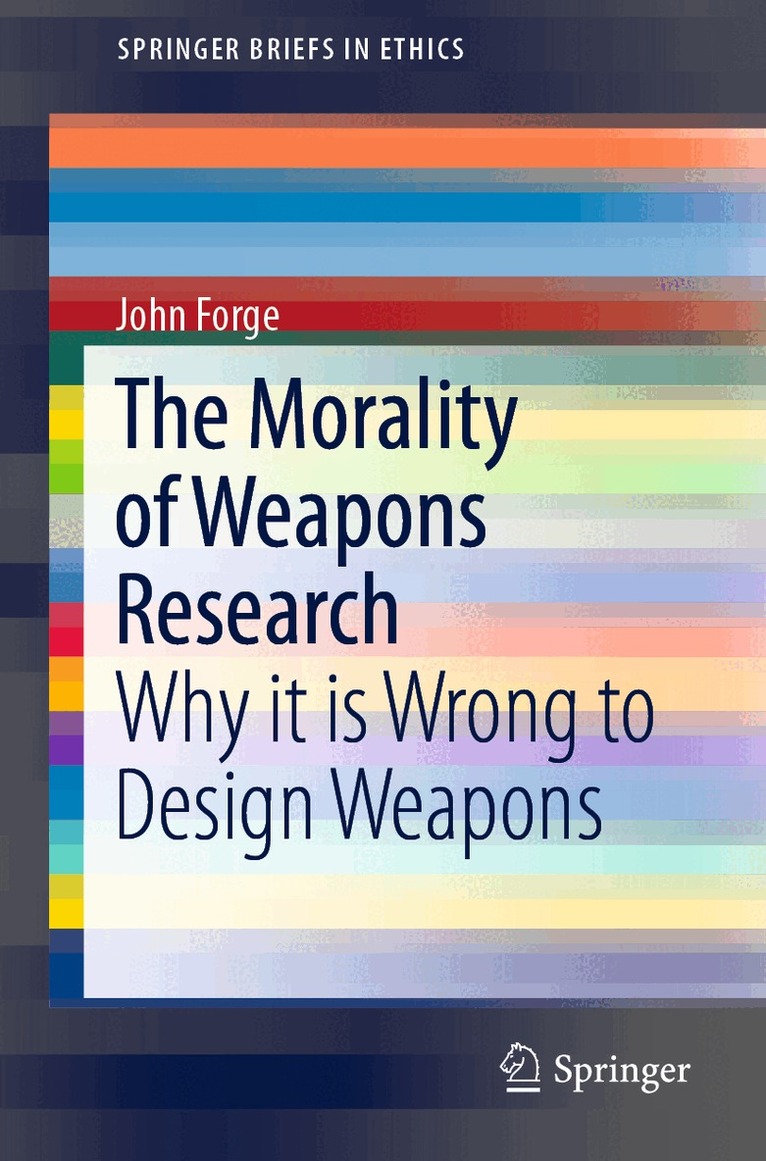
Morality of Weapons Research
Why it is Wrong to Design Weapons
Av John Forge
Häftad, 2019
548 kr
Lägg i varukorg
This book addresses the morality of engaging in weapons research, a topic that has been neglected but which is extremely important. It is argued that this activity is both morally wrong and morally unjustifiable, and this implies that moral persons should not engage in it. The argument is not based …
Morality of Weapons Research
Why it is Wrong to Design Weapons
Av John Forge
E-bok, 2019
734 kr
Lägg i varukorg
This book addresses the morality of engaging in weapons research, a topic that has been neglected but which is extremely important. It is argued that this activity is both morally wrong and morally unjustifiable, and this implies that moral persons should not engage in it. The argument is not based …
Designed to Kill: The Case Against Weapons Research
Av John Forge
Inbunden, 2012
1093 kr
Lägg i varukorg
The pilot-less drones, smart bombs and other high-tech weapons on display in recent conflicts are all the outcome of weapons research. However, the kind of scientific and technological endeavour has been around for a long time, producing not only the armaments of Nazi Germany and the atomic bombs …
Designed to Kill: The Case Against Weapons Research
Av John Forge
E-bok, 2012
1459 kr
Lägg i varukorg
The pilot-less drones, smart bombs and other high-tech weapons on display in recent conflicts are all the outcome of weapons research. However, the kind of scientific and technological endeavour has been around for a long time, producing not only the armaments of Nazi Germany and the atomic bombs …
Designed to Kill: The Case Against Weapons Research
Av John Forge
Häftad, 2015
1093 kr
Lägg i varukorg
The pilot-less drones, smart bombs and other high-tech weapons on display in recent conflicts are all the outcome of weapons research. However, the kind of scientific and technological endeavour has been around for a long time, producing not only the armaments of Nazi Germany and the atomic bombs …