John Hooker – författare
990 kr
Skickas inom 7-10 vardagar
2 714 kr
Skickas inom 10-15 vardagar
848 kr
Skickas inom 10-15 vardagar
Logic-Based Methods for Optimization
Combining Optimization and Constraint Satisfaction
2 462 kr
Skickas inom 5-8 vardagar
Optimization Methods for Logical Inference
2 100 kr
Skickas inom 5-8 vardagar
394 kr
Skickas inom 3-6 vardagar
386 kr
Skickas inom 5-8 vardagar
276 kr
Skickas inom 5-8 vardagar
2 793 kr
Läs direkt efter köp
2 402 kr
Läs direkt efter köp
520 kr
Skickas inom 10-15 vardagar
249 kr
Skickas inom 5-8 vardagar
418 kr
Skickas inom 3-6 vardagar
936 kr
Läs direkt efter köp
Mycenaean Greece, first published in 1976, investigates from an historical point of view some of the crucial periods in the Greek Bronze Age. The principal subject is the so-called ‘Mycenaean’ culture which arose during the sixteenth century BC, as assimilation of the previous ‘Helladic’ culture of mainland Greece with some of the developments of Minoan Crete.
Many of the material aspects of the Mycenaean civilisation are examined, as are the extent of Mycenaean expansion overseas and the eventual destruction of Mycenaean sites which marked the end of their civilisation. The author also considers the evidence relating to the religious beliefs of the Mycenaeans and their social, political and economic organisations, and he relates the Mycenaean culture to the later civilisation of Archaic and Classical Greece. There is an Appendix containing a list of Mycenaean sites, with reference to excavation reports, and a full bibliography.
936 kr
Läs direkt efter köp
Mycenaean Greece, first published in 1976, investigates from an historical point of view some of the crucial periods in the Greek Bronze Age. The principal subject is the so-called ‘Mycenaean’ culture which arose during the sixteenth century BC, as assimilation of the previous ‘Helladic’ culture of mainland Greece with some of the developments of Minoan Crete.
Many of the material aspects of the Mycenaean civilisation are examined, as are the extent of Mycenaean expansion overseas and the eventual destruction of Mycenaean sites which marked the end of their civilisation. The author also considers the evidence relating to the religious beliefs of the Mycenaeans and their social, political and economic organisations, and he relates the Mycenaean culture to the later civilisation of Archaic and Classical Greece. There is an Appendix containing a list of Mycenaean sites, with reference to excavation reports, and a full bibliography.
602 kr
Läs direkt efter köp
This book develops an intellectual framework for analyzing ethical dilemmas that is both grounded in theory and versatile enough to deal rigorously with real-world issues. It sees ethics as a necessary foundation for the social infrastructure that makes modern life possible, much as engineering is a foundation for physical infrastructure. It is not wedded to any particular ethical philosophy but draws from several traditions to construct a unified and principled approach to ethical reasoning. Rather than follow the common academic practice of seeking a reflective equilibrium of moral intuitions and principles, it builds on a few bedrock principles of rational thought that serve as criteria for valid argumentation. It develops the ideas from the ground up, without presupposing any background in ethics or philosophy.
Epistemologically, the book views ethics as parallel to mathematics, in that it relies on generally accepted proof techniques to establish results. Whereas mathematics rests on such proof paradigms as mathematical induction and proof by contradiction, ethics can be seen as relying on proof by applying consistency tests, such as generalizability and respect for autonomy. Utilitarianism also plays a key role, but it is reconceived as a deontological criterion. This approach obviously requires that these criteria be formulated more rigorously than is normally the case. To accomplish this, the book begins with the classical idea that an action is distinguishable from mere behavior by virtue of its having a coherent rationale, where coherence requires passing certain consistency tests such as generalizability. An action is therefore inseparable from its rationale, and generalizability is defined in terms of consistency with the rationale. A utilitarian criterion receives a similar treatment with respect to a means-end rationale. Respect for autonomy is grounded in a carefully developed action theory that takes into account such concepts as joint autonomy, implied consent, and the permissibility of interference with unethical behavior. It provides an account of responsibility that is both practical and theoretically satisfying, and it yields a novel solution of the much-discussed trolley car dilemmas.
The book is written for a general audience and strives to be as readable and engaging as possible, while maintaining rigor. It begins by dispelling a raft of misconceptions that trivialize ethics and block its development as an essential tool of modern life, such as the notion that ethics is just a matter of opinion without rational foundation. After presenting the ethical principles just described, along with many examples, it provides several chapters that analyze real-life dilemmas, many obtained from the author’s students and professional workshop participants. One cannot understand physics or chemistry without seeing how their principles are applied to real problems, and the same is true of ethics. These chapters demonstrate that a unified normative theory can deal with a wide range of real cases while achieving a reasonable level of objectivity and rigor.
602 kr
Läs direkt efter köp
This book develops an intellectual framework for analyzing ethical dilemmas that is both grounded in theory and versatile enough to deal rigorously with real-world issues. It sees ethics as a necessary foundation for the social infrastructure that makes modern life possible, much as engineering is a foundation for physical infrastructure. It is not wedded to any particular ethical philosophy but draws from several traditions to construct a unified and principled approach to ethical reasoning. Rather than follow the common academic practice of seeking a reflective equilibrium of moral intuitions and principles, it builds on a few bedrock principles of rational thought that serve as criteria for valid argumentation. It develops the ideas from the ground up, without presupposing any background in ethics or philosophy.
Epistemologically, the book views ethics as parallel to mathematics, in that it relies on generally accepted proof techniques to establish results. Whereas mathematics rests on such proof paradigms as mathematical induction and proof by contradiction, ethics can be seen as relying on proof by applying consistency tests, such as generalizability and respect for autonomy. Utilitarianism also plays a key role, but it is reconceived as a deontological criterion. This approach obviously requires that these criteria be formulated more rigorously than is normally the case. To accomplish this, the book begins with the classical idea that an action is distinguishable from mere behavior by virtue of its having a coherent rationale, where coherence requires passing certain consistency tests such as generalizability. An action is therefore inseparable from its rationale, and generalizability is defined in terms of consistency with the rationale. A utilitarian criterion receives a similar treatment with respect to a means-end rationale. Respect for autonomy is grounded in a carefully developed action theory that takes into account such concepts as joint autonomy, implied consent, and the permissibility of interference with unethical behavior. It provides an account of responsibility that is both practical and theoretically satisfying, and it yields a novel solution of the much-discussed trolley car dilemmas.
The book is written for a general audience and strives to be as readable and engaging as possible, while maintaining rigor. It begins by dispelling a raft of misconceptions that trivialize ethics and block its development as an essential tool of modern life, such as the notion that ethics is just a matter of opinion without rational foundation. After presenting the ethical principles just described, along with many examples, it provides several chapters that analyze real-life dilemmas, many obtained from the author’s students and professional workshop participants. One cannot understand physics or chemistry without seeing how their principles are applied to real problems, and the same is true of ethics. These chapters demonstrate that a unified normative theory can deal with a wide range of real cases while achieving a reasonable level of objectivity and rigor.
372 kr
Skickas inom 5-8 vardagar
1 640 kr
Skickas inom 5-8 vardagar
283 kr
Läs direkt efter köp
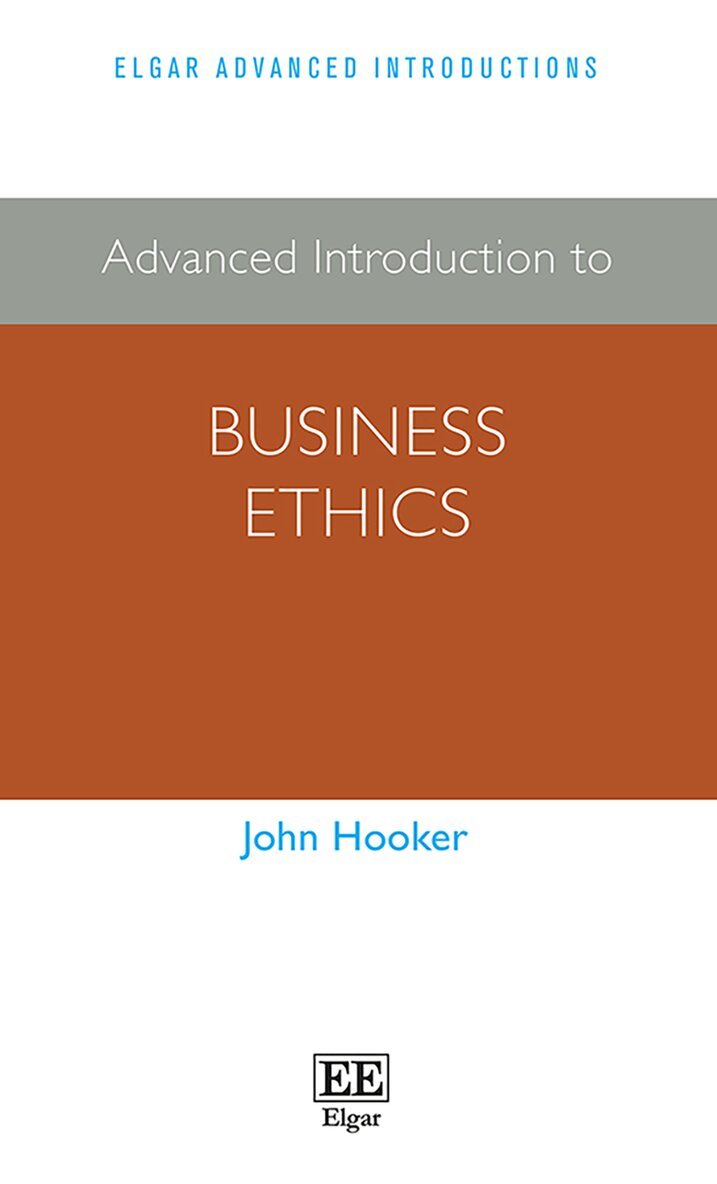
This concise and engaging Advanced Introduction provides the conceptual tools necessary to make ethical decisions in today’s business world. John Hooker provides an objective and closely-reasoned analysis of ethical issues based on a unified conceptual framework that distils the best of ethical thought into three clearly articulated principles: the generalization, utilitarian, and autonomy principles.
Key features include:
examples and case studies that illustrate ethical reasoning in complex business dilemmas exploration of business ethics in relation to environmental, social, and financial sustainability factorscoverage of cross-cultural business ethics, technological unemployment, and the ethics of artificial intelligence and machine learning.This Advanced Introduction will be a valuable resource for academics and advanced students of business ethics and trust, business leadership, and corporate social responsibility. It will also be beneficial for business managers who wish to build an ethical organization, as well as technical personnel who incorporate ethics into automated systems.
296 kr
534 kr
Skickas inom 5-8 vardagar
544 kr
Skickas inom 10-15 vardagar
687 kr
Läs direkt efter köp
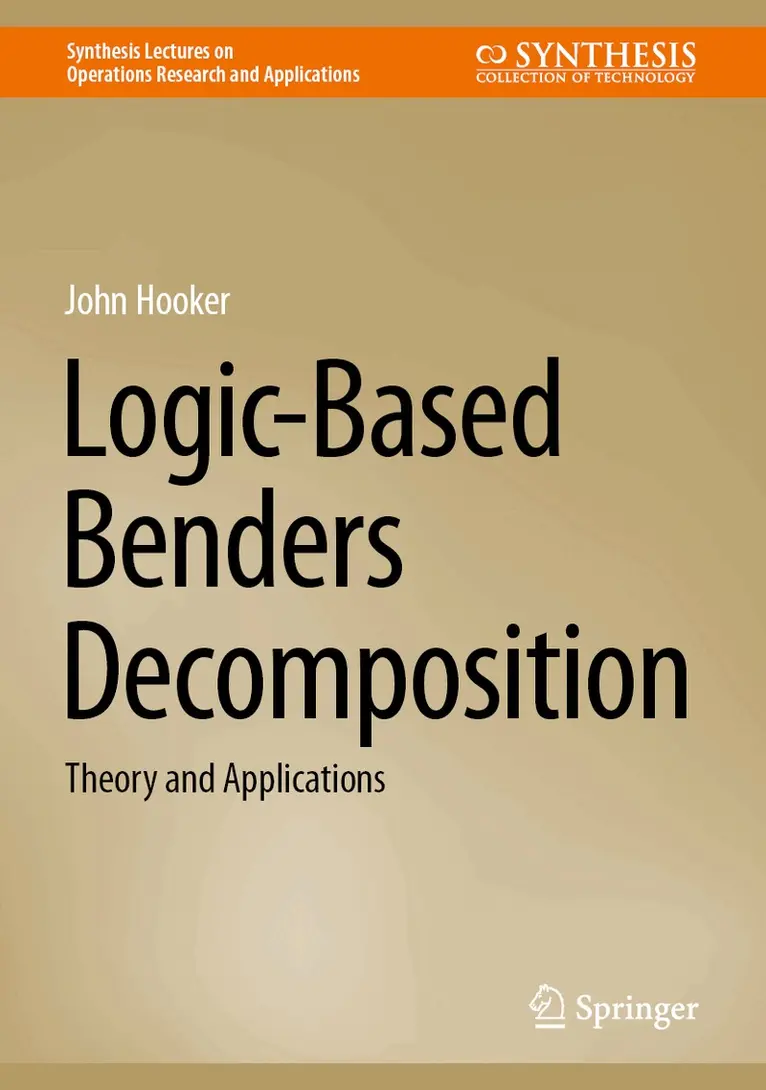
This book is the first comprehensive guide to logic-based Benders decomposition (LBBD), a general and versatile method for breaking large, complex optimization problems into components that are small enough for practical solution. The author introduces logic-based Benders decomposition for optimization, which substantially generalizes the classical Benders method. It can reduce solution times by orders of magnitude and allows decomposition to be applied to a much wider variety of optimization problems. On the theoretical side, this book provides a full account of inference duality concepts that underlie LBBD, as well as a description of how LBBD can be combined with stochastic and robust optimization, heuristic methods, and decision diagrams. It also clarifies the connection between LBBD and combinatorial Benders cuts for mixed integer programming. On the practical side, it explains how LBBD has been applied to a rapidly growingvariety of problem domains. After describing basic theory, this book provides a comprehensive review of the rapidly growing literature that describes these applications, in each case explaining how LBBD is adapted to the problem at hand. In doing so this work provides a sourcebook of ideas for applying LBBD to new problems as they arise.
544 kr
Skickas inom 10-15 vardagar
437 kr
Skickas inom 10-15 vardagar
535 kr
Läs direkt efter köp
948 kr
Skickas inom 10-15 vardagar
1 148 kr
Läs direkt efter köp
This book introduces a novel approach to discrete optimization, providing both theoretical insights and algorithmic developments that lead to improvements over state-of-the-art technology. The authors present chapters on the use of decision diagrams for combinatorial optimization and constraint programming, with attention to general-purpose solution methods as well as problem-specific techniques.
The book will be useful for researchers and practitioners in discrete optimization and constraint programming.
"Decision Diagrams for Optimization is one of the most exciting developments emerging from constraint programming in recent years. This book is a compelling summary of existing results in this space and a must-read for optimizers around the world." [Pascal Van Hentenryck]
921 kr
Skickas inom 10-15 vardagar