John J. Watkins – författare
522 kr
Läs direkt efter köp
522 kr
Läs direkt efter köp
664 kr
Skickas inom 5-8 vardagar
1 841 kr
Skickas inom 5-8 vardagar
83 kr
Skickas inom 5-8 vardagar
1 005 kr
Skickas inom 5-8 vardagar
164 kr
Skickas inom 5-8 vardagar
919 kr
Skickas inom 5-8 vardagar
315 kr
Skickas inom 5-8 vardagar
416 kr
Läs direkt efter köp
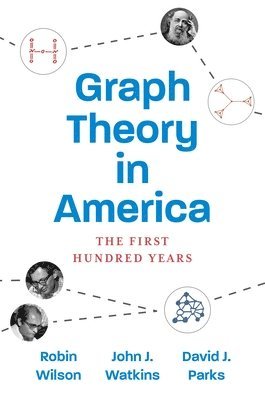
How a new mathematical field grew and matured in America Graph Theory in America focuses on the development of graph theory in North America from 1876 to 1976. At the beginning of this period, James Joseph Sylvester, perhaps the finest mathematician in the English-speaking world, took up his appointment as the first professor of mathematics at the Johns Hopkins University, where his inaugural lecture outlined connections between graph theory, algebra, and chemistry—shortly after, he introduced the word graph in our modern sense. A hundred years later, in 1976, graph theory witnessed the solution of the long-standing four color problem by Kenneth Appel and Wolfgang Haken of the University of Illinois.Tracing graph theory’s trajectory across its first century, this book looks at influential figures in the field, both familiar and less known. Whereas many of the featured mathematicians spent their entire careers working on problems in graph theory, a few such as Hassler Whitney started there and then moved to work in other areas. Others, such as C. S. Peirce, Oswald Veblen, and George Birkhoff, made excursions into graph theory while continuing their focus elsewhere. Between the main chapters, the book provides short contextual interludes, describing how the American university system developed and how graph theory was progressing in Europe. Brief summaries of specific publications that influenced the subject’s development are also included.Graph Theory in America tells how a remarkable area of mathematics landed on American soil, took root, and flourished.
1 385 kr
Läs direkt efter köp
Topics in Commutative Ring Theory is a textbook for advanced undergraduate students as well as graduate students and mathematicians seeking an accessible introduction to this fascinating area of abstract algebra. Commutative ring theory arose more than a century ago to address questions in geometry and number theory. A commutative ring is a set-such as the integers, complex numbers, or polynomials with real coefficients--with two operations, addition and multiplication. Starting from this simple definition, John Watkins guides readers from basic concepts to Noetherian rings-one of the most important classes of commutative rings--and beyond to the frontiers of current research in the field. Each chapter includes problems that encourage active reading--routine exercises as well as problems that build technical skills and reinforce new concepts. The final chapter is devoted to new computational techniques now available through computers. Careful to avoid intimidating theorems and proofs whenever possible, Watkins emphasizes the historical roots of the subject, like the role of commutative rings in Fermat''s last theorem. He leads readers into unexpected territory with discussions on rings of continuous functions and the set-theoretic foundations of mathematics. Written by an award-winning teacher, this is the first introductory textbook to require no prior knowledge of ring theory to get started. Refreshingly informal without ever sacrificing mathematical rigor, Topics in Commutative Ring Theory is an ideal resource for anyone seeking entry into this stimulating field of study.
222 kr
Läs direkt efter köp
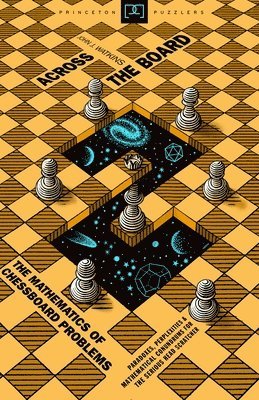
Across the Board is the definitive work on chessboard problems. It is not simply about chess but the chessboard itself--that simple grid of squares so common to games around the world. And, more importantly, the fascinating mathematics behind it. From the Knight''s Tour Problem and Queens Domination to their many variations, John Watkins surveys all the well-known problems in this surprisingly fertile area of recreational mathematics. Can a knight follow a path that covers every square once, ending on the starting square? How many queens are needed so that every square is targeted or occupied by one of the queens? Each main topic is treated in depth from its historical conception through to its status today. Many beautiful solutions have emerged for basic chessboard problems since mathematicians first began working on them in earnest over three centuries ago, but such problems, including those involving polyominoes, have now been extended to three-dimensional chessboards and even chessboards on unusual surfaces such as toruses (the equivalent of playing chess on a doughnut) and cylinders. Using the highly visual language of graph theory, Watkins gently guides the reader to the forefront of current research in mathematics. By solving some of the many exercises sprinkled throughout, the reader can share fully in the excitement of discovery. Showing that chess puzzles are the starting point for important mathematical ideas that have resonated for centuries, Across the Board will captivate students and instructors, mathematicians, chess enthusiasts, and puzzle devotees.