John N. Crossley – författare
Visar alla böcker från författaren John N. Crossley. Handla med fri frakt och snabb leverans.
13 produkter
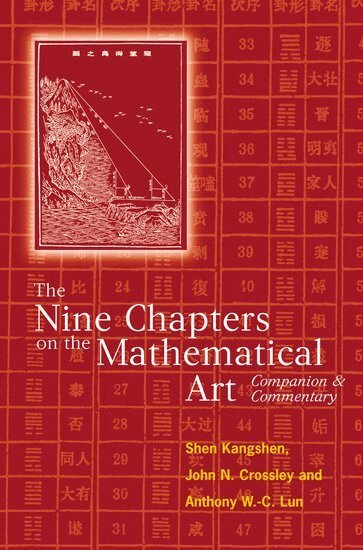
The Nine Chapters on the Mathematical Art
Companion and Commentary
Av K'Ang-Shen Shen, John N. Crossley
Inbunden, 1999
9502 kr
Lägg i varukorg
The Nine Chapters on the Mathematical Art is a classic text: the most important mathematical source in China during the past 2000 years, and comparable in significance to Euclid's Elements in the West. This volume contains the first complete English translation of the Nine Chapters, together with …
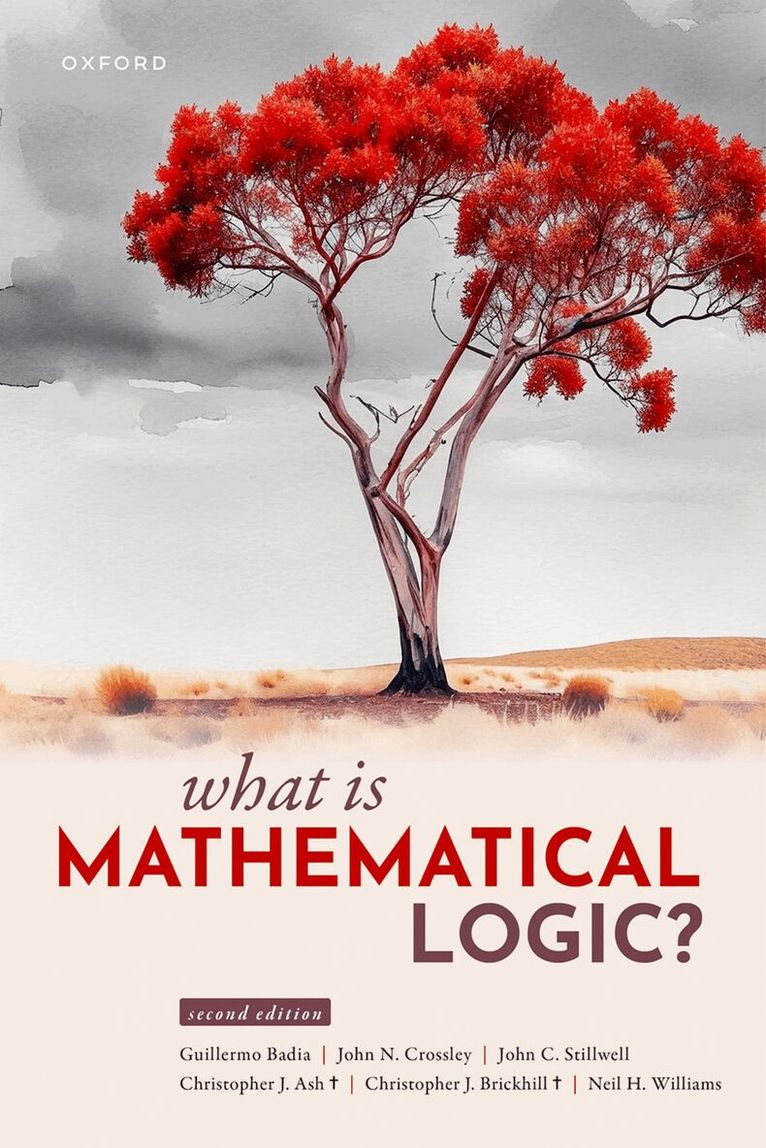
What Is Mathematical Logic?
Av Guillermo Badia, John N. Crossley m. fl.
Inbunden, 2025
351 kr
Lägg i varukorg
Mathematical logic has grown from an exotic branch of mathematics into an indispensable tool in computer science as well as other parts of mathematics. This concise book presents the subject of mathematical logic in a lively and approachable fashion although logic can be a formidably abstruse …
What Is Mathematical Logic?
Av Neil H. Williams, Christopher J. Brickhill m. fl.
E-bok, 2025
284 kr
Lägg i varukorg
Mathematical logic has grown from an exotic branch of mathematics into an indispensable tool in computer science as well as other parts of mathematics. This concise book presents the subject of mathematical logic in a lively and approachable fashion although logic can be a formidably abstruse …
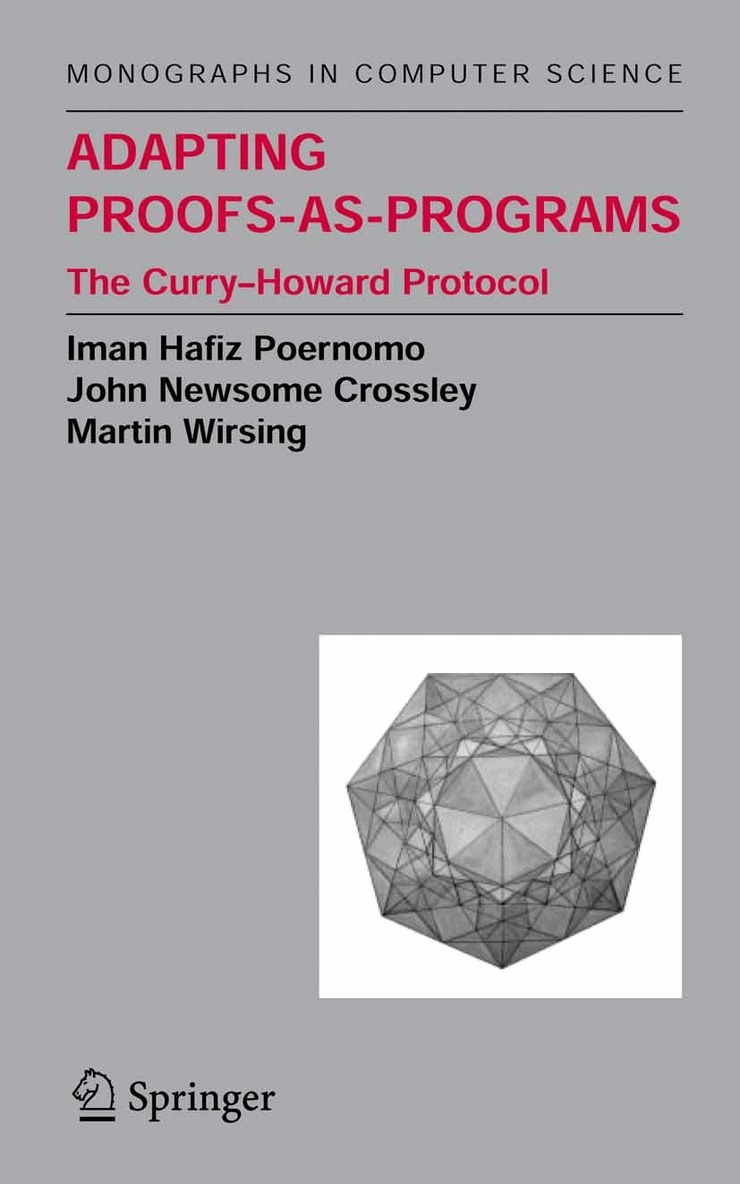
Adapting Proofs-as-Programs
The Curry--Howard Protocol
Av Iman Poernomo, John N. Crossley m. fl.
Inbunden, 2005
1643 kr
Lägg i varukorg
This book ?nds new things to do with an old idea. The proofs-as-programs paradigm constitutes a set of approaches to developing programs from proofs in constructive logic. It has been over thirty years since the paradigm was ?rst conceived. At that time, there was a belief that proofs-as-programs …
Adapting Proofs-as-Programs
The Curry--Howard Protocol
Av Martin Wirsing, John N. Crossley m. fl.
E-bok, 2007
2111 kr
Lägg i varukorg
This book ?nds new things to do with an old idea. The proofs-as-programs paradigm constitutes a set of approaches to developing programs from proofs in constructive logic. It has been over thirty years since the paradigm was ?rst conceived. At that time, there was a belief that proofs-as-programs …
Logical Methods
In Honor of Anil Nerode’s Sixtieth Birthday
Av Crossley, John N. Crossley m. fl.
Inbunden, 1994
1643 kr
Lägg i varukorg
Anil Nerode, Director of the Mathematics Institute at Cornell, USA, is one of the most influential logicians in the world. This volume, published in his honour, contains much new and significant work. The papers in this book are principally concerned with mathematical logic and some of its …
Adapting Proofs-as-Programs
The Curry--Howard Protocol
Av Iman Poernomo, John N. Crossley m. fl.
Häftad, 2010
1647 kr
Lägg i varukorg
This book ?nds new things to do with an old idea. The proofs-as-programs paradigm constitutes a set of approaches to developing programs from proofs in constructive logic. It has been over thirty years since the paradigm was ?rst conceived. At that time, there was a belief that proofs-as-programs …
Logical Methods
In Honor of Anil Nerode’s Sixtieth Birthday
Av Moss E. Sweedler, Richard Shore m. fl.
E-bok, 2012
2065 kr
Lägg i varukorg
The twenty-six papers in this volume reflect the wide and still expanding range of Anil Nerode''s work. A conference on Logical Methods was held in honor of Nerode''s sixtieth birthday (4 June 1992) at the Mathematical Sciences Institute, Cornell University, 1-3 June 1992. Some of the conference …
Logical Methods
In Honor of Anil Nerode’s Sixtieth Birthday
Av John N. Crossley, Jeffrey B. Remmel m. fl.
Häftad, 2013
1647 kr
Lägg i varukorg
The twenty-six papers in this volume reflect the wide and still expanding range of Anil Nerode's work. A conference on Logical Methods was held in honor of Nerode's sixtieth birthday (4 June 1992) at the Mathematical Sciences Institute, Cornell University, 1-3 June 1992. Some of the conference …
Guy of Saint-Denis, Tractatus de tonis
Av Medieval Institute Publications, John N. Crossley
Häftad, 2017
284 kr
Lägg i varukorg
The Tractatus de tonis of Guy of Saint-Denis (written ca. 1300-10)differs from other treatises on plainchant in the depth of its analysis of thevarious tones into which chant was traditionally classified. The treatise ofGuy of Saint-Denis is preserved as the concluding item in an anthology of …
Guy of Saint-Denis, Tractatus de tonis
Av Medieval Institute Publications, John N. Crossley
Inbunden, 2017
731 kr
Lägg i varukorg
The Tractatus de tonis of Guy of Saint-Denis (written ca. 1300-10) differs from other treatises on plainchant in the depth of its analysis of the various tones into which chant was traditionally classified. Guy's treatise presents itself as a synthetic overview of both the theory and practice of …
CREATING NUMBER: HOW HUMANS DEVELOPED NATURAL, COMPLEX, REAL AND INFINITE NUMBERS
Inbunden, 2026
1511 kr
Lägg i varukorg
This book explores one of humanity's most profound intellectual journeys — the creation of numbers themselves. Moving beyond a simple chronological history of mathematics, this book examines the ideas and cultural contexts that gave rise to new kinds of numbers, from the earliest counting systems …
Ars musice
Av Johannes de Grocheio, John N. Crossley
Häftad, 2011
254 kr
Tillfälligt slut
Ars musice, composed in Paris during the late thirteenth century, reflects Johannes de Grocheio's awareness of the complexity of the task of describing music. As the editors note in their introduction, "Grocheio is aware of the enormous range of types of music performed in different ways in …