John S. Chipman – författare
Visar alla böcker från författaren John S. Chipman. Handla med fri frakt och snabb leverans.
3 produkter
3 produkter
3 158 kr
Skickas inom 5-8 vardagar
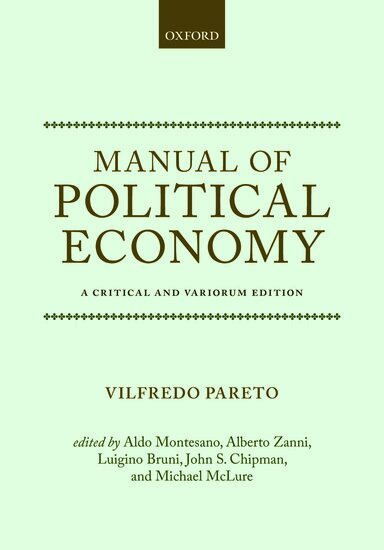
Vilfredo Pareto's Manual of Political Economy is a 'classic' study in the history of economic thought for many reasons, the most noteworthy of which include the setting of general equilibrium economics within a choice theoretic framework based on the opposition between tastes and obstacles; the definitive formulation of economic efficiency, including the surplus approach to collective welfare; the technically flawed but nonetheless insightful treatment of path dependence in consumer theory; and the introduction of non-competitive market analysis to the general equilibrium economics. In so doing, Pareto's general study of economic equilibrium not only substantially extended the contributions to economic theory made by Léon Walras, his predecessor in the Chair of Political Economy at the University of Lausanne, it did so in a manner that was often contrary to Walras's own thinking on the formalisation of economic theory. . This English language 'critical edition' of Pareto's Manual of Political Economy - a revised and extended translation of the 'Edizione critica' published in Italian in 2006 - is a very significant book for two main reasons. First, it is the only variorum translation of the Italian language Manuale di Economia Politica, originally published in 1906, and the subsequent French language Manuel d'Économie Politique, originally published in 1909. Second, it includes extensive contributions from the editors including annotations, to clarify particular points in Pareto's text; editors' notes, to critically reflect on major themes in Pareto's text and to draw attention to the historical influences that led to their development and their anticipation of, or influence on, subsequent ideas that emerged in economics; and notes to the 1909 mathematical appendix, to highlight the mix of insight and imperfection in Pareto's mathematical economics.
2 179 kr
Skickas inom 7-10 vardagar
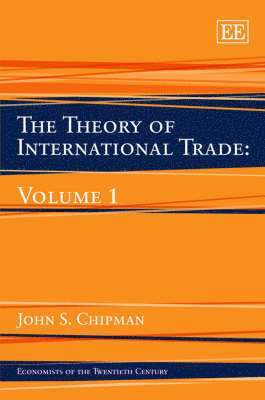
John Chipman is one of the most esteemed economists working in international trade theory. This major reference work, presented in two volumes, offers his principal work in an accessible form. Volume I presents Chipman's famous survey articles on the theory of international trade which are generally recognized to be an essential starting point for any serious study of the subject. The papers explore the evolution of thought from classical to new-classical and on to modern theory. The work remains pertinent and lively and will prove invaluable to anyone interested in international trade. The volume closes with two non-survey articles that expand upon ideas first discussed in the earlier works.This landmark book and its companion volume gather together truly seminal articles that are widely scattered through the literature, and will be an essential source of reference for both instructors and graduate students concerned with international trade theory.
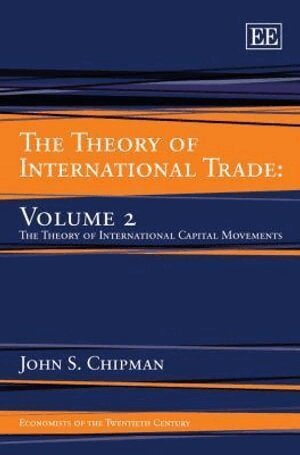
Theory of International Trade
Volume 2, The Theory of International Capital Movements
Inbunden, Engelska, 2009
2 296 kr
Skickas inom 7-10 vardagar
John Chipman is one of the most esteemed economists working in international trade theory. This major reference work, presented in two volumes, offers his principal work in an accessible form. Expanding and elaborating on the theoretical work presented in Volume 1, this broad yet cohesive collection presents a carefully selected presentation of his principal articles. It offers a wide-ranging exploration of international trade by one of the leading thinkers in the field.Volume 2 collects the author's most influential work on the theory of international movements of capital (both physical and financial). The main emphasis is the effects of these movements on resource allocation within countries, and the consequent changes in relative prices and thus both real and nominal exchange rates, as well as the terms of trade. It is argued that chronic deficits or surpluses in countries' balances of payments on current accounts are in all but a few cases the consequence of capital movements resulting from demographic, governmental budgetary, and other causes, as opposed to the popular view that they result from the manipulation of exchange rates.This landmark book and its companion volume gather together truly seminal articles that are widely scattered through the literature, and will be an essential source of reference for both instructors and graduate students concerned with international trade theory.