John Tresch - Böcker
Visar alla böcker från författaren John Tresch. Handla med fri frakt och snabb leverans.
7 produkter
7 produkter
263 kr
Skickas inom 7-10 vardagar
In the years immediately following Napoleon's defeat, French thinkers in all fields set their minds to the problem of how to recover from the long upheavals that had been set into motion by the French Revolution. Many challenged the Enlightenment's emphasis on mechanics and questioned the rising power of machines, seeking a return to the organic unity of an earlier age and triggering the artistic and philosophical movement of romanticism. Previous scholars have viewed romanticism and industrialization in opposition, but in this groundbreaking volume John Tresch reveals how thoroughly entwined science and the arts were in early nineteenth-century France and how they worked together to unite a fractured society. Focusing on a set of celebrated technologies, including steam engines, electromagnetic and geophysical instruments, early photography, and mass-scale printing, Tresch looks at how new conceptions of energy, instrumentality, and association fueled such diverse developments as fantastic literature, popular astronomy, grand opera, positivism, utopian socialism, and the Revolution of 1848.He shows that those who attempted to fuse organicism and mechanism in various ways, including Alexander von Humboldt and Auguste Comte, charted a road not taken that resonates today.
799 kr
Skickas inom 7-10 vardagar
In the years immediately following Napoleon's defeat, French thinkers in all fields set their minds to the problem of how to recover from the long upheavals that had been set into motion by the French Revolution. Many challenged the Enlightenment's emphasis on mechanics and questioned the rising power of machines, seeking a return to the organic unity of an earlier age and triggering the artistic and philosophical movement of romanticism. Previous scholars have viewed romanticism and industrialization in opposition, but in this groundbreaking volume John Tresch reveals how thoroughly entwined science and the arts were in early nineteenth-century France and how they worked together to unite a fractured society. Focusing on a set of celebrated technologies, including steam engines, electromagnetic and geophysical instruments, early photography, and mass-scale printing, Tresch looks at how new conceptions of energy, instrumentality, and association fueled such diverse developments as fantastic literature, popular astronomy, grand opera, positivism, utopian socialism, and the Revolution of 1848.He shows that those who attempted to fuse organicism and mechanism in various ways, including Alexander von Humboldt and Auguste Comte, charted a road not taken that resonates today. Essential reading for historians of science, intellectual and cultural historians of Europe, and literary and art historians, "The Romantic Machine" is poised to profoundly alter our understanding of the scientific and cultural landscape of the early nineteenth century.
1 343 kr
Kommande
Collects key articles by Simon Schaffer, one of the most important historians of science working today. Working Knowledge is the first English-language collection of essays by Simon Schaffer, coauthor of Leviathan and the Air-Pump, a landmark text in the history of science. Though the latter may be his most famous book, Schaffer is also renowned for seminal articles on Isaac Newton and the cultures of popular spectacle, nineteenth-century physics and its practices of labor discipline and standardization, the history of anthropology and collecting, and the globe-spanning cultural interactions that have shaped modern science. Working Knowledge compiles these well-known pieces alongside newer selections, making them accessible in a single place and representing the huge scope and impact of Schaffer’s oeuvre.The Reader divides sixteen of Schaffer’s articles across five thematic sections, which take up timely issues like the turn toward global histories of science; the intersection of science and capitalism; the interaction between bodies and machines; and the connection between science, politics, and the environment. Eight new essays by notable historians such as Adrian Johns, Lissa Roberts, and Steven Shapin bring Schaffer’s pieces into discussion with current scholarship. Illustrations and brief commentaries by Schaffer and the artist Adam Lowe, a longtime collaborator, are included throughout the volume. Bringing together essential articles that were previously scattered across several publications, Working Knowledge is an insightful introduction to Schaffer and his ever-relevant writing.
472 kr
Skickas
Collects key articles by Simon Schaffer, one of the most important historians of science working today. Working Knowledge is the first English-language collection of essays by Simon Schaffer, coauthor of Leviathan and the Air-Pump, a landmark text in the history of science. Though the latter may be his most famous book, Schaffer is also renowned for seminal articles on Isaac Newton and the cultures of popular spectacle, nineteenth-century physics and its practices of labor discipline and standardization, the history of anthropology and collecting, and the globe-spanning cultural interactions that have shaped modern science. Working Knowledge compiles these well-known pieces alongside newer selections, making them accessible in a single place and representing the huge scope and impact of Schaffer's oeuvre. The Reader divides sixteen of Schaffer's articles across five thematic sections, which take up timely issues like the turn toward global histories of science; the intersection of science and capitalism; the interaction between bodies and machines; and the connection between science, politics, and the environment. Eight new essays by notable historians such as Adrian Johns, Lissa Roberts, and Steven Shapin bring Schaffer's pieces into discussion with current scholarship. Illustrations and brief commentaries by Schaffer and the artist Adam Lowe, a longtime collaborator, are included throughout the volume. Bringing together essential articles that were previously scattered across several publications, Working Knowledge is an insightful introduction to Schaffer and his ever-relevant writing.
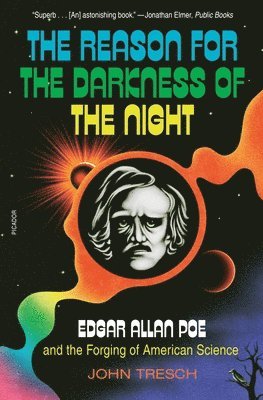
Reason for the Darkness of the Night
Edgar Allan Poe and the Forging of American Science
Häftad, Engelska, 2022
265 kr
Skickas inom 3-6 vardagar
We all think we know Poe — the most popular American writer around the world, dissolute puzzle-maker, pioneer of detective fiction, and author of haunting, atmospheric verse. But what if there was another side to the man who wrote “The Raven” and “The Fall of the House of Usher”? What if Poe were as well known for his speculations about the birth of the universe or his “Sonnet — to Science”?In The Reason for the Darkness of the Night: Edgar Allan Poe and the Forging of American Science, John Tresch offers a bold new life of one of the nineteenth century’s most iconic writers. By shining a spotlight on a time when the line between speculative endeavors and scientific inquiry was blurred, Tresch reveals Poe to have been much more than a practitioner of science fiction — in fact, he was an avid commentator on scientific developments, publishing and circulating in literary milieux that also played host to lectures and demonstrations by the era’s most prominent scientists, semi-scientists, and pseudo-intellectual rogues. As one newspaper put it, “Mr. Poe is not merely a man of science — not merely a poet — not merely a man of letters. He is all combined; and perhaps he is something more.”Beginning with his study of mathematics and engineering at West Point, and taking us through the tumultuous years leading up to publication of “The Raven,” Tresch shows that Poe nurtured a fascination with science from his earliest days as a writer. In works such as “A Descent into the Maelstrom” and “Mesmeric Revelation,” Poe explored subjects ranging from the physics of vortices to occult psychology, later turning his attention to the origins of the universe in a dazzling lecture that would win the admiration of Albert Einstein and other twentieth–century physicists. Throughout, he lived and suffered for his ideas, and remained a figure of brilliant contradiction: he gleefully exposed the hoaxes of the era’s pseudo-scientific fraudsters even as he perpetrated hoaxes himself.
1 582 kr
Skickas inom 10-15 vardagar
Born out of a major international dialogue held at the Fondazione Giorgio Cini in Venice, Italy, this collection of essays presents innovative and provocative arguments about the claims of universal knowledge schemes and the different aesthetic and material forms in which such claims have been made and executed.
1 742 kr
Skickas inom 10-15 vardagar
Born out of a major international dialogue held at the Fondazione Giorgio Cini in Venice, Italy, this collection of essays presents innovative and provocative arguments about the claims of universal knowledge schemes and the different aesthetic and material forms in which such claims have been made and executed.