John W. Sheppard - Böcker
Visar alla böcker från författaren John W. Sheppard. Handla med fri frakt och snabb leverans.
5 produkter
5 produkter
1 584 kr
Skickas inom 10-15 vardagar
System approaches embody the partitioning of problems into smaller inter-related subsystems that will be solved together. Thus, words like hierarchical, dependence, inference, model, and partitioning are frequent throughout this text. Each of the authors deals with the complexity issue in a similar fashion, but the real value in a collected work such as this is in the subtle differences that may lead to synthesized approaches that allow even more progress. The works included in this volume are an outgrowth of the 2nd International Workshop on System Test and Diagnosis held in Alexandria, Virginia in April 1998. The first such workshop was held in Freiburg, Germany, six years earlier. In the current workshop nearly 50 experts from around the world struggled over issues concerning the subject. In this volume, a group of workshop participants was invited to provide a chapter that expanded their workshop presentations and incorporated their workshop interactions. While we have attempted to present the work as one volume and requested some revision to the work, the content of the individual chapters was not edited significantly.Consequently, the reader should see different approaches to solving the same problems and occasional disagreement between authors as to definitions or the importance of factors.
1 584 kr
Skickas inom 10-15 vardagar
This text describes test and diagnosis at the system level, defined as any aggregation of related elements that together form an entity of sufficient complexity for which it is impractical to treat all of the elements at the lowest level of detail. The ideas presented emphasize that it is possible to diagnose complex systems efficiently. Since the notion of system is hierarchical, these ideas are applicable to all levels. The philosophy is presented in the context of a model-based approach, using the information-flow model, that focuses on the information provided by the tests rather than the functions embedded in the system. Detailed algorithms are offered for evaluating system testability, performing efficient diagnosis, verifying and validating the models, and constructing an architecture for system maintenance. Several advanced algorithms, not commonly available in existing diagnosis tools, are discussed, including reasoning with inexact or uncertain test data, breaking large problems into manageable smaller problems, diagnosing systems with time-sensitive information and time-dependent tests and learning from experience. The book is divided into three parts.The first part provides motivation for careful development of the subject and the second part provides the tools necessary for analyzing system testability and computing diagnostic strategies. The third part presents advanced topics in diagnosis. Several case studies are provided, including a single detailed case study. Smaller case studies describe experiences from actual applications of the methods discussed. The detailed case study walks the reader through a complete analysis of a system to illustrate the concepts and describe the analyses that are possible. All case studies are based upon real systems that have been modelled for the purposes of diagnosis. "System Test and Diagnosis" is the culmination of nearly 12 years of research into diagnosis modelling and its applications. It is designed as a primary reference for engineers and practitioners interested in system test and diagnosis.
1 943 kr
Skickas inom 10-15 vardagar
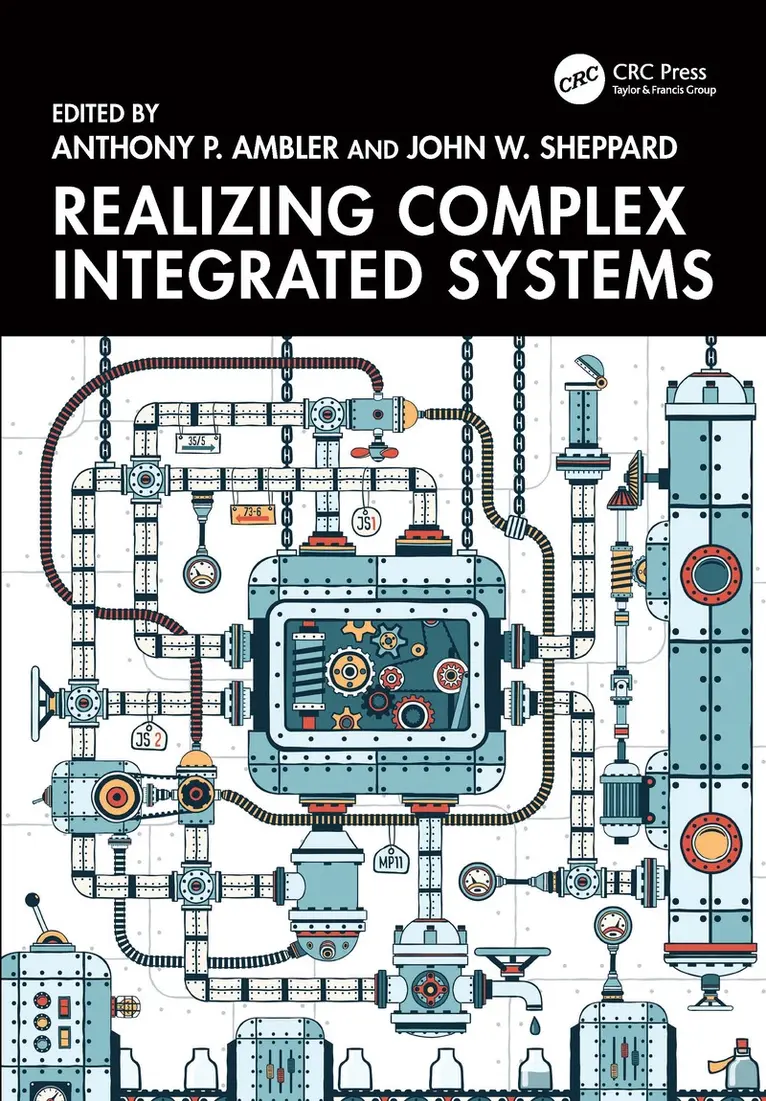
The creation of complex integrated systems is, in itself, complex. It requires immense planning and a large team of people with diverse backgrounds based in dispersed geographical locations (and countries) supposedly working to a coordinated schedule and cost. The systems engineering task is not new, but recent scales most definitely are. The world is now capable of designing and manufacturing systems whose complexity was not considered possible 10 years ago. While many are trained to think in terms of a complete system, where ‘everything’ is designed and produced by a single project team, today such systems involve integrating subsystems and components (which are also complex) that have been developed by other project teams. Inevitably, this introduces additional complexities, involving elements out of the direct control of the project, but which are essential to its overall success.In addition to traditional systems engineering topics of hardware and software design, testability, and manufacturability, there are wider issues to be contemplated: project planning; communication language (an issue for international teams); units of measure (imperial vs. metric) used across members of the team; supply chains (pandemics, military action, and natural disasters); legal issues based on place of production and sale; the ethics associated with target use; and the threat of cyberattack. This book is the first attempt to bring many of these issues together to highlight the complexities that need to be considered in modern system design. It is neither exhaustive nor comprehensive, but it gives pointers to the topics for the reader to follow up on in more detail.
1 578 kr
Skickas inom 10-15 vardagar
System Test and Diagnosis is the first book on test and diagnosis at the system level, defined as any aggregation of related elements that together form an entity of sufficient complexity for which it is impractical to treat all of the elements at the lowest level of detail. The ideas presented emphasize that it is possible to diagnose complex systems efficiently. Since the notion of system is hierarchical, these ideas are applicable to all levels. The philosophy is presented in the context of a model-based approach, using the information flow model, that focuses on the information provided by the tests rather than the functions embedded in the system. Detailed algorithms are offered for evaluating system testability, performing efficient diagnosis, verifying and validating the models, and constructing an architecture for system maintenance. Several advanced algorithms, not commonly available in existing diagnosis tools, are discussed, including reasoning with inexact or uncertain test data, breaking large problems into manageable smaller problems, diagnosing systems with time sensitive information and time dependent tests and learning from experience. The book is divided into three parts. The first part provides motivation for careful development of the subject and the second part provides the tools necessary for analyzing system testability and computing diagnostic strategies. The third part presents advanced topics in diagnosis. Several case studies are provided, including a single detailed case study. Smaller case studies describe experiences from actual applications of the methods discussed. The detailed case study walks the reader through a complete analysis of a system to illustrate the concepts and describe the analyses that are possible. All case studies are based upon real systems that have been modeled for the purposes of diagnosis. System Test and Diagnosis is the culmination of nearly twelve years of research into diagnosis modeling and its applications. It is designed as a primary reference for engineers and practitioners interested in system test and diagnosis.
Del 13 - Frontiers in Electronic Testing
Research Perspectives and Case Studies in System Test and Diagnosis
Häftad, Engelska, 2012
1 578 kr
Skickas inom 10-15 vardagar
"System level testing is becoming increasingly important. It is driven by the incessant march of complexity ... which is forcing us to renew our thinking on the processes and procedures that we apply to test and diagnosis of systems. In fact, the complexity defines the system itself which, for our purposes, is ¿any aggregation of related elements that together form an entity of sufficient complexity for which it is impractical to treat all of the elements at the lowest level of detail . System approaches embody the partitioning of problems into smaller inter-related subsystems that will be solved together. Thus, words like hierarchical, dependence, inference, model, and partitioning are frequent throughout this text. Each of the authors deals with the complexity issue in a similar fashion, but the real value in a collected work such as this is in the subtle differences that may lead to synthesized approaches that allow even more progress. The works included in this volume are an outgrowth of the 2nd International Workshop on System Test and Diagnosis held in Alexandria, Virginia in April 1998. The first such workshop was held in Freiburg, Germany, six years earlier. In the current workshop nearly 50 experts from around the world struggled over issues concerning the subject... In this volume, a select group of workshop participants was invited to provide a chapter that expanded their workshop presentations and incorporated their workshop interactions... While we have attempted to present the work as one volume and requested some revision to the work, the content of the individual chapters was not edited significantly. Consequently, you will see different approaches to solving the same problems and occasional disagreement between authors as to definitions or the importance of factors. ... The works collected in this volume represent the state-of-the-art in system test and diagnosis, and the authors are at the leading edge ofthat science...”. From the Preface