Jon Anderson - Böcker
Visar alla böcker från författaren Jon Anderson. Handla med fri frakt och snabb leverans.
20 produkter
20 produkter
2 103 kr
Skickas inom 10-15 vardagar
This book outlines how the theoretical ideas, empirical foci, and methodological techniques of cultural geography make sense of the ‘culture wars’ that define our time. It is on the battleground of culture that our opportunities, rights, and futures are determined and Understanding Cultural Geography showcases how this discipline can be used to understand these battles and how we can engage in them. Through doing so, the book not only introduces the reader to the rich and complex history of cultural geography, but also the key terms on which the discipline is built. From these insights, the text approaches place as an ‘ongoing composition of traces’, highlighting the dynamic and ever-changing nature of the world around us, and what our role can be in transforming it for the better.The third edition has been fully revised and updated to incorporate recent literature and reflect the changing cultural context of its time. Retaining its exciting and innovative structure, the third edition will expand its focus into new areas, including updated chapters on ethnicity and race, and new chapters on gender and the body. This new edition captures not only recent changes in the cultural world, but also the discipline itself, offering the most up-to-date text to understand and engage with the cultural battlegrounds which constitute our lives. Understanding Cultural Geography is the ideal text for students being introduced to the discipline through either undergraduate or postgraduate degree courses. The third edition is an important update to a highly successful text that incorporates a vast foundation of knowledge; it is an invaluable book for lecturers and students.
812 kr
Skickas inom 10-15 vardagar
This book outlines how the theoretical ideas, empirical foci, and methodological techniques of cultural geography make sense of the ‘culture wars’ that define our time. It is on the battleground of culture that our opportunities, rights, and futures are determined and Understanding Cultural Geography showcases how this discipline can be used to understand these battles and how we can engage in them. Through doing so, the book not only introduces the reader to the rich and complex history of cultural geography, but also the key terms on which the discipline is built. From these insights, the text approaches place as an ‘ongoing composition of traces’, highlighting the dynamic and ever-changing nature of the world around us, and what our role can be in transforming it for the better.The third edition has been fully revised and updated to incorporate recent literature and reflect the changing cultural context of its time. Retaining its exciting and innovative structure, the third edition will expand its focus into new areas, including updated chapters on ethnicity and race, and new chapters on gender and the body. This new edition captures not only recent changes in the cultural world, but also the discipline itself, offering the most up-to-date text to understand and engage with the cultural battlegrounds which constitute our lives. Understanding Cultural Geography is the ideal text for students being introduced to the discipline through either undergraduate or postgraduate degree courses. The third edition is an important update to a highly successful text that incorporates a vast foundation of knowledge; it is an invaluable book for lecturers and students.
107 kr
Skickas inom 11-20 vardagar
714 kr
Skickas inom 10-15 vardagar
Invisible as the seas and oceans may be for so many of us, life as we know it is almost always connected to, and constituted by, activities and occurrences that take place in, on and under our oceans. The Routledge Handbook of Ocean Space provides a first port of call for scholars engaging in the ‘oceanic turn’ in the social sciences, offering a comprehensive summary of existing trends in making sense of our water worlds, alongside new, agenda-setting insights into the relationships between society and the ‘seas around us’. Accordingly, this ambitious text not only attends to a growing interest in our oceans, past and present; it is also situated in a broader spatial turn across the social sciences that seeks to account for how space and place are imbricated in socio-cultural and political life.Through six clearly structured and wide-ranging sections, The Routledge Handbook of Ocean Space examines and interrogates how the oceans are environmental, historical, social, cultural, political, legal and economic spaces, and also zones where national and international security comes into question. With a foreword and introduction authored by some of the leading scholars researching and writing about ocean spaces, alongside 31 further, carefully crafted chapters from established as well as early career academics, this book provides both an accessible guide to the subject and a cutting-edge collection of critical ideas and questions shaping the social sciences today.This handbook brings together the key debates defining the ‘field’ in one volume, appealing to a wide, cross-disciplinary social science and humanities audience. Moreover, drawing on a range of international examples, from a global collective of authors, this book promises to be the benchmark publication for those interested in ocean spaces, past and present. Indeed, as the seas and oceans continue to capture world-wide attention, and the social sciences continue their seaward ‘turn’, The Routledge Handbook of Ocean Space will provide an invaluable resource that reveals how our world is a water world.
577 kr
Skickas inom 10-15 vardagar
The act of surfing involves highly-skilled humans gliding, sliding, or otherwise riding waves of energy as they pass through water. As this book argues, however, this act of surfing does not exist in isolation. It is defined by the cultures and geographies that synergize with it – by the places, ideas, images, and other representations which at once reflect, create, and commodify this spatial practice. This book innovatively explores the spaces of surf and surf-riding, informed specifically by the perspective of human geography. Based on a range of critical turns within the social sciences, the book explores the locations, relational sensibilities, and transformative nature of surfing spaces, and examines how the spatial practice has been scripted by dominant surfing cultures. The book details how prescriptive (b)orders of access, entitlement, and marginalization have been created, and how, with the advent of new craft, media, and ideals, they are being actively challenged to redefine surfing spaces in the twenty-first century.
2 263 kr
Skickas inom 10-15 vardagar
This book documents a new approach to literary geographies based around the Literary Atlas of Wales. It introduces an innovative "plotted" approach which empowers reading, creates connections to localities, histories, and communities, and inspires interest in literature and geography.It showcases how literary geographies can be mobilized through the plotted approach to reading. Through documenting the Literary Atlas of Wales project, this book outlines how the plotted approach was used to engage with English-language novels set in Wales. It argues that the future of this interdisciplinary subject area should be premised upon nurturing instability, turbulence, and experimentation in order to produce new insights which can change the way we understand the relations not only between literature and place but also between other modern categories, including academic disciplines.This book will be of interest to all readers of literature, human geography, mapping, heritage studies, and tourism. It will be beneficial to those interested in the domains of cartography, creative humanities, cultural sociology, human geography, literary studies, and print cultures.
776 kr
Kommande
This book documents a new approach to literary geographies based around the Literary Atlas of Wales. It introduces an innovative "plotted" approach which empowers reading, creates connections to localities, histories, and communities, and inspires interest in literature and geography.It showcases how literary geographies can be mobilized through the plotted approach to reading. Through documenting the Literary Atlas of Wales project, this book outlines how the plotted approach was used to engage with English-language novels set in Wales. It argues that the future of this interdisciplinary subject area should be premised upon nurturing instability, turbulence, and experimentation in order to produce new insights which can change the way we understand the relations not only between literature and place but also between other modern categories, including academic disciplines.This book will be of interest to all readers of literature, human geography, mapping, heritage studies, and tourism. It will be beneficial to those interested in the domains of cartography, creative humanities, cultural sociology, human geography, literary studies, and print cultures.
3 288 kr
Skickas inom 10-15 vardagar
Invisible as the seas and oceans may be for so many of us, life as we know it is almost always connected to, and constituted by, activities and occurrences that take place in, on and under our oceans. The Routledge Handbook of Ocean Space provides a first port of call for scholars engaging in the ‘oceanic turn’ in the social sciences, offering a comprehensive summary of existing trends in making sense of our water worlds, alongside new, agenda-setting insights into the relationships between society and the ‘seas around us’. Accordingly, this ambitious text not only attends to a growing interest in our oceans, past and present; it is also situated in a broader spatial turn across the social sciences that seeks to account for how space and place are imbricated in socio-cultural and political life.Through six clearly structured and wide-ranging sections, The Routledge Handbook of Ocean Space examines and interrogates how the oceans are environmental, historical, social, cultural, political, legal and economic spaces, and also zones where national and international security comes into question. With a foreword and introduction authored by some of the leading scholars researching and writing about ocean spaces, alongside 31 further, carefully crafted chapters from established as well as early career academics, this book provides both an accessible guide to the subject and a cutting-edge collection of critical ideas and questions shaping the social sciences today.This handbook brings together the key debates defining the ‘field’ in one volume, appealing to a wide, cross-disciplinary social science and humanities audience. Moreover, drawing on a range of international examples, from a global collective of authors, this book promises to be the benchmark publication for those interested in ocean spaces, past and present. Indeed, as the seas and oceans continue to capture world-wide attention, and the social sciences continue their seaward ‘turn’, The Routledge Handbook of Ocean Space will provide an invaluable resource that reveals how our world is a water world.
754 kr
Skickas inom 10-15 vardagar
Our world is a water world. Seventy percent of our planet consists of ocean. However, geography has traditionally overlooked this vital component of the earth's composition. The word 'geography' directly translates as 'earth writing' and in line with this definition the discipline has preoccupied itself with the study of terrestrial spaces of society and nature. This book challenges human geography's preoccupation with the terrestrial, investigating the terra incognita of the seas and oceans. Linking to new theoretical debates shaping the geographic discipline (such as affect, assemblage, emotion, hybridity and the more-than-human), this volume unlocks new knowledge concerning the human geographies of ocean space. The book casts adrift stable, bounded and fixed conceptions of space and advances geographical understanding based on the world as 'becoming', changing, mobile and processional. This ontology supports the notion that the oceans are not simply fluid in a literal way, but also in a conceptual sense, suggesting that the seas have their own fluid natures - their own capacities and agencies - which are co-fabricated with social and cultural life. This book features twelve chapters, authored by key academics contributing to this growing field of research. The book is divided into three sections, including an Introduction by the editors and a foreword by Prof. Philip E. Steinberg, the leading scholar in the field of maritime geographies. The first section of the book considers the ways in which different watery spaces from the Atlantic Ocean to the Mediterranean Sea have been conceptualized, theorized and ’known’ through metaphors, voyages of discovery and scientific endeavour. The second section examines how oceans are experienced; through various activities including driving on water, kayaking in water and diving under water. The final section explores the relations between human life and the nature of the sea as a material, mobile and more-than-human spa
1 387 kr
Kommande
2 103 kr
Skickas inom 10-15 vardagar
The act of surfing involves highly-skilled humans gliding, sliding, or otherwise riding waves of energy as they pass through water. As this book argues, however, this act of surfing does not exist in isolation. It is defined by the cultures and geographies that synergize with it – by the places, ideas, images, and other representations which at once reflect, create, and commodify this spatial practice. This book innovatively explores the spaces of surf and surf-riding, informed specifically by the perspective of human geography. Based on a range of critical turns within the social sciences, the book explores the locations, relational sensibilities, and transformative nature of surfing spaces, and examines how the spatial practice has been scripted by dominant surfing cultures. The book details how prescriptive (b)orders of access, entitlement, and marginalization have been created, and how, with the advent of new craft, media, and ideals, they are being actively challenged to redefine surfing spaces in the twenty-first century.
1 547 kr
Skickas inom 7-10 vardagar
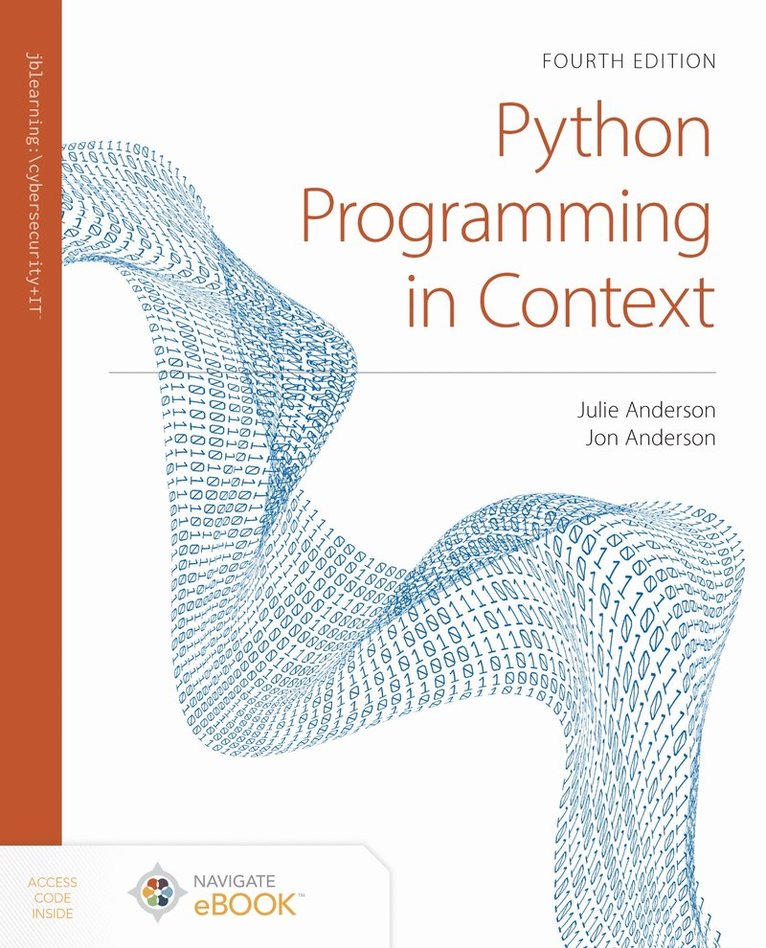
Python Programming in Context, Fourth Edition provides a comprehensive and accessible introduction to Python fundamentals. Updated with Python 3.10, the Fourth Edition offers a thorough overview of multiple applied areas, including image processing, cryptography, astronomy, the Internet, and bioinformatics. Taking an active learning approach, each chapter starts with a comprehensive real-world project that teaches core design techniques and Python programming to immediately engage students. An ideal first language for learners entering the rapidly expanding fields of computer science, data science, and scientific programing, Python gives students a solid platform of key problem-solving skills that translate easily across programming languages. This text is designed to be a first course in computer science that focuses on problem-solving, with language features being introduced as needed to solve the problem at hand.The Fourth Edition's emphasis on problem-solving, extrapolation, and the development of independent exploration and solution-building provides students with a unique and innovative approach to learning programming. While students solve problems of general interest, language elements are introduced with deliberate and incremental exposure to the fundamentals. Python Programming in Context, Fourth Edition is the ideal introductory text for those learning the Python language.
2 170 kr
Skickas inom 10-15 vardagar
Our world is a water world. Seventy percent of our planet consists of ocean. However, geography has traditionally overlooked this vital component of the earth's composition. The word 'geography' directly translates as 'earth writing' and in line with this definition the discipline has preoccupied itself with the study of terrestrial spaces of society and nature. This book challenges human geography's preoccupation with the terrestrial, investigating the terra incognita of the seas and oceans. Linking to new theoretical debates shaping the geographic discipline (such as affect, assemblage, emotion, hybridity and the more-than-human), this volume unlocks new knowledge concerning the human geographies of ocean space. The book casts adrift stable, bounded and fixed conceptions of space and advances geographical understanding based on the world as 'becoming', changing, mobile and processional. This ontology supports the notion that the oceans are not simply fluid in a literal way, but also in a conceptual sense, suggesting that the seas have their own fluid natures - their own capacities and agencies - which are co-fabricated with social and cultural life. This book features twelve chapters, authored by key academics contributing to this growing field of research. The book is divided into three sections, including an Introduction by the editors and a foreword by Prof. Philip E. Steinberg, the leading scholar in the field of maritime geographies. The first section of the book considers the ways in which different watery spaces from the Atlantic Ocean to the Mediterranean Sea have been conceptualized, theorized and ’known’ through metaphors, voyages of discovery and scientific endeavour. The second section examines how oceans are experienced; through various activities including driving on water, kayaking in water and diving under water. The final section explores the relations between human life and the nature of the sea as a material, mobile and more-than-human spa
1 780 kr
Skickas inom 5-8 vardagar
If people are geographical beings, what can fiction tell us about this truth? This book explores how literature can help us understand the nature of the relations between people and place, how humans create connections between their identities and their geographies, and how these can be threatened and lost. Literature is an important, if unusual, way to explore these relations. At once centred in imagination and ideas, fiction is also indelibly connected to, as well as influenced by, the geographies in which it is set. As this book argues, the relationship between fiction and location is so important that it is often difficult to know which is imagined and which is real. Exploring the relations between people and place through fiction writing set in Wales, Page and Place garners poetic insight into how places are written into our stories, and how these stories take and make the places around us. The book introduces the notion of ‘plot’ to describe the complex entanglement between fiction and geography, and to help understand the role that places play in defining human identity.
239 kr
Skickas inom 5-8 vardagar
195 kr
Skickas inom 5-8 vardagar
202 kr
Skickas inom 5-8 vardagar
179 kr
Skickas inom 5-8 vardagar
136 kr
Skickas inom 5-8 vardagar
194 kr
Skickas inom 5-8 vardagar